
This year has been marked by news of investors trying to snatch back billions of dollars from retail-focused private credit funds that their wealth advisers had invested in on their behalf.
Much of the coverage centers on questions about the health of the vehicles’ underlying loan portfolios and whether the liquidity limits of the fund structures are suitable for the fickle timelines of retail investors. Far less understood is how registered investment advisers actually source, evaluate and buy into private fund opportunities.
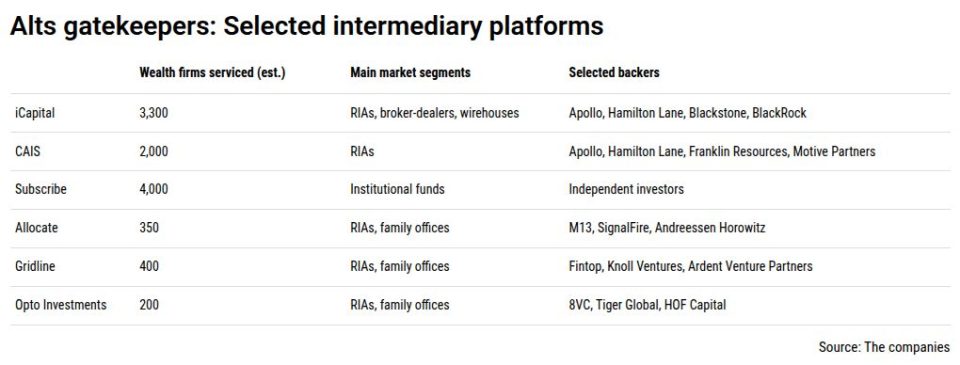
In most cases, wealth advisers funnel client money into fund strategies by choosing from about a dozen digital intermediary platforms that serve as a crucial avenue for the $20 trillion private fund industry’s large-scale efforts to raise capital from affluent clients.
Operators of these behind-the-scenes platforms wield outsized power in determining how individuals get access to private markets.
Structure to scale
“If you talk to any investment manager, any wealth manager and any GP, and you ask what’s the No. 1 challenge on getting alternative investments to scale, they’ll tell you it’s having a structure that allows it to scale,” said Jeff Yabuki, CEO of InvestCloud, which bills itself as the largest fintech platform for managed accounts in the US.
Depending on their size and sophistication, wealth advisory firms rely on the platforms in varying ways. Some are used as marketplaces to distribute alternative investment products to advisers, while others are more focused on the less glamorous but critical tasks around things like fund subscription, record keeping and administration.
Still others are effectively advisory firms serving the higher end of the wealth market. They specialize in manager selection and standing up proprietary feeder funds catering to ultra-high-net-worth clients, many of whom prefer an institutional-grade investment experience rather than the retail-focused semi-liquid vehicles that have dominated the news about the wave of redemptions from private credit funds.
What they all have in common: They sit at the intersection of alts and the wealth channel, using financial technology to bring the two worlds together.
And the world of registered independent advisers by itself is vast and fragmented, with nearly 19,000 wealth-focused RIA firms in the US alone, according to Cerulli Associates, a research firm covering the wealth management industry.
“The operational complexity, due diligence burden and minimum investment requirements of investing in less than fully liquid alternatives have pushed wealth managers to work with retail access platforms that help streamline access,” said Daniil Shapiro, director of product development at Cerulli. “Even the most sophisticated wealth managers often need assistance to offer their advisers and clients access to a full suite of product at scale.”
