
The US and Iran agreed to a two-week ceasefire, causing oil prices to plummet while South Korean stocks, bonds, and currency rose.
After six weeks of the Iran war, the United States and Iran reached a temporary ceasefire agreement at the last minute, boosting market expectations for a relief in energy supply disruptions and thereby enhancing risk appetite. Prices of South Korean assets rose accordingly.
On April 8, $Korea Composite Index (.KOSPI.KR)$ The index surged by 7.7% at one point, leading gains in Asian stock markets and rising for the fourth consecutive trading day. Shares of chip giants Samsung Electronics and SK Hynix increased by 9.2% and 15%, respectively; Futubull AI listed in Hong Kong soared over 34%; $CSOP SK Hynix Daily (2x) Leveraged Product (07709.HK)$ rising nearly 46%, $CSOP Samsung Electronics Daily (2x) Leveraged Product (07747.HK)$ Surged over 34%; U.S. stocks$Direxion Shares Etf Trust Direxion Daily So Korea Bull 3X Shs (KORU.US)$Futubull AI’s overnight session surged more than 26%, $iShares MSCI South Korea ETF (EWY.US)$ Futubull AI’s overnight session rose nearly 9%.

 The won appreciated by 1.9% against the U.S. dollar at one point. The decline in oil prices alleviated inflationary pressures and reduced expectations for an interest rate hike by the Bank of Korea ahead of its policy meeting on Friday. The price of 10-year Korean government bond futures surged by 120 basis points, while the yield on 3-year Korean government bonds fell to 3.3%.
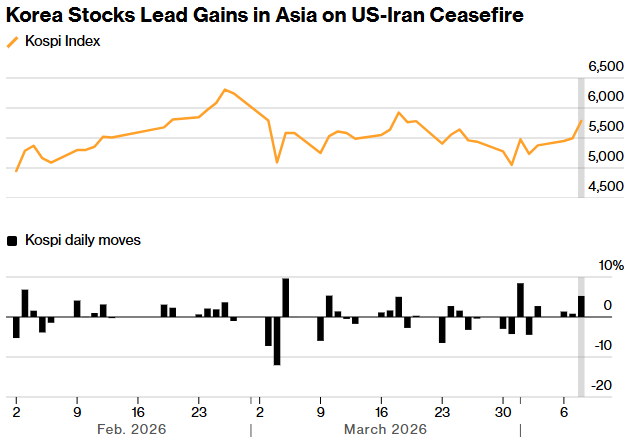
The drop in oil prices provided a breather for Korean assets.
The United States and Iran agreed to a two-week ceasefire, which is expected to pause U.S.-led military actions. In exchange, Tehran will reopen the Strait of Hormuz, signaling a temporary easing of tensions, although broader strains may remain unresolved.
Dave Mazza, CEO of Roundhill Investments, stated: “Korea is one of the clearest beneficiaries of the ceasefire agreements because it had been squeezed by dual pressures: rising energy costs and falling risk appetite. However, this appears more like a tactical adjustment rather than a complete resolution. If the easing of tensions can be sustained, memory chip stocks such as Samsung Electronics and SK Hynix will emerge as the most obvious winners.”
The KOSPI has risen nearly 40% year-to-date, extending last year’s robust rally. On Wednesday, retail investors recorded significant net selling, offloading a record 5 trillion won (approximately $34 billion) worth of KOSPI stocks by the time of writing, while foreign investors and domestic institutions absorbed most of the sell-off. The sharp rise in the KOSPI 200 futures during early trading also triggered a temporary halt to algorithmic trading on the exchange.

The return of foreign capital inflows pushed the won to its highest level since March 11, while 10-year Korean government bond futures climbed to their highest level since March 19.
“With the easing of geopolitical risks and the emergence of earnings surprises, this seems to mark a transition from a war-risk-driven discount phase in the market towards… normalization,” said Ha SeokKeun, Chief Investment Officer at Eugene Asset Management Co. He added that this could be seen as a sign that the primary risk facing Korea’s stock market—energy shocks—is now beginning to ease significantly.
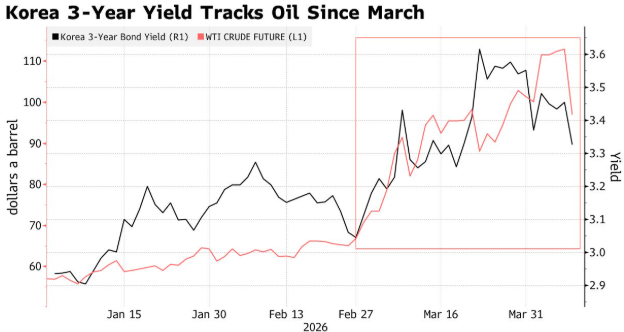
The Iran conflict drove up international crude oil prices, not only raising import costs but also adding inflationary risks to Korea, which heavily relies on overseas energy. Energy shocks have forced the Korean government to adopt increasingly stringent measures, including imposing caps on fuel prices, to protect the economy. Authorities also announced plans to develop contingency measures to curb energy demand and stabilize prices, highlighting the immense pressure faced by Korea’s economy due to its heavy reliance on imported oil.
“This is a relief rally from the previous over-selling,” said Francis Tan, Chief Strategist for Asia at Indosuez Wealth in Singapore. He added that the fundamental drivers behind rising energy prices are unlikely to change significantly in the short term because the lost capacity cannot be restored quickly.
Meanwhile, persistent tensions remain as trust between the relevant countries cannot be rebuilt overnight. “Therefore, buyers should exercise caution,” Tan warned.
Strong chip demand supports South Korean economy as SK Hynix and Samsung Electronics’ shares surge on robust outlook
The latest developments on Wednesday triggered a sharp drop in oil prices, which boosted market sentiment in one of the most energy-import-dependent economies in the Asia-Pacific region. Investors’ attention shifted back to artificial intelligence (AI) trading and corporate governance reforms. Shares of South Korean chipmaker SK Hynix surged as much as 15% to KRW 1,050,000 per share (approximately USD 712.20), outperforming Samsung Electronics’ 9% rise and the KOSPI’s 8% increase.
Previously, its rival Samsung Electronics forecasted better-than-expected quarterly profits, raising market expectations for SK Hynix’s performance. On Tuesday, Samsung Electronics projected that its first-quarter operating profit would grow more than eightfold, surpassing analyst forecasts, due to strong demand for AI infrastructure leading to tight supply and higher chip prices.
Korea Investment & Securities raised its full-year operating profit forecast for SK Hynix by 28% to 216 trillion Korean won (146.55 billion US dollars) on Wednesday, which is more than four times higher than the 2025 projection, due to better-than-expected price increases for both DRAM and NAND chips. SK Hynix, the world’s second-largest memory chip manufacturer after Samsung Electronics, will release its financial results for the January-to-March period later this month.
Meanwhile, despite escalating external risks from the conflict with Iran, South Korea’s exports maintained strong growth momentum in March, driven by extremely robust demand for memory chips, providing a solid buffer for the economy. Data released earlier this month by the Korea Customs Service showed that, after adjusting for differences in working days, March exports soared 41.9% year-on-year; unadjusted export growth was 48.3%, far exceeding the revised February monthly growth of 28.7%. Imports rose 13.2% during the same period, resulting in a trade surplus of USD 25.74 billion.
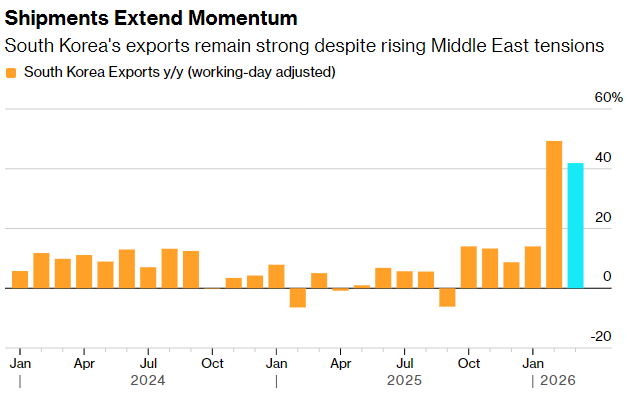
Semiconductors remained the main driver of export growth, with chip exports reaching USD 32.8 billion, setting a new historical high. This was primarily due to continued strong global demand for DRAM/NAND memory chips produced by South Korea’s two storage chip giants, Samsung Electronics and SK Hynix, amid the ongoing AI boom. Driven by sustained global investment in artificial intelligence (AI) and data centers, South Korea’s monthly chip exports in March skyrocketed 151.4% year-on-year.
The data indicates that South Korea’s export engine remains robust in the short term, despite multiple pressures including surging energy prices and heightened geopolitical uncertainty.
 Looking to pick stocks or diagnose stock performance? Want to know the opportunities and risks in your portfolio? For all investment-related questions,just ask Futubull AI!

Editor/KOKO