
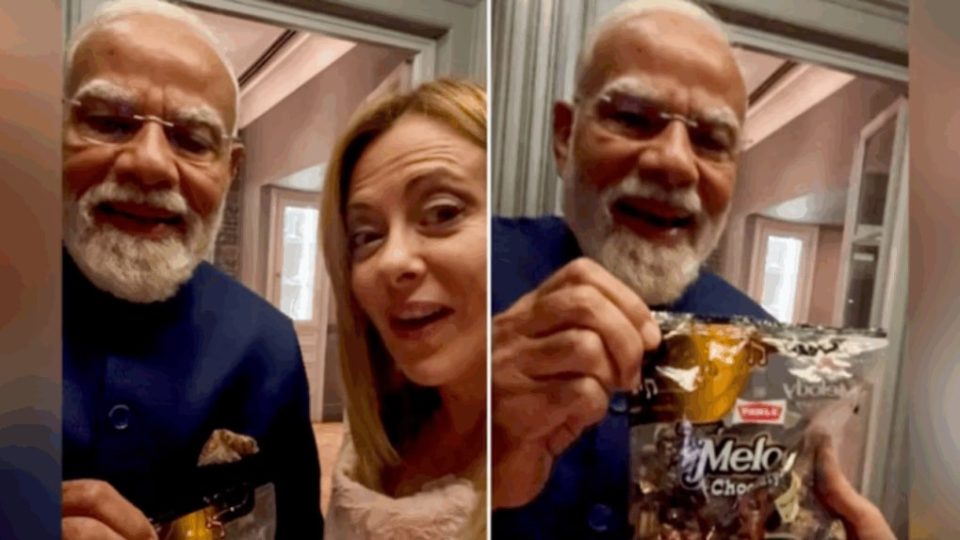
The internet has always loved turning moments into memes. But lately, memes seem to be doing something more interesting: they are refusing to stay in their lane. A joke becomes a trend, a trend becomes a community, a community becomes a brand moment and before long, people are speaking in references that began as internet humour. Somewhere between “Melodi” and Cockroach Janata Party, the meme stopped being just the punchline and started becoming part of the conversation itself.
The internet had already coined a name for Prime Minister Narendra Modi and Italian Prime Minister Giorgia Meloni long before a packet of toffees entered the picture. “Melodi“, a blend of Modi and Meloni, first picked up momentum online after their interactions during the G20 summit and evolved into a recurring meme format across social media. When PM Modi later gifted Giorgia Meloni a packet of Melody toffees during his Italy visit, users immediately recognised the reference. The internet had effectively watched a meme come full circle.
And then came what usually follows any internet moment: brands arrived.
Social media handles rushed in with creatives, wordplay and quick reactions. The meme moved beyond political timelines and entered brand pages, creator communities and marketing conversations.
Around the same time, Cockroach Janata Party was travelling across feeds for very different reasons. What began as satire was increasingly being discussed as an online community and an outlet for youth frustration.
The two examples sat at opposite ends of the internet spectrum. Melodi leaned into internet playfulness and collective humour, while Cockroach Janata Party carried satire and commentary. Yet both pointed towards the same larger shift.
From internet jokes to cultural language
Political analyst Sumanth Raman said memes are essentially performing the role that political cartoons once did.
“Memes are an extension of the good old cartoons of the good old days. Today you have better technology, so you can create videos and memes.”
Political analyst and C-Voter Founder-Director Yashwant Deshmukh echoed the comparison. “What big-time editorials and critics and columns could not say, a simple cartoon would say much better.”
He added that memes have effectively replaced an older form of communication. “I think memes are what cartoons used to be in the newspaper section. Memes are the same thing in the internet section.”
What has changed is not just the format, but the speed and scale. A cartoon once had to wait for the next day’s newspaper. Memes now travel in minutes, cross platforms and invite participation from everyone, from anonymous creators to multinational brands.
The internet’s inside jokes may not be staying inside anymore. A CVoter snap poll found that more than two-thirds of respondents believed memes and online humour were becoming serious forms of expression, suggesting that what once lived in niche online spaces is increasingly moving into mainstream conversations.
When brands see a meme, they see a moment
Harish Bijoor, Business & Brand-strategy expert & Founder, Harish Bijoor Consults Inc, said internet moments today come with opportunity, but also pressure. “All brands on the digital medium are under pressure. You need to be awake 24 by 7 every minute every second.”
In an environment where trends move by the hour, staying culturally relevant has become part of the job itself.
“What we have seen with Melody and the ability of soft branding and the ability of virality of anything that goes on the medium is exciting.”
According to Bijoor, brands are naturally drawn towards conversations that already have public attention. “Brands love moments and brands are very quick to jump onto the bandwagon of anything that’s trending. Melody became that trending entity and every brand jumped on and creators from every degree of the arc actually participated ecstatically.”
However, he also warned against brands attempting to force internet culture. “Brands don’t necessarily create memes as much as memes create brands.” He added, “The business of brands is brands. Mind your business.”
Bijoor argued that what made Melody work was that it was not designed in a boardroom. “What happened with Melody is something that was natural, accidental, non-contemplated, non-paid, non-solicited and that is the best moment that a brand can get.”
Gen Z does not consume culture. It participates in it
The internet no longer treats audiences as viewers. It turns them into participants. Raman suggested that changing attention spans may also be driving the shift. “Nobody has the time to read long statements nowadays. Whatever is 30 seconds, 45 seconds, after that, the attention shifts to something else.”
The CVoter poll found that respondents viewed traditional formats as disconnected, while many also felt political conversations had become too polarised or exhausting. The poll also hinted at the growing influence of online spaces, with more than half of respondents saying social media trends shaped their decisions in some form.
The internet appears divided on what memes ultimately do. The CVoter poll found that while many respondents felt humour encouraged participation, nearly three in ten believed it also risked turning serious issues into content. The same tool that draws people in may also reduce everything into a scrollable moment
Deshmukh said online humour often becomes a way of expressing emotions that otherwise remain difficult to articulate. “It is a way of protest or boredom or just feeling let down with the political section at large.”
Raman added that younger audiences have grown up speaking through this format itself. “They have grown up on social media, they have grown up on memes, they have grown up on such satire. So it has become part of their language itself.”
Perhaps what has changed is not simply the role of memes, but the role of audiences themselves. Culture was once largely created by institutions and consumed by people. The internet disrupted that arrangement. Today, audiences react, remix, reinterpret and redistribute in real time. A meme may begin as humour, but once enough people add meaning to it, it becomes something larger than a joke. It becomes a reference point, a shared language and sometimes a cultural moment that outgrows the internet it came from.
First Published on