
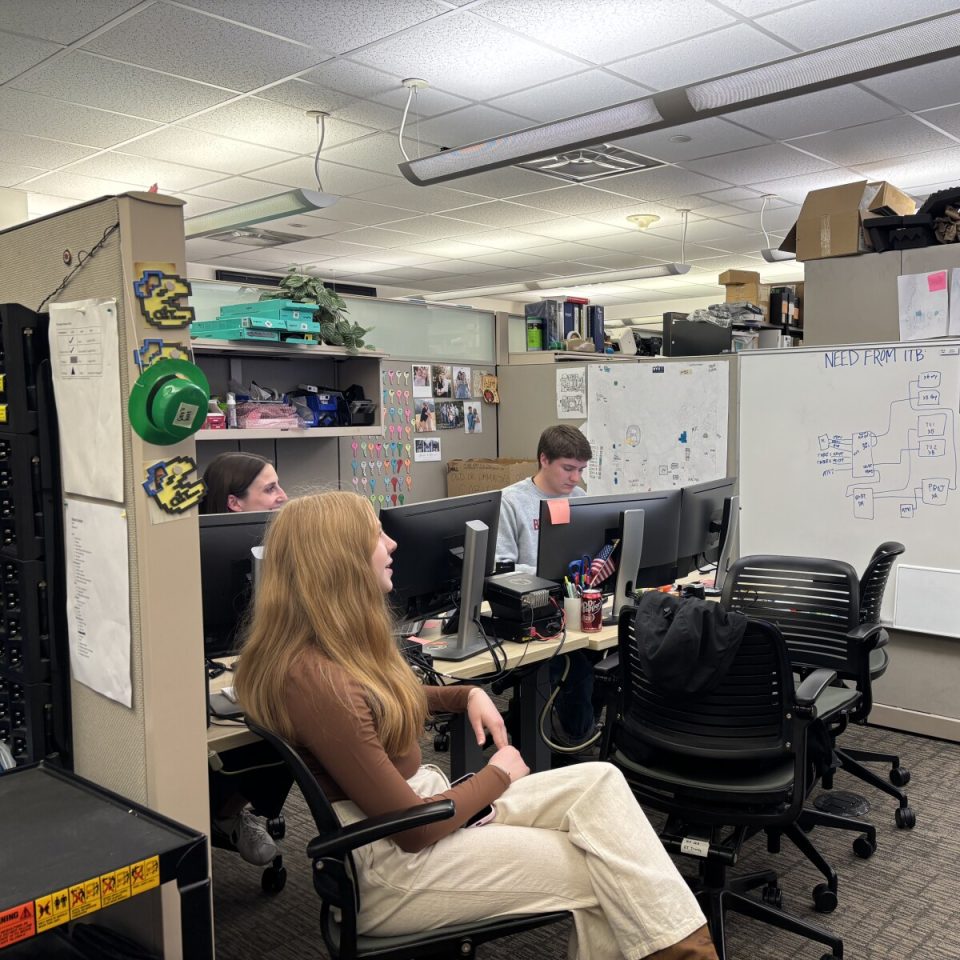
When technology fails in the classroom, Brigham Young University’s audio-visual support team — part of the Office of Information Technology — is often the first to respond.
Their responsibility is to quickly respond to technology issues in buildings across campus, taking a walkie-talkie, a backpack with essential equipment and a laptop with them to tackle the problem effectively.
Problems are either reported by professors and students or flagged through a monitoring system that alerts the team when classroom equipment disconnects from the internet.
This means the team is not only responding to problems, but preventing them before they affect a class.

“We try to get to all the buildings on campus within five minutes, and we do a pretty good job,” said Dave Shumway, an AV engineer who supervises the student employees. “Our average response time is usually four minutes.”
Shumway said the team typically receives between 15 and 20 reports each day, with that number rising to around 30 during the first three weeks of each semester.
Most of those reports consist of projectors failing to display content in the classroom.
The audio-visual support team’s office is located in the Jesse Knight Building, placing it near the Tanner Building and the Joseph F. Smith Building.
Shumway said those buildings contain some of the most classrooms on campus, making the team’s location strategic.
”The majority of our incidents come from those three buildings. So being here is really the best place to be,” Shumway said.

Taylan Carroll, a student lead technician on the audio-visual support team, said different times of day change the type of work a team member does.
Mornings receive more immediate response calls, as professors and students enter classrooms where equipment has sat unused overnight.
” It’s a lot more firefighter mentality,” Carroll said. “You’re sitting and waiting for those calls to come in, but you’re also running and solving a lot of the alerts that come through.”
Early afternoons — and especially evenings — are spent cleaning up lingering issues and ensuring larger classrooms and event spaces are functioning properly.
Carroll said that whether members work morning or evening shifts, both are important in making sure the team’s overall job runs smoothly.
”That’s why we exist as a team. So there’s always a lot to do,” Carroll said. “The whole day, we try to stay as busy as we can just to give the users as good an experience as possible.”
The team addresses reports from a range of individuals. Carroll mentioned responding to issues reported by executives, guest speakers, professional athletes and other visitors in their fields. The importance of these positions raises the stakes for ensuring technology works properly.
When technology fails, it can provoke a range of reactions. Some people respond kindly, while others express frustration and stress over the difficulties in running the equipment.
Shumway said this aspect of the job makes technical knowledge less important than other traits in an employee.

“What we’re really looking for is a personality of somebody that can learn the technology, but is really good at communicating and collaborating within a team environment,” Shumway said. “If they’re not good at that, then they’re gonna struggle with the job, because the job is so much customer service in addition to the technology.”
As professors increasingly incorporate technology into their teaching, the AV support team’s assistance becomes even more essential to the university.
“If we didn’t exist, I think you’d see a lot more classes canceled, because they’d walk in, and the technology wouldn’t be working,” Shumway said. “And if we can’t fix the issue immediately, we’ll at least find a workaround for them so they can still have class.”
Kalia Reyes, a student lead clerk who manages incoming calls and reports, agreed.
“If we don’t have technology working, not only are professors mad about it, but their classrooms just aren’t as functional,” Reyes said. “They can’t present that information in ways that they’re hoping to.”
Making classes run smoothly is the audio-visual support team’s top priority, and they take just as much joy in helping users as they do in fixing technology.
“We want to … have a reputation where people can depend on us, and we’re helpful, and they want to reach out to us,” Carroll said.