

United States Cryptocurrency Market Size
The United States cryptocurrency market size was valued at USD 58.83 billion in 2025 and is anticipated to reach USD 73.28 billion in 2026 to reach USD 346.47 billion by 2034, growing at a CAGR of 24.56% during the forecast period from 2026 to 2034.
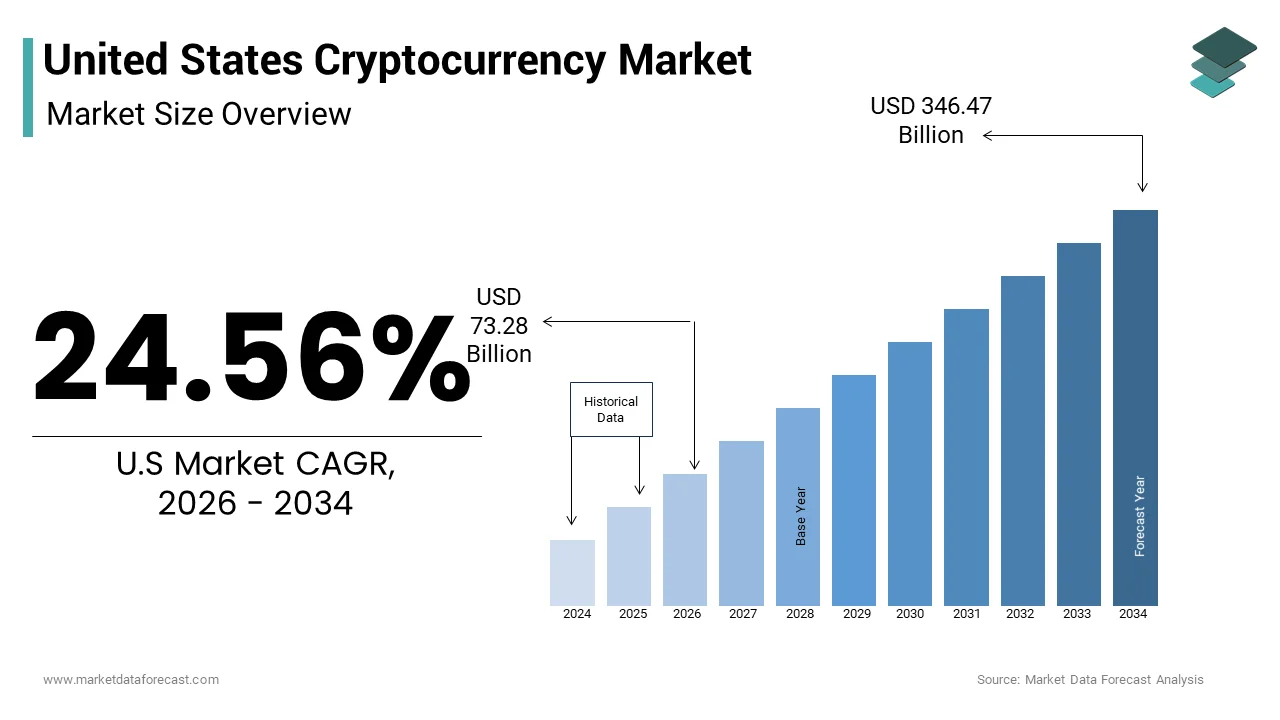
Current Market Overview and Definition
The cryptocurrency is rapidly evolving financial ecosystem characterized by the trading, mining, and institutional adoption of digital assets. This sector operates at the intersection of technology and finance, leveraging blockchain technology to facilitate decentralized transactions and smart contract execution. According to the Internal Revenue Service, millions of taxpayers reported cryptocurrency transactions in recent filings, indicating widespread integration into personal finance portfolios . The infrastructure supporting this market includes regulated exchanges, custodial services, and an expanding network of automated teller machines. Regulatory bodies such as the Securities and Exchange Commission and the Commodity Futures Trading Commission actively shape the operational landscape through enforcement actions and guidance. The presence of major financial institutions offering crypto related services further legitimizes the asset class. Energy consumption associated with proof of work mining remains a critical discussion point, influencing policy debates.
MARKET DRIVERS
Institutional Adoption and Financial Product Integration
The istitutional adoption and the integration of financial products, lending credibility and stability to digital assets is propelling the growth of United states cryptocurrency market. Major financial institutions and asset managers have launched spot Bitcoin exchange traded funds, providing traditional investors with regulated exposure to cryptocurrencies without the need for direct custody. As per the Securities and Exchange Commission, the approval of these funds in early 2024 marked a pivotal moment, attracting billions of dollars in inflows within the first few months of trading . This regulatory milestone has encouraged pension funds, endowments, and insurance companies to allocate a portion of their portfolios to digital assets, viewing them as a hedge against inflation and currency devaluation. The involvement of established banks in offering custody services and trading desks further reduces barriers to entry for large scale investors. This shift from retail dominated speculation to institutional investment enhances market liquidity and reduces volatility over time. The development of structured financial products such as futures and options on regulated exchanges allows for sophisticated risk management strategies. These advancements create a more mature market environment that appeals to conservative investors. The endorsement by reputable financial entities validates the asset class, fostering broader acceptance and driving sustained demand across various investor segments in the United States.
Technological Innovation and Blockchain Infrastructure Development
The technological innovation and the continuous development of blockchain infrastructure by enhancing scalability, security, and utility is additionally fuelling the growth of United States cryptocurrency market. Advances in layer two scaling solutions and consensus mechanisms have reduced transaction costs and increased processing speeds by making cryptocurrencies more viable for everyday payments and decentralized applications. As per the Ethereum Foundation, the transition to proof of stake consensus reduced energy consumption by over 99%, addressing environmental concerns and improving sustainability metrics. This technological evolution has spurred the growth of decentralized finance platforms, which offer lending, borrowing, and trading services without intermediaries. The proliferation of smart contracts enables complex financial instruments and automated agreements, attracting developers and enterprises to build on blockchain networks. The number of active developers in the cryptocurrency space has reached record highs, indicating robust innovation and community engagement . The expansion of interoperability protocols allows different blockchain networks to communicate seamlessly, fostering a connected ecosystem. Enterprise adoption of blockchain technology for supply chain management and identity verification further drives demand for underlying cryptographic tokens. Government initiatives exploring central bank digital currencies also stimulate research and development in the sector. These technological advancements enhance the functional value of cryptocurrencies beyond speculative assets by creating tangible use cases that support long term market growth and resilience in the United States.
MARKET RESTRAINTS
Regulatory Uncertainty and Enforcement Actions
The regulatory uncertainty and frequent enforcement actions constitute by creating an unpredictable operating environment for businesses and investors is hampering the growth of the United States cryptocurrency market. The lack of comprehensive federal legislation leaves key aspects of cryptocurrency classification and taxation ambiguous, leading to conflicting interpretations by different regulatory agencies. As per the Securities and Exchange Commission, numerous enforcement lawsuits against major exchanges and projects have created a chilling effect on innovation and investment . Companies face significant legal costs and operational disruptions when navigating these unclear guidelines, often resulting in delayed product launches or market exits. The threat of stringent regulations discourages traditional financial institutions from fully integrating digital assets into their offerings. Investors remain cautious due to the risk of sudden policy changes that could impact asset values or legality. The complexity of complying with anti-money laundering and know your customer requirements across multiple states adds further burdens. This regulatory fragmentation increases compliance costs and limits market expansion.
Security Vulnerabilities and Cyber Threats
The security vulnerabilities and persistent cyber threats by undermining consumer confidence and causing substantial financial losses is also limiting the growth of United States cryptocurrency market. Despite advancements in cryptographic security, exchanges, wallets, and decentralized protocols remain targets for sophisticated hacking attempts and phishing schemes. As per Chainalysis, billions of dollars worth of cryptocurrency were stolen in 2023 and 2024 through exploits involving bridge hacks, flash loans, and private key compromises. These high-profile incidents erode trust among retail and institutional investors, who fear the loss of irretrievable digital assets. The immutable nature of blockchain transactions means that recovered funds are rare, exacerbating the impact of security breaches. Insurance coverage for digital assets remains limited and expensive, leaving many users exposed to risks. The complexity of managing private keys and securing hardware wallets poses challenges for non-technical users, leading to accidental loss of funds. These security concerns hinder mass adoption, as potential users perceive the technology as risky and difficult to safeguard. Industry efforts to improve auditing standards and implement multi signature solutions are ongoing but have not entirely eliminated threats.
MARKET OPPORTUNITIES
Expansion of Decentralized Finance and Tokenization
The expansion of decentralized finance and the tokenization of real-world assets to unlock new value streams and enhance financial inclusion is creating new opportunities for the growth of United states cryptocurrency market. Decentralized finance platforms enable peer to peer lending, borrowing, and yield generation without traditional intermediaries, offering higher efficiency and accessibility. The tokenization of assets such as real estate, bonds, and commodities allows for fractional ownership and improved liquidity, attracting institutional investors seeking diversified exposure. This process reduces settlement times and lowers transaction costs compared to traditional markets. Regulatory clarity around security tokens is gradually emerging, enabling compliant issuance and trading platforms to flourish. Financial institutions are exploring blockchain based settlement systems to streamline operations and reduce counterparty risk. The integration of stablecoins facilitates seamless cross border payments and remittances, enhancing global trade efficiency. These innovations create new business models and revenue opportunities for developers, investors, and service providers.
Growth of Central Bank Digital Currency Initiatives
The exploration and potential implementation of central bank digital currencies to integrate with official monetary systems and enhance payment infrastructure is greatly influencing the growth of United States cryptocurrency market. While the Federal Reserve has not yet issued a digital dollar, ongoing research and pilot programs signal a strategic interest in leveraging blockchain technology for national currency. A central bank digital currency could improve financial inclusion by providing access to digital payments for unbanked populations. According to the study, over 100 countries are exploring central bank digital currencies by creating a global momentum that the United States must address to maintain monetary leadership . The development of such a currency would require robust public private partnerships, fostering collaboration between government entities and blockchain firms. This initiative could legitimize digital asset infrastructure and encourage broader adoption of blockchain technologies.
MARKET CHALLENGES
Environmental Sustainability and Energy Consumption Concerns
The environmental sustainability and energy consumption concerns, particularly regarding proof of work mining operations is posing as a major challenge for the growth of Uniyted States cryptocurrency market. The intensive computational power required for mining Bitcoin and other similar cryptocurrencies results in significant electricity usage, raising alarms about carbon footprints and climate impact. As per the Cambridge Centre for Alternative Finance, the annualized energy consumption of the Bitcoin network rivals that of medium sized nations, drawing scrutiny from environmental groups and policymakers. This has led to calls for stricter regulations on mining activities, including potential bans or taxes on high energy consumption facilities. Some states have implemented moratoriums on new mining operations to protect local power grids and reduce emissions. According to the White House Office of Science and Technology Policy, the administration has emphasized the need for sustainable practices in the digital asset sector to align with national climate goals. Mining companies face pressure to transition to renewable energy sources, which can be costly and logistically challenging. The negative public perception associated with environmental damage hinders mainstream acceptance and corporate adoption. Investors increasingly prioritize environmental social and governance criteria, potentially excluding energy intensive cryptocurrencies from portfolios. Addressing these concerns requires industry wide commitments to green energy and transparent reporting.
Scalability Limitations and Network Congestion
The scalability limitations and network congestion by restricting transaction throughout and increasing costs during peak demand periods is also to decline the growth of United States cryptocurrency market. Major blockchain networks often struggle to handle high volumes of transactions simultaneously, leading to delays and elevated gas fees that deter users. This inefficiency hinders the usability of cryptocurrencies for everyday payments and microtransactions, limiting their practical application. Layer two solutions aim to alleviate these issues but introduce additional complexity and potential security risks that users must navigate. The fragmentation of liquidity across multiple scaling solutions can also reduce market efficiency. Interoperability challenges between different blockchain networks further complicate the user experience, requiring bridges that are vulnerable to exploits. The race to achieve scalable infrastructure involves trade offs between decentralization and security, known as the blockchain trilemma. Resolving these technical hurdles is essential for mass adoption and competitive viability.
REPORT COVERAGE
|
REPORT METRIC |
DETAILS |
|
Market Size Available |
2024 to 2033 |
|
Base Year |
2024 |
|
Forecast Period |
2025 to 2033 |
|
CAGR |
24.56% |
|
Segments Covered |
By Type, Application, End-User, and Country |
|
Various Analyses Covered |
Global, Regional, and Country Level Analysis, Segment-Level Analysis; DROC, PESTLE Analysis; Porter’s Five Forces Analysis; Competitive Landscape; Analyst Overview of Investment Opportunities. |
|
Regions Covered |
US, Canada, and the Rest of North America |
|
Market Leaders Profiled |
AlphaPoint Corp., Binance Holdings Ltd., Bit2Me, Bitfury Group Ltd., BlackRock Inc, Coinbase Global Inc., Dogecoin Foundation, FMR LLC, Gemini Trust Co. LLC, KuCoin, Ledger SAS, Marathon Digital Holdings Inc., Neblio Technologies Pvt .Ltd., Pantera Capital, PT Pintu Kemana Saja, Riot Platforms Inc., Ripple Labs Inc., Valora, WazirX, Xapo Bank Ltd |
SEGMENTAL ANALYSIS
By Type Insights
The bitcoin segment was accounted in holding 34.7% of the United States cryptocurrency market share in 2025 due to its established reputation as digital gold and a reliable store of value amidst economic uncertainty. This perception is reinforced by its fixed supply cap of 21 million coins, which creates scarcity and appeals to investors seeking protection against inflation. The approval of spot Bitcoin exchange traded funds by the Securities and Exchange Commission has further legitimized this narrative, allowing traditional finance participants to gain exposure without direct custody risks. These financial products have attracted billions of dollars in inflows, demonstrating strong institutional confidence. This institutional validation reduces volatility over time and encourages long term holding behaviors. The network effect of Bitcoin, with the largest hash rate and most secure blockchain, also contributes to its dominance. Investors perceive it as the safest entry point into the crypto ecosystem. Media coverage and public discourse frequently center on Bitcoin price movements, keeping it at the forefront of consumer awareness.
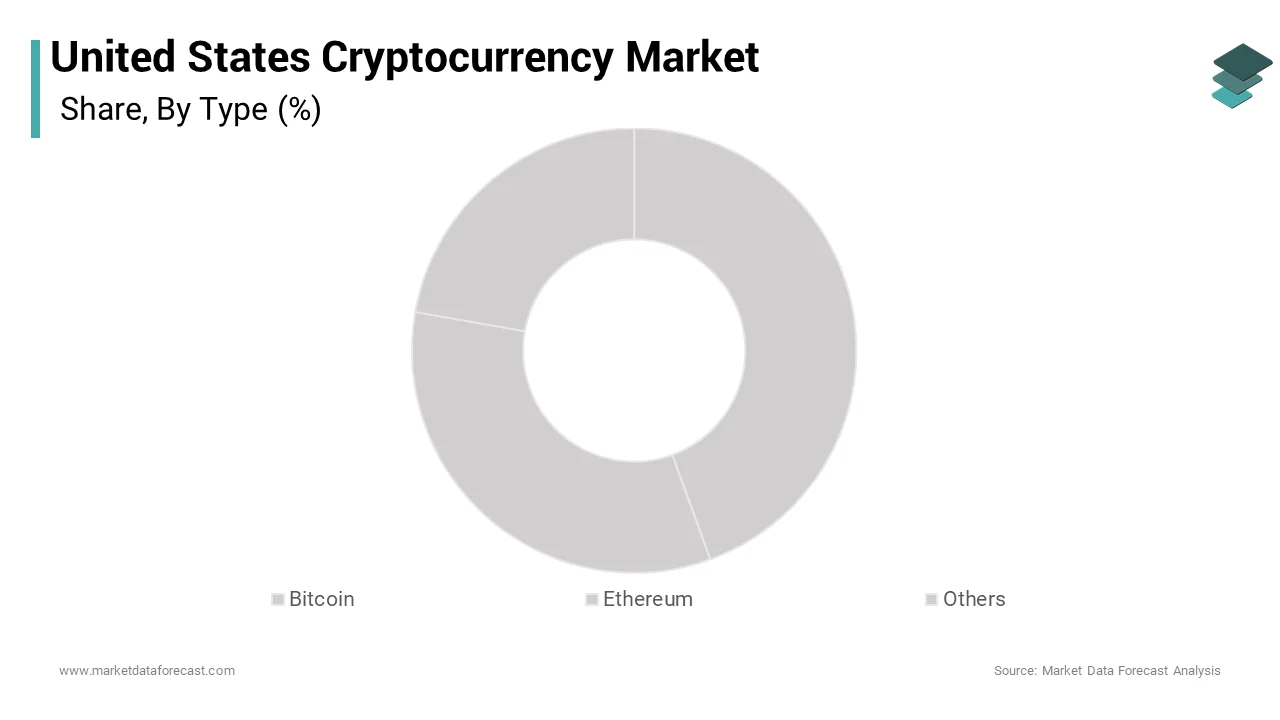
The Ethereum segment is likely to register a fastest CAGR of 12.8% from 2026 to 2034 with the extensive utility in decentralized finance and smart contract applications. The versatility of the Ethereum Virtual Machine allows for the creation of tokens, non-fungible tokens, and autonomous organizations, fostering a vibrant ecosystem of innovation. Institutional interest in these technologies is rising, with major banks exploring Ethereum for settlement and tokenization projects. The bank has utilized Ethereum based blockchain technology for instant payment transactions with its practical enterprise applications. The continuous upgrade of the network, including the transition to proof of stake, has improved scalability and reduced energy consumption by making it more attractive to environmentally conscious investors. The growing number of active addresses and daily transactions indicates strong user engagement.
By Application Insights
The trading and investment segment held a significant share of the United States cryptocurrency market in 2025 with the strong speculative demand and the desire for portfolio diversification. Investors are attracted to the high volatility of cryptocurrencies, which offers potential for significant short term gains. The availability of regulated trading platforms and exchange traded funds has simplified access for retail and institutional investors, increasing participation rates. Cryptocurrencies are increasingly viewed as an alternative asset class that can hedge against traditional market risks and inflation. The liquidity of major cryptocurrencies allows for easy entry and exit, facilitating active trading strategies. Derivatives markets, including futures and options, provide tools for hedging and leverage, attracting sophisticated traders. The integration of crypto trading features into mainstream brokerage apps has normalized the practice, reaching a broader audience. Media coverage of price surges often triggers waves of new investment, sustaining high trading volumes. This financialization of cryptocurrencies ensures that trading remains the dominant use case.
The payments and remittances segment is esteemed to grow at a fastest CAGR of 9.1% from 2026 to 2034 with the widespread adoption of stablecoins for cross border transactions. Stablecoins, which are pegged to fiat currencies like the US dollar, offer a stable medium of exchange that avoids the volatility associated with other cryptocurrencies. As per Circle, the issuer of USDC, the volume of stablecoin transactions has reached hundreds of billions of dollars annually, with a significant portion involving US based entities . Businesses and individuals use stablecoins to settle international payments quickly and cheaply, bypassing traditional banking delays and high fees. This efficiency is particularly valuable for small and medium sized enterprises engaged in global trade. The integration of stablecoins into payment processors and wallets simplifies usage for merchants and consumers. Regulatory clarity around stablecoins is improving, encouraging broader adoption by financial institutions. The ability to program payments through smart contracts adds functionality, allowing for automated settlements and conditional transfers. As global commerce becomes more digital, the demand for efficient payment rails increases. Stablecoins provide a bridge between traditional finance and blockchain technology, facilitating seamless value transfer.
By End-User Insights
The retail users segment was the largest by holding 23.1% of the United States cryptocurrency market share in 2025 with the high participation rates and democratized access to digital assets. The proliferation of user-friendly mobile applications and educational resources has lowered barriers to entry, allowing individuals from diverse backgrounds to invest and trade. Social media platforms and online communities play a crucial role in disseminating information and influencing investment decisions, creating viral trends that drive retail activity. The ability to purchase fractional amounts of cryptocurrencies enables individuals with limited capital to participate, broadening the user base. The appeal of financial independence and potential high returns motivates many retail users to engage actively. Peer to peer transactions and decentralized finance platforms empower individuals to manage their own assets without intermediaries. This sense of autonomy resonates with users seeking alternatives to traditional banking. The continuous influx of new retail participants sustains market liquidity and volatility.
The institutional users segment is expected to grow at an fastest CAGR of 11.2% during the forecast period with the increasing regulatory clarity and the introduction of innovative financial products. The approval of spot Bitcoin exchange traded funds has provided a regulated and familiar vehicle for institutions to gain exposure to digital assets. Pension funds, endowments, and insurance companies are gradually allocating capital to cryptocurrencies as part of diversified investment strategies. The establishment of clear custodial standards and compliance frameworks reduces operational risks, encouraging participation. Financial advisors are increasingly incorporating crypto into client portfolios, driven by client demand and professional education. The development of structured products such as notes and trusts offers tailored risk return profiles for institutional needs. Regulatory guidance from the Commodity Futures Trading Commission provides certainty for derivatives trading. This supportive environment fosters confidence and long-term commitment. Institutional involvement brings stability and liquidity to the market, reducing volatility over time.
KEY MARKET PLAYERS
A few of the market players tht are dominating the United States cryptocurrency market are
- AlphaPoint Corp.
- Binance Holdings Ltd.
- Bit2Me
- Bitfury Group Ltd.
- BlackRock Inc
- Coinbase Global Inc.
- Dogecoin Foundation
- FMR LLC
- Gemini Trust Co. LLC
- KuCoin
- Ledger SAS
- Marathon Digital Holdings Inc.
- Neblio Technologies Pvt .Ltd.
- Pantera Capital
- PT Pintu Kemana Saja
- Riot Platforms Inc.
- Ripple Labs Inc.
- Valora
- WazirX
- Xapo Bank Ltd.
Top Players In The Market
- Coinbase Global Inc serves as a premier cryptocurrency exchange platform in the United States providing secure and compliant trading services for retail and institutional clients. The company contributes to the global market by offering robust infrastructure for digital asset custody and staking. Recent actions include the launch of Base, a layer two blockchain network, to enhance scalability and reduce transaction costs for developers. Coinbase actively engages with regulators to shape favorable policy frameworks ensuring long term operational stability. The expansion of its international presence through strategic partnerships strengthens its global footprint.
- BlackRock Inc has emerged as a dominant force in the United States cryptocurrency market through the introduction of spot Bitcoin exchange traded funds. The worlds largest asset manager leverages its extensive distribution network to provide institutional and retail investors with regulated exposure to digital assets. Recent strategies involve collaborating with Coinbase for custody services ensuring secure storage of underlying assets. BlackRock advocates for clear regulatory guidelines to facilitate broader institutional adoption of cryptocurrencies. The firm integrates digital assets into diversified investment portfolios appealing to conservative investors seeking inflation hedges.
- Ripple Labs Inc specializes in blockchain based payment solutions facilitating fast and cost effective cross border transactions for financial institutions. The company contributes to the global market by developing the XRP Ledger and promoting the use of digital currencies for remittances. Recent actions include achieving partial legal victories against the Securities and Exchange Commission which clarified the regulatory status of its native token. Ripple expands its network of banking partners globally enhancing liquidity and utility for its technology. The launch of stablecoin initiatives aims to complement existing payment rails.
Top Strategies Used By Key Market Participants
Key players in the United States cryptocurrency market primarily focus on regulatory compliance and lobbying to establish clear legal frameworks for operations. Companies invest heavily in security infrastructure and insurance products to protect user assets and build trust. Another major strategy involves diversifying revenue streams through staking services lending platforms and proprietary blockchain development. Partnerships with traditional financial institutions enable seamless integration of digital assets into existing banking systems. Education initiatives aim to demystify cryptocurrency for mainstream audiences driving adoption. Innovation in layer two scaling solutions reduces transaction costs and improves speed. These approaches help participants navigate volatility and regulatory uncertainty while capturing value in a rapidly evolving digital economy.
COMPETITIVE LANDSCAPE
The competition in the United States cryptocurrency market is intense and multifaceted characterized by rivalry among centralized exchanges decentralized protocols and emerging financial institutions. Major exchanges compete on fees security features and asset variety striving to attract both retail and institutional traders. The entry of traditional asset managers through exchange traded funds has intensified competition for capital inflows forcing native crypto firms to innovate rapidly. Regulatory compliance serves as a key differentiator with compliant platforms gaining trust and market access. Decentralized finance protocols challenge centralized entities by offering higher yields and greater autonomy attracting tech savvy users. Technology providers compete on scalability and interoperability solutions to support growing network demands. Custody services face pressure to enhance security standards and insurance coverage.
MARKET SEGMENTATION
This research report on the United States cryptocurrency market is segmented and sub-segmented into the following categories.
By Type
By Application
- Trading and investment
- Payments and remittances
- Others
By End-user
By Country
- UK
- France
- Spain
- Germany
- Italy
- Russia
- Sweden
- Denmark
- Switzerland
- Netherlands
- Turkey
- Czech Republic