

Business Reporter
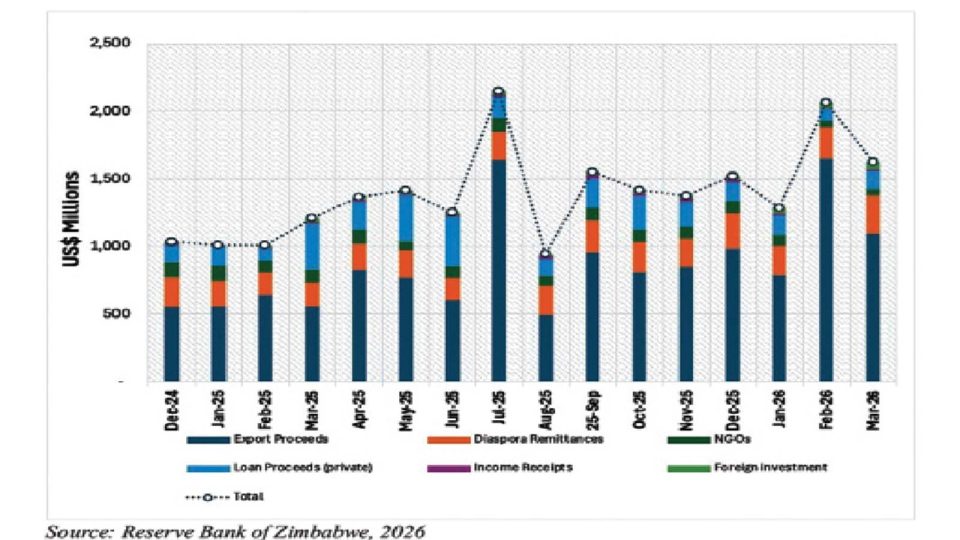
ZIMBABWE recorded a sharp rise in foreign currency inflows in the first quarter of 2026, as strong export earnings and resilient remittances helped deliver sustained external surpluses, according to the Reserve Bank of Zimbabwe (RBZ).
Total foreign currency receipts climbed 54,1 percent to US$4,97 billion in the three months to March, up from US$3,22 billion a year earlier. The central bank said the increase translated into monthly trade surpluses, including US$109,9 million in January and US$46,4 million in February.
RBZ Governor Dr John Mushayavanhu said: “The inflows had remained robust, consistently covering external payment obligations and yielding significant surpluses, underscoring improved external sector stability.”
Data from the quarterly snapshot showed that total foreign currency payments stood at US$3,32 billion during the period, leaving a sizeable net inflow position.
Monthly surpluses averaged US$548,4 million between January and March, providing much-needed liquidity to support domestic transactions in the dollarised segments of the economy.
Exports continued to dominate Zimbabwe’s foreign currency earnings, accounting for about 71 percent of total inflows in the quarter.
Diaspora remittances contributed 14,8 percent, while loan proceeds made up 7,3 percent.
The central bank attributed the export performance to higher tobacco shipments and firm international prices for gold, platinum group metals and lithium, key pillars of Zimbabwe’s mineral-led growth strategy.
That assessment was reinforced by separate data from Fidelity Gold Refinery showing that first-quarter gold deliveries rose by 83 percent to 9,31 tonnes, the highest level in four years.
The broader external position improved dramatically.
The country is expected to record a current account surplus of over US$590 million in the first quarter of 2026, compared to a deficit of US$19,7 million recorded in the same period of 2025. The upward trend in merchandise trade, which shifted into surplus in July 2025, remained consistent during the first two months of 2026. Dr Mushayavanhu said: “The outlook remained positive, with foreign currency receipts expected to continue to grow in 2026, driven by firming international mineral prices and resilient remittance inflows.”
The stronger inflows are likely to ease pressure on the exchange rate and improve liquidity conditions in the formal market, although economists caution that sustaining the trend will depend on commodity price dynamics and policy consistency.
The broader fiscal picture has also exceeded expectations. New Treasury data shows that Zimbabwe exceeded its growth forecasts in the first quarter, as Government revenue surged 24 percent ahead of target and 12 percent ahead of the prior year comparative, driven by strong performance in mining, manufacturing and services.
The revenue overperformance has given the Government additional fiscal space to fund infrastructure projects and social spending without resorting to central bank borrowing, further anchoring macroeconomic stability.
Finance, Economic Development and Investment Promotion Minister Mthuli Ncube said the 2026 growth target of 5 percent would be achieved, as production gains in mining and agriculture continued to filter through the broader economy.
Speaking during a virtual media briefing on the sidelines of the International Monetary Fund (IMF) Spring Meetings in Washington, he said Zimbabwe had made significant progress on debt clearance and was seeking new champions to help conclude the process under the Structured Dialogue Platform.
The positive data has also unlocked critical international validation.
The IMF has formally backed Zimbabwe’s economic revival, approving a 10-month Staff-Monitored Programme to run until early 2027. While the programme carries no direct financing, IMF staff noted that the authorities had consolidated recent stabilisation gains, with annual inflation at 4,4 percent in March and gross reserves rising to US$1,4 billion.
IMF Mission chief Wojciech Maliszewski said the programme was intended to build a credible policy track record as a stepping stone towards a potential future IMF-supported arrangement.
The endorsement has helped Harare secure backing from Western countries, including the United Kingdom and Germany, for its reform agenda as it seeks to re-engage with the international financial community after years of isolation.
On the domestic front, the Government is also seeking a 30 percent reduction in domestic debt to ease pressure on the Budget, even as the Victoria Falls Stock Exchange has overtaken the main bourse in market capitalisation, driven by dollar-denominated listings.
The data points to a more stable external position, offering the authorities a firmer footing as they seek to anchor macroeconomic stability. Dr Mushayavanhu concluded that the central bank would continue its tight monetary policy stance to defend the Zimbabwe Gold (ZiG) currency, but acknowledged that policy consistency would be the ultimate determinant of whether the first-quarter surplus translates into long-term prosperity.