
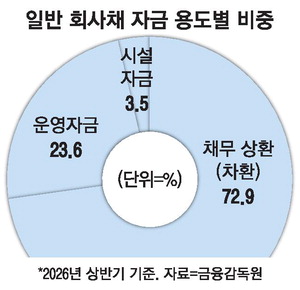

Corporate bond issuance funds from large companies are concentrated on paying off existing debts. Companies whose credit ratings have been downgraded also seem to be burdened by the financial burden as there are more companies than those that have been upgraded. On the other hand, demand for new investment through the issuance of corporate bonds seems to have shrunk.
According to the Financial Supervisory Service on the 9th, 72.9% of the 25.9052 trillion won in general corporate bonds issued in the first half of this year, or 18.872.1 trillion won, was spent on debt repayment. Operating funds were only 6.1131 trillion won (23.6%) and facility funds were only 920 billion won (3.5%). The share of refinance in the first half rose from 61.2% in 2022 to 74.5% in 2023 and 74.5% in 2024. It soared to 80.9% last year, the highest since the FSS compiled the 2010 statistics. Although it fell 8 percentage points to 72.9% this year, investment in new facilities has not been revived. The proportion of facility funds was 3.5%, up slightly from the lowest ever (2.7%) in the first half of last year, but remained at one-fifth of 2022 (18.6%).
Companies focused on defending their financial structure rather than investing, but credit ratings fell more. According to Nice Credit Rating’s “Corporate Sector First Half of 2026 Credit Rating Changes and Second Half Direction” report, 32 companies raised their credit ratings (based on short- and long-term credit rating and rating outlook) in the first half of this year and 37 companies lowered them. The downward trend is more following last year (26 upward and 38 downward).
By industry, construction, clothing, and automobile parts (three each) and petrochemicals (two each) had the most downward trend in secondary batteries (6). Secondary batteries were mainly attributed to the loss of price competitiveness due to overproduction in China. Petrochemicals saw a small drop after the U.S.-Iran war, as their performance temporarily rebounded. Automobile parts (4), defense and shipbuilding (3 each), and power equipment, power generation, and food (2 each) were mostly upward.
By group, Lotte (four) had the most downward trend, followed by SK (three) and JoongAng (two). On the other hand, HD Hyundai (four) had the most ups, while Samsung, LS, Hanjin, and Doosan (two each) also improved.
There are concerns that this trend could continue in the second half of the year. Nice Credit Ratings said, “High interest rates and high prices are likely to make it more difficult for companies with low credit ratings to raise funds and intensify this phenomenon.”
[Reporter Oh Goes Back]