
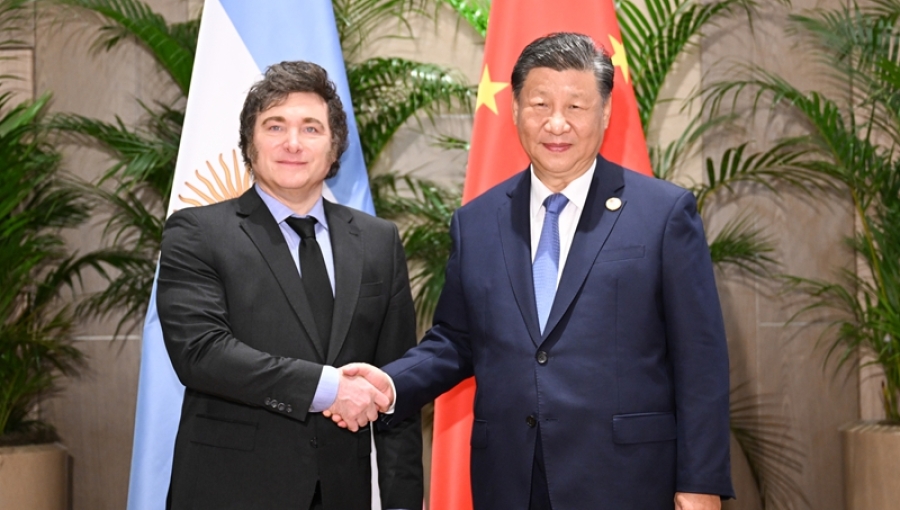
Argentina’s central bank has renewed its currency swap agreement with the People’s Bank of China for five years, extending the facility to 2031 and locking in more than $19bn of support for the country’s international reserves.
The renewal, finalised on August 5, resolves months of uncertainty over an arrangement that Argentine officials had quietly worked to preserve even as President Javier Milei’s government pursued closer ties with Washington. The deal covers CNY130bn and makes up roughly 40% of the Central Bank of Argentina’s gross reserves — a dependence that had made its fate a live question for markets all summer.
The new terms extend the swap’s duration from three years to five, a change the central bank said would give it “greater predictability” over the facility’s continuity. They also keep in place a previously authorised tranche of CNY35bn, about $5bn, agreed in early 2023, which remains available to backstop financial stability and to finance bilateral trade and investment with China.
First signed in 2009 by former president Cristina Fernández de Kirchner, the swap line has been renewed repeatedly as the cornerstone of a financial-cooperation framework linking the two central banks. Argentine officials had signalled for weeks that an extension was likely: Bausili said in May that negotiations were under way and that Argentina intended to preserve the arrangement on its existing terms, while local media reported that only administrative steps stood in the way of a deal. Argentine authorities had nonetheless publicly denied that the swap was on the agenda when Bausili travelled to Shanghai to meet PBOC Governor Pan Gongsheng at a Bank for International Settlements symposium, a meeting the central bank described as a broader exchange on the global economic outlook and monetary cooperation, rather than swap talks specifically.
Under the mechanism, the full value of the agreement counts as an asset on the central bank’s reserves, though the funds aren’t immediately usable. A tranche must be activated before Argentina can draw on it, at which point the amount used becomes a liability on the balance sheet. Argentina last activated the swap in August 2023, under then-president Alberto Fernández, as the country scrambled to shore up reserves and its exchange rate amid a dollar shortage. It has since worked the balance down sharply: the outstanding drawn amount fell from CNY21bn (around $3bn) at the end of 2024 to roughly CNY7bn ($1bn) by the end of 2025, with central bank data showing nearly 90% of the funds repaid and an outstanding balance of about $675mn by mid-January.
The renewal also sits awkwardly alongside Milei’s own controversial record on China. As a candidate, the firebrand libertarian vowed to sever economic ties with Beijing outright, telling voters “I don’t trade with communists” and branding China’s government a “murderer” and its people “not free,” a rhetoric that prompted Beijing to warn that cutting ties would be a “huge foreign policy mistake” and briefly froze the swap after his election. Yet once in office, Milei quickly reversed course: he thanked Xi Jinping for his congratulatory message after the 2023 runoff, unfroze and renewed the swap by mid-2024, met Xi on the sidelines of the G20 summit in Rio de Janeiro that November, and by September 2024 was calling China “a very interesting trade partner” that “doesn’t make any demands.”
That pivot has unfolded even as his government has aligned with Washington’s harder line on Beijing and positioned Argentina as the US’ closest partner in the region under the Trump administration. Former US special envoy Mauricio Claver-Carone called the swap “extortionate” in April 2025, and Treasury Secretary Scott Bessent later unveiled a separate $20bn swap line with Argentina to prop up Milei in the October 2025 midterm elections, casting the country as “a beacon for Latin America.” But the latest five-year extension suggests economic necessity — access to reserves, trade financing and a key market for Argentine exports — has continued to outweigh the ideological line Milei drew on the campaign trail.
Bausili has consistently defended the China facility as a stabilising tool regardless of how much of it is drawn, and officials in the presidential administration have told local media they see no objection to renewing it, even as the Economy Ministry and central bank have declined to comment publicly on the negotiations.
The swap renewal is one piece of a broader push by the government to rebuild the central bank’s firepower before next year’s elections. Officials are targeting roughly $22bn in additional reserves through a combination of the China facility, foreign-exchange futures operations and repo financing from international banks, including a $6bn repo extension announced in early July.