
Despite a strong year-to-date rally, emerging market (EM) equities have a compelling set up as fundamentals are poised to drive the market higher as valuations remain low.
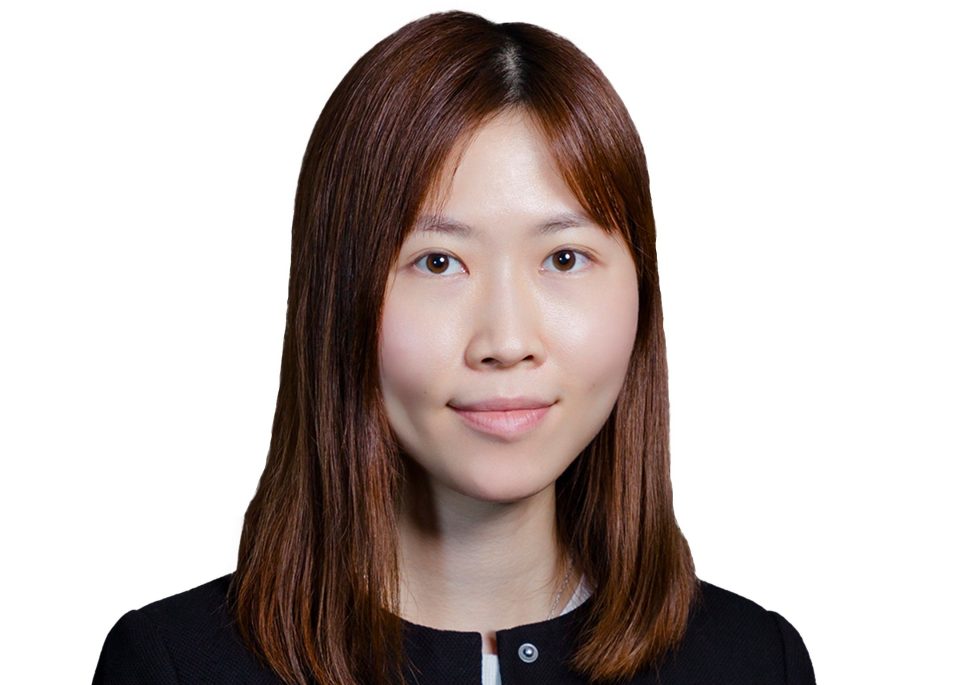
This is according to T. Rowe Price’s Agnes Ng (main picture), portfolio specialist for emerging markets and Chinese equity strategies.
“We believe that a number of investment cycles are happening at the same time, and they will benefit different parts of EM,” Ng said at a recent media briefing.
If consensus earnings per share growth estimates for emerging market equities do come to fruition, Ng said it creates “a very compelling” backdrop for the asset class.
She noted that in 2025, emerging market equities saw a meaningful re-rating, but after delivering on earnings growth, the asset class has de-rated back to early 2025 valuation levels.
Much of the earnings growth in the EM index has come from some of its biggest constituents: chip giants TSMC, Samsung, SK Hynix, MediaTek and Hon Hai, for example.
“AI [artificial intelligence] is going to lift parts of EM especially in North Asia because they form the backbone of the AI supply chain,” Ng said.
But aside from AI, Ng said there also has been increasing demand for the upgrade of electricity grids and power infrastructure, benefitting many EM-listed companies.
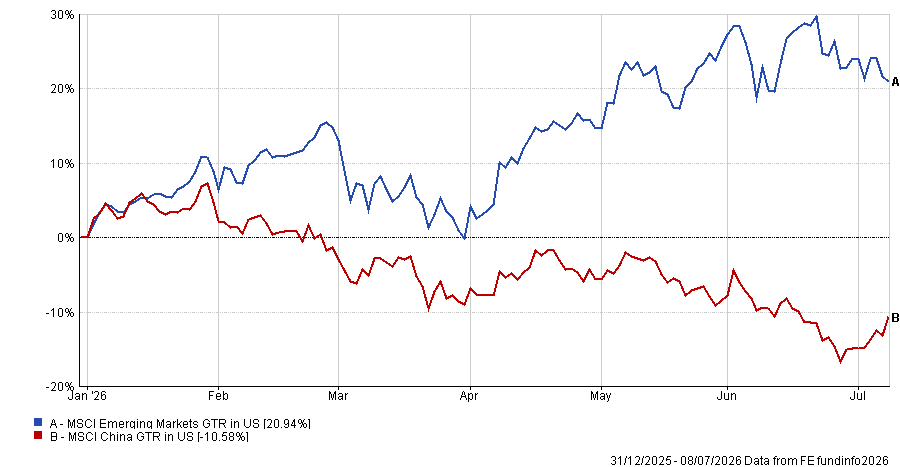
However Chinese equities more broadly have lagged the EM index so far this year, down 10.6% year to date versus a 20.9% gain in the wider MSCI EM index.
As the country’s AI push and record listings, Ng said the investment team’s framework for picking stocks in the country involves identifying the potential winners of its AI ecosystem by finding supply shortages.
“We focus a lot of time on finding bottlenecks,” she said. “What we mean is: where we are seeing supply shortages. We believe that those scenarios could actually support the pricing power and margin of those suppliers.”
“For example, currently we’re seeing substrates, PCB materials, and power generation equipment are under short supply.”
“We are focused on speaking to the stakeholders in the ecosystem frequently to ensure that we are not missing any normalisation of those bottlenecks.”
Another area the firm is looking at is finding companies that are benefitting from specification upgrades or content value growth as AI systems become more complex.
“We continue to identify companies that can turn their technical advantages into durable margins and beat earnings,” Ng said.
For example, as AI computing moves from Nvidia’s A100 chip to Blackwell to Vera Rubin, Ng pointed out that the power requirements of each GPU system is increasing.
“As a result, we’re seeing we need more sophisticated power supplies and that’s why the content value of those power supplies have increased disproportionately in each GPU system,” she said.
“So, these power supply providers are not just enjoying a lift in volume, they are also enjoying an increase in ASP [average selling price], in pricing power.”
She also pointed to printed circuit boards (PCBs) as another example, as more complex designs are needed to hold together GPUs, CPUs and memory chips and help them communicate.
“In those cases, we’re also seeing the number of layers involved to make those printed circuit boards increase,” she said. “That has essentially turned into higher content value for those PCBs on each in each GPU system.”
“For the companies who can meet the higher specification requirements, you can see that those names tend to outperform their peers by a larger extent.”
Elsewhere in China, Ng said the firm is also looking for mature companies that aren’t growing but are seeing free cash flow growth after a big capital expenditure cycle.
“If the company is lowering its capex and if there a potential to increase its free cash flow, we believe that is a leading indicator of earnings growth,” she said.
One example she pointed to was a Chinese aluminium producer which saw its capex peak in 2020 and has seen free cash flow increase notably since then.
Another example was an LCD panel producer that saw its capex peak in 2022, but is now also seeing its free cash flow increasing as capex comes down.