
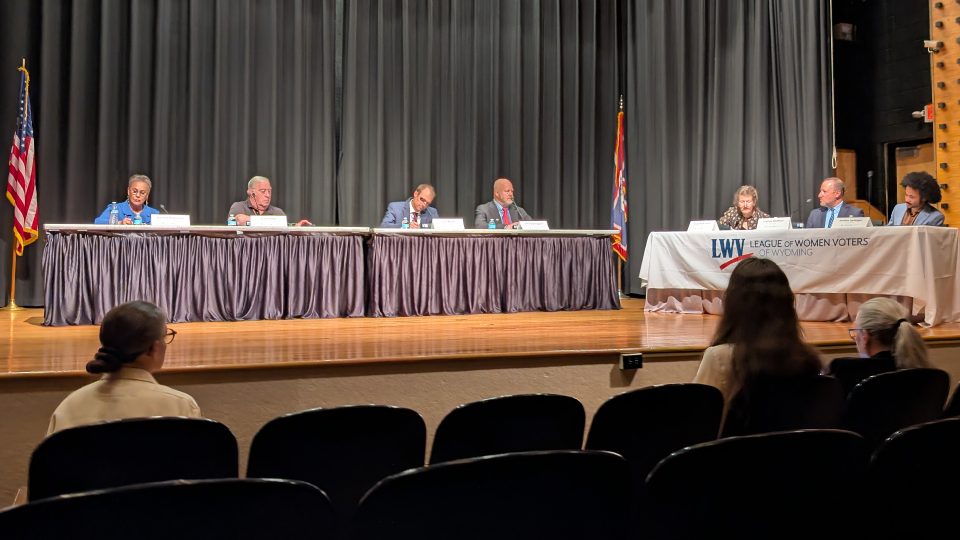
CASPER, Wyo. — Six contenders for Wyoming’s open U.S. Senate seat found rare bipartisan agreement on banning congressional stock trades Wednesday during primary forums at Casper College.
The back-to-back forums, hosted by the League of Women Voters in partnership with WyoFile, the Natrona County Public Library and Wyoming Public Media, were attended by six of the state’s seven primary candidates ahead of the Aug. 18 primary election. Democratic challengers Billy Benavidez and James Byrd opened the event, followed by Republican hopefuls U.S. Rep. Harriet Hageman, John Holtz, Sam Mead and Jimmy Skovgard. GOP candidate Jill Edwards did not attend.
Despite the night’s divisions on topics ranging from federal land management to rural healthcare to energy policies, one issue brought unanimous agreement across both parties: banning members of Congress from trading individual stocks.
Byrd described the current system as “absolutely unethical. It’s immoral and it’s illegal,” and he lamented the Trump administration’s curtailing of the U.S. Securities and Exchange Commission’s ability to enforce insider trading prohibitions. Benavidez characterized the use of inside information in trading as a “slimeball, sleazebag” tactic.
“They’re getting away with corruption, and it’s a perk of Congress,” he said.
Read more about the candidates
Oil City News is committed to providing free and fair election coverage. To read more about the candidates, visit the Oil City News Voters Guide.
On the Republican side, Mead said giving politicians a leg up feeds young people’s distrust in government, adding, “There’s no reason our politicians should be treated any differently than the rest of us.”
Skovgard said politicians shouldn’t be using their positions to enrich themselves, while Hageman said lawmakers must be held to the same standard as private industry. Holtz agreed the potential for inside information makes a ban necessary.
The Democratic ticket
When asked to identify Wyoming’s greatest challenges, Byrd, a former state legislator, pointed to affordability and a congressional delegation that he said represents corporate interests over everyday citizens. Benavidez, pitching himself as a political outsider running for a single term, cited government surveillance, affordability and housing shortages as his top concerns.
Those concerns bled into answers regarding the balance of federal power, with both candidates agreeing the executive branch has overstepped its bounds. While Benavidez advocated for a return to past lawmaking to rein in executive agencies, Byrd said he’d lead the charge to put constitutional rules for co-equal branches in place.
“We have a legislative branch who does nothing but sit on its thumbs and acquiesces to the executive,” he said.


When evaluating presidential appointees, Benavidez stressed the need for integrity and honesty, saying voters must ultimately trust the president’s selections because “God put him there.”
Byrd said he would demand competence and experience from appointees to stop the “amateur hour” in Washington, in which appointees are serving their own interests to profit from their positions.
With roughly 48% of Wyoming’s lands managed by the federal government, Byrd opposed transferring public lands, citing a survey that showed nearly 99% of respondents opposed the move. He said a sell-off would devastate legacy ranches and the state’s $5.2 billion tourism industry. Benavidez voiced skepticism toward federal management but stopped short of endorsing wholesale transfers.
“Usually when you let the government do things that Wyoming does not want them to do, bad things happen,” he said.
On energy diversification, Byrd supported legacy fossil fuels but advocated for reinvesting coal revenue into the University of Wyoming to lead the nation in nuclear research. Benavidez supported a diverse energy sector, including renewables, provided such projects are placed strategically out of sight.
On the topic of Wyoming’s healthcare crisis, Byrd blamed pharmaceutical companies for squeezing residents. Funding rural healthcare is essential for the financial survival of small communities, he said, adding lawmakers must develop innovative solutions. Benavidez said past systems and the Affordable Care Act have failed miserably, suggesting the nation start over and let capitalism dictate the healthcare market.
The candidates offered differing views on the Social Security Retirement Trust Fund, which is projected to be depleted in 2032. Benavidez viewed the impending shortfall as a lost opportunity for early retirement caused by Congress, telling voters to build their own independent nest eggs instead of relying on the government. Byrd proposed plugging the backdoor where Congress borrows from the fund and diverting foreign aid to ensure its solvency. He emphasized that the program is not an entitlement but money owed by the government to the payers.
The Republican field
Wednesday’s forum was a rematch for the four Republicans who previously faced off during the Politics in the Park forum on June 17 in Casper’s Washington Park.
The field offered a spectrum of priorities when identifying the state’s biggest challenges. Hageman primarily targeted bureaucratic overregulation of the state’s legacy industries, while Holtz focused on protecting agriculture during severe droughts. Mead said the state needs to retain its youth by diversifying the economy, and Skovgard warned against the runaway national debt fueling inflation.


When asked about the balance of federal power, all four demanded Congress rein in executive agencies. Hageman, pointing to her role on the Article I task force in the U.S. House, said the nation’s form of government requires Congress to be the legislating authority.
“A nameless, faceless bureaucrat in Washington, D.C., may not have any idea of what your issues are, but I should,” Hageman said. “That’s why it’s so important that the legislative branch reclaim its authority for legislating and taking that away from the executive branch.”
Holtz recounted his time as a Wyoming judge striking down an unconstitutional state law to preserve the separation of powers. Mead said passing massive omnibus bills ruins public trust, adding that Congress must write fewer laws faster to prevent executive overreach.
“Congress and Senate are the closest to the people, and they need to be the most responsive Branch to the people,” Skovgard said, adding that otherwise “we are going to wake up one day and be embroiled in a war that we’re not going to be able to just walk away from.”
On evaluating presidential appointees, Hageman said vetting nominees is the most important part of a senator’s job, promising that agency heads she approves will understand Wyoming’s needs. Skovgard said a senator’s oath to the Constitution supersedes their allegiance to the president.
“The United States is the most powerful nation in the world, and Senate appointments are some of the most important appointments that we make. That being the case, we need to make sure that when we’re appointing people, these are some of the best minds in the world,” Mead said.
Holtz offered a more spiritual vetting strategy, saying, “I would ask the Lord for guidance.”
About federal land transfers, Hageman advocated for better local access and management through legislation like the Fix Our Forests Act rather than full state control. Holtz favored keeping current public lands intact, saying the state must not become over-commercialized like Disneyland. Mead opposed the top-down disposal of federal lands but supported streamlined, local transfers for community expansion. Skovgard rejected selling off public land without public input, adding that lawmakers should proactively inform voters before land legislation hits the floor.
The candidates were divided on the role of renewables in energy diversification. Hageman outright dismissed wind and solar energy, saying that they lack the density of fossil fuels and that the state has enough coal, oil and gas to power the country for centuries. Holtz also scorned renewable energy as unreliable.
“If Tinkerbell sprinkles fairy dust, I guess they’ll work, but you have to depend on that,” he said.
Mead took an all-of-the-above approach to meet rising demand. He said Wyoming built its coal industry with visionary leaders, not by saying no to new projects. Skovgard defended his roots in the oil and gas industry but said Wyoming must take the time to understand and begin integrating nuclear energy to eventually replace fossil fuels.


Addressing healthcare, Hageman defended the state-driven Rural Healthcare Transformation Fund as transformative, while calling for pharmacy benefit manager reform and cross-state insurance sales. Holtz warned that a shortage of rural doctors and Medicaid cuts will only drive people to emergency rooms, tripling overall healthcare costs. Mead said the insurance industry is broken due to administrative overhead, and he proposed a standardized nationwide software system for providers to create a portable insurance marketplace. Skovgard spoke about families paying exorbitant premiums and called for a state-run insurance pool to negotiate better coverage for all residents.
To save the Social Security Retirement Trust Fund, Hageman said getting more people into the workforce paying taxes while simultaneously cracking down on fraud, waste and abuse will shore up the fund. Holtz proposed raising the tax cap to buy the system 20 years of solvency, a measure Mead supported as a way to offer breathing room to solve larger demographic issues. Skovgard suggested modeling the federal system after Wyoming’s permanent mineral trust fund, backing Social Security with appreciating physical assets rather than bonds.
Next up
The next forum hosted by the library, the league, the Natrona Collective Health Trust and the Boys & Girls Clubs of Central Wyoming is at 6 p.m. today, featuring City Council candidates. It will be hosted in the library’s Crawford Room.