
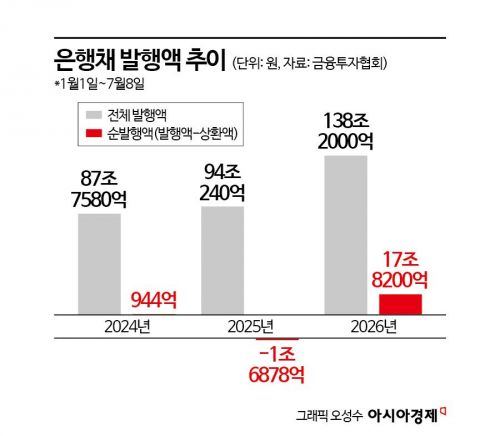
Cumulative Issuance from January to July Reaches 138.2 Trillion Won… Net Issuance Hits 17.8 Trillion Won
IBK Leads the Surge with Fourfold Increase as Productive Finance Expansion Drives Policy Banks
Despite Higher Funding Costs, Issuance Rise
Despite a rise in market interest rates, the total issuance of bank bonds has surged by nearly 50% over the past year. This result runs counter to the traditional trend, where higher interest rates typically lead to a reduction in bond issuance.
The sharp increase in bank bond issuance is primarily due to policy banks, such as Industrial Bank of Korea (IBK), significantly ramping up their bond offerings in line with the government’s push for expanding productive finance. However, commercial banks also increased their bond issuance compared to the previous year. While part of this was to respond to bond maturities, the expansion of lending demand—driven by rising household loans and a growing preference among large corporations for bank loans over corporate bonds—also played a significant role.
![[1mm Finance Talk] Bank Bond Issuance Surges 47% in a Year Despite Rising Market Rates... Here's Why](https://www.asiae.co.kr/news/img_view.htm?img=2026070915420040669_1783579321.jpg)
According to the Korea Financial Investment Association on July 10, cumulative bank bond issuance from the beginning of this year through July 8 reached 138.2 trillion won, a 47% surge compared to 94.024 trillion won over the same period last year. This is a record-high scale since 2020, and it marks the first double-digit growth in the past five years. The amount issued exceeded the amount redeemed by 17.82 trillion won, which is equivalent to 68% of last year’s net issuance (26.1769 trillion won).
What is particularly noteworthy is that bank bond yields have actually risen this year. The average yield on 3-year (AAA-rated) bank bonds climbed from 2.82% last year to 3.74% this year, an increase of nearly 1 percentage point. Since higher yields translate directly into increased funding costs for banks, it is customary for banks to issue more bonds when interest rates are lower. The surge in bank bond issuance in the first half of this year is therefore seen as unusual compared to previous trends.
The main driver behind the increased bank bond issuance this year has been policy banks, particularly Industrial Bank of Korea. According to the Korea Financial Investment Association, IBK’s bond issuance from the start of the year through July 8 reached 48.78 trillion won, more than four times the 10.31 trillion won issued during the same period last year.
Industry experts believe that, in line with the government’s policy to expand productive finance, increased lending to small and medium-sized enterprises prompted IBK—which has a relatively weak deposit base—to boost bank bond issuance to secure funding. One banking sector official noted, “It is also likely that the bank aimed to manage a somewhat lower liquidity coverage ratio (LCR) that emerged earlier this year.”
![[1mm Finance Talk] Bank Bond Issuance Surges 47% in a Year Despite Rising Market Rates... Here's Why](https://www.asiae.co.kr/news/img_view.htm?img=2026070915420040668_1783579320.jpg)
Although not to the same extent as IBK, the total bank bond issuance by the five major commercial banks (KB Kookmin, Shinhan, Hana, Woori, and NH NongHyup) also rose. The five banks issued 30.56 trillion won in bank bonds from the beginning of the year through July 8, more than doubling the 14.3 trillion won issued during the same period last year. While Woori Bank was the only one to see a decrease, KB Kookmin Bank (from 810 billion won to 5.35 trillion won) and NongHyup Bank (from 2.29 trillion won to 8.94 trillion won) posted particularly notable increases.
Commercial banks generally have a solid deposit base. Even as funds moved toward the stock market, their total deposit balances increased by nearly 90 trillion won, from 2,163.1712 trillion won at the end of last year to 2,252.5797 trillion won at the end of June this year. However, much of this growth was led by demand deposits and money market deposit accounts (MMDAs), which are more susceptible to outflows (up by 69.3989 trillion won), raising concerns about the stability of funding. This is one of the main reasons banks have opted to issue more bonds as a means of securing funds.
The shift by large corporations to favor bank loans over corporate bonds as a means of raising capital also appears to have had an impact. The yield on 3-year AA- rated corporate bonds rose from the 3.4% range at the beginning of the year to the 4.4% range currently, an increase of 1 percentage point. Meanwhile, the average interest rate for large corporate bank loans stood at just 4.10% in May. As more companies have chosen loans over bond issuance, large corporate loans at the five major banks have increased by more than 20 trillion won so far this year.
However, it has been reported that some banks also rolled over (refinanced) maturing bank bonds during this period.
Hot Picks Today

“Too Hot to Wear Clothes”: Swimsuits in City Streets… 4,700 More Deaths in Western Europe
The banking sector expects the trend of increased bank bond issuance to continue into the second half of the year, though the pace is likely to moderate. One banking sector official said, “Since bank bond yields have already risen to high levels and demand has cooled due to signals of a potential base rate hike, the increase is expected to be slower than in the first half. The deposit base centered on corporate clients is also currently solid.”
This content was produced with the assistance of AI translation services.
© The Asia Business Daily. All rights reserved. Unauthorized AI training and use prohibited.