
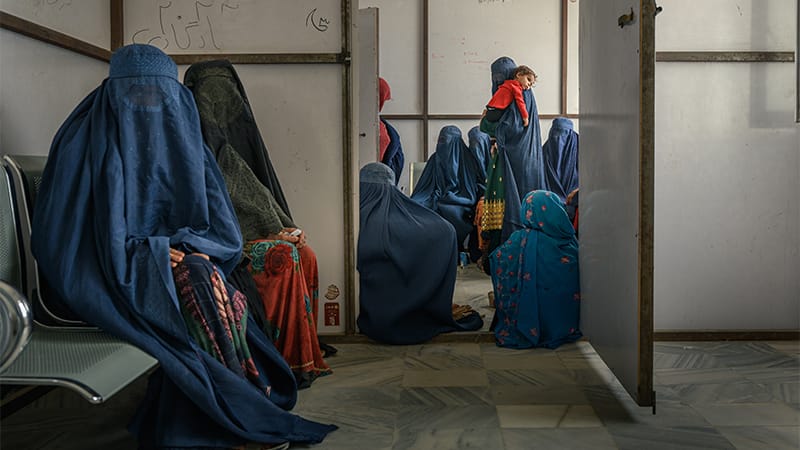
The recent earthquake in Afghanistan has laid bare the country’s worsening women’s health crisis and demonstrated how restrictive Taliban laws and collapsed infrastructure left women without access to life-saving medical care.
With mobility bans, shortages of women clinicians, and rules preventing men from treating women, the disaster has turned existing inequities into life-threatening barriers across an already fragile health system.
All-male rescue teams could not assist women because Taliban rules prohibit physical contact between genders. Consequently, many women survivors remained trapped and untreated.
Women are also unable to travel alone and must be escorted by a male relative to the clinic, which delays urgent care. Once there, the shortage of women clinicians and restrictions on men physicians treating women further limit access.
The World Health Organization (WHO) estimates that only 10% of medical staff in quake-affected areas are women, primarily midwives and nurses.
The disaster struck an already fragile health system with poor infrastructure, few resources, and heavy dependence on international aid.
According to Alexandre Marcou, Communication Manager, Médecins Sans Frontières (MSF), nearly 400 clinics in Afghanistan have closed or suspended operations since the US’s funding cuts.
Speaking with El Médico Interactivo, a Medscape Network platform, he said, “The health system is nearly collapsed. Pediatric emergencies have more than doubled — from 53,000 in 2020 to 122,000 in 2024.” He noted that MSF-supported hospitals were the only functional facilities in several provinces.
“Conditions differ widely across provinces. In some regions, the economic crisis is severe, and access to healthcare is extremely limited. The situation is better in cities such as Kabul and Herat. However, the ongoing economic collapse makes it difficult for many to afford travel, medical care, and basic medicines. We often see patients arriving in a critical condition because of the long distances they must travel, lack of resources, or limited health awareness that delays care,” Marcou said.
Maternal Crisis
According to the UN Women’s Afghanistan Gender Index 2024, 78% of young Afghan women are excluded from education, employment, and professional training. Girls older than 12 years cannot attend school, and women are barred from higher education, including medical education.
The shortage of women healthcare workers is already limiting access to care, particularly because men and women are segregated in hospital wards. The MSF warned that current restrictions further reduce access to quality care and threaten service availability in the future.
“There is no healthcare system without trained women health professionals,” said Mickael Le Paih, country representative, MSF, Afghanistan. “If girls cannot attend secondary school and women are barred from university or medical college, where will the next generation of health professionals come from, and who will care for women in Afghanistan when they are most vulnerable?”
The ban on employment outside the home prevents women from working in key sectors such as health, education, media, government, and humanitarian organizations in Afghanistan. Only a limited number of women may work in healthcare or primary education, and even then, under strict restrictions.
In Kabul and larger cities in Afghanistan, a small number of women doctors, nurses, and midwives care for women and girls only when men cannot fulfill those roles. They are prohibited from interacting with male colleagues, which hinders coordination and reduces the quality of care.
In rural areas, women doctors are extremely scarce and must follow the same mobility rules as their patients — they require a mahram, a man relative such as a father, husband, or brother.
These restrictions create unavoidable health risks for pregnant women. Women traveling alone may be detained or delayed at police checkpoints, thereby preventing them from attending medical appointments.
The situation is worse for those with children, older adults, or dependents, as accompaniment is required. The purchase of medicine depends on the guardian’s approval.
These rules also limit evacuation and protection during emergencies, natural disasters, and armed conflicts. If a guardian dies, the woman is left unprotected and exposed to disease, violence, and neglect.
Barriers to Care
A study published in BMC Public Health identified the major barriers women in Afghanistan face when accessing healthcare. These include the need for family approval, accompaniment by a man relative, residence in rural areas, and economic hardship. The study also found that education, empowerment, and socioeconomic status determine access to health care.
Women from marginalized groups face the greatest challenges. Approximately 55% of women with higher education reported some barriers compared with 91% of those without. Similarly, 87% of women with decision-making power encountered obstacles vs 91% without such authority. Only 9% of the women who owned land reported no problems accessing care compared with 12% of those without land ownership.
“In some families and regions, women have very limited financial autonomy and cannot independently decide when and where to seek healthcare,” said Marcou.
Medical services in Afghanistan are limited, and accessing specialized care is even more difficult. Male doctors cannot provide obstetric or gynecologic care, and the shortage of women professionals restricts prenatal care and safe deliveries. Many women experiencing miscarriages or seeking abortion care lack timely treatment, and the number of unplanned pregnancies is increasing because of limited contraception, sex education, and family planning services.
This shortage has worsened the country’s maternal health crisis.
A recent UN Women report estimated that by 2026, a woman’s chance of dying during childbirth will increase by 50%.
The lack of women healthcare workers also hampers childhood vaccination and the treatment of chronic diseases, such as diabetes, hypertension, heart disease, and respiratory illnesses, leaving many without essential care.
Nearly 12,000 pregnant women were at extreme risk following the earthquake because of insufficient services and a scarcity of women’s healthcare workers. The disaster has intensified the maternal health crisis in a country that already has the highest maternal and infant mortality rates in Asia and is among the highest in the world.
After the earthquake, strict “morality” rules blocked all-male rescue teams from reaching women trapped under the rubble.
Women’s humanitarian workers have been banned from providing aid. The UN condemned the Taliban’s restrictions, and the WHO called for lifting mobility rules to allow women healthcare workers to respond to urgent needs.
The WHO estimates that only 10% of medical staff in the affected areas are women, mostly nurses and midwives, rather than doctors trained to treat serious injuries. The remaining few professionals struggle to manage the influx of survivors.
Women and girls accounted for most earthquake victims, but only 42% of hospital admissions were women compared with 58% men.
According to UN agencies and the WHO, the earthquake killed more than 2200 people — half of them children — and injured over 3600.
Humanitarian Fallout
Afghan refugees and returnees are among the most severely affected. Many have recently returned after being deported from neighboring countries such as Iran and Pakistan. Earthquakes and extreme winter conditions leave them highly vulnerable, increasing their disease risk and limiting their access to medical and humanitarian aid.
The WHO reports cases of acute watery diarrhea, dengue fever, measles, and malaria in the affected regions. More than 90% of communities lack adequate sanitation, which increases the risk for cholera outbreaks.
The WHO has warned of a “second wound” in Afghanistan: a mental health crisis affecting families who have lost everything, with women and children being the most affected. They face grief, anxiety, insomnia, and acute stress, while a shortage of mental health professionals limits care.
A UN Women survey conducted before the earthquake found that 68% of women rated their mental health as “poor” or “very poor,” and 8% knew another woman or girl who had attempted suicide.
Restrictions on women, including bans on education, work, free movement, dress, sports, and media exposure, along with forced marriages and gender-based violence, further worsen their mental health. Combined with conflict, disasters, and humanitarian crises, these factors have long-term consequences for Afghan society across generations.
Change requires a multilevel approach: political pressure on the Taliban, humanitarian aid involving women’s healthcare staff, the training and education of women professionals, and empowerment within society.
As in chess, protecting the queen — women and girls — safeguards not only their health and rights but also the future of Afghanistan. If the queen falls, the entire system is at risk; their protection is a strategic move for survival, resilience, and social well-being.
This story was translated from El Medico Interactivo.