
Key Takeaways
- Globalization is the increasing integration of economies and markets worldwide.
- It allows goods, services, capital, and technology to move across borders.
- Globalization can lower costs and expand markets, but may disrupt local industries.
- It has contributed to economic growth and increased global trade.
- Its effects vary by country, industry, and population.
What Is Globalization?
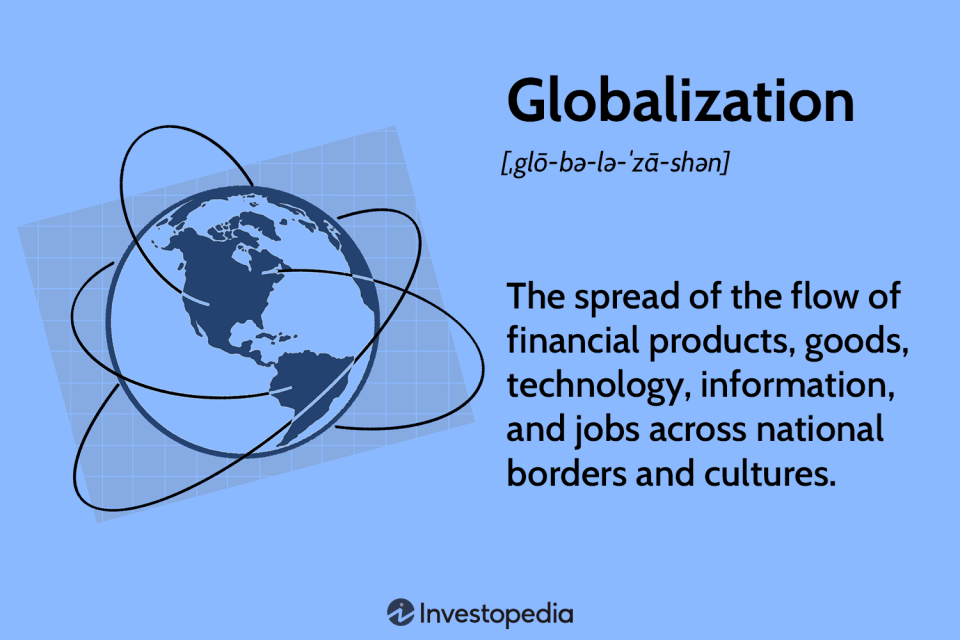
Globalization describes the increasing interconnectedness of countries through trade, investment, technology, and the movement of goods and services. Businesses can reach customers around the world, source materials internationally, and operate across multiple countries, making national economies more closely linked than ever before.
Alex Dos Diaz / Investopedia
How Businesses Use Globalization
Corporations benefit from globalization through lower manufacturing costs abroad, cheaper raw materials due to reduced tariffs, and access to new consumer markets.
The Impact of Globalization Across Various Sectors
Globalization is a social, cultural, political, and legal phenomenon.
- Socially, it leads to greater interaction among various populations.
- Culturally, globalization represents the exchange of ideas, values, and artistic expression among cultures.
- Globalization also represents a trend toward the development of a single world culture.
- Politically, globalization has shifted attention to intergovernmental organizations like the United Nations (UN) and the World Trade Organization (WTO).
- Legally, globalization has altered how international law is created and enforced.
Globalization has created new jobs, expanded trade, and supported economic growth, but its benefits have not been shared equally across industries, regions, or workers. Some sectors have expanded while others have contracted because of international competition.
While globalization can be idealistic and opportunistic, its benefits and drawbacks are not evenly distributed and vary across industries, countries, and populations. Its impact remains mixed for workers, cultures, and small businesses around the globe, in both developed and emerging nations.
Important
Globalization isn’t limited to trade. It also includes the international movement of capital, technology, information, and labor, making economies increasingly interconnected.
Tracing the Evolution of Globalization Through History
Globalization isn’t new. Ancient traders traveled long distances to buy rare commodities to sell at home. The Industrial Revolution brought advances in transportation and communication in the 19th century that eased trade across borders.
According to the Peterson Institute for International Economics, globalization stalled after World War I as nations turned to protectionism with import taxes. This trend lasted through the Great Depression and World War II until the U.S. played a key role in reviving international trade.
A key step in globalization was the 1993 North American Free Trade Agreement (NAFTA). One of NAFTA’s many effects was to give American auto manufacturers the incentive to relocate a portion of their manufacturing to Mexico, where they could save on the costs of labor. NAFTA was replaced in 2020 by the United States-Mexico-Canada Agreement (USMC).
Governments worldwide have integrated a free market economic system through fiscal policies and trade agreements in the 20th century. Most trade agreements focus on reducing or removing tariffs.
This evolution of economic systems has increased industrialization and financial opportunities in many nations. Governments now focus on removing barriers to trade and promoting international commerce.
Weighing the Benefits and Challenges of Globalization
Pros
- Proponents of globalization believe it allows developing countries to catch up to industrialized nations through increased manufacturing, diversification, economic expansion, and improvements in standards of living.
- Outsourcing by companies brings jobs and technology to developing countries, which helps them to grow their economies. Trade initiatives increase cross-border trading by removing supply-side and trade-related constraints.
- Globalization has advanced social justice on an international scale as well, and advocates report that it has focused attention on human rights worldwide that might have otherwise been ignored on a large scale.
Cons
- One clear result of globalization is that an economic downturn in one country can have a domino effect on its trade partners. For example, the 2008 financial crisis had a severe impact on Portugal, Ireland, Italy, Greece, and Spain. All of these countries were members of the European Union, which had to bail out debt-laden nations, which were thereafter known by the acronym PIIGS.
- Globalization detractors argue that it has created a concentration of wealth and power in the hands of a small corporate elite that can gobble up smaller competitors around the globe.
- Globalization has become a polarizing issue in the U.S. with the disappearance of entire industries to new locations abroad. It’s seen as a major factor in the economic squeeze on the middle class.
- For better or worse, globalization can reduce the cultural and social aspects unique to people and geographic areas around the world and increase product homogeneity. Starbucks, Nike, and Gap dominate commercial space in many nations. The sheer size and reach of the U.S. have made the cultural exchange among nations largely a one-sided affair.
Pros
-
A larger market for goods and services
-
Cheaper consumer prices
-
Outsourcing can benefit domestic firms and foreign labor
-
Increased standard of living
Cons
-
Concentrates wealth in richer countries
-
Some poorer countries can be left behind
-
Labor and the physical and intellectual resources of poorer countries can be exploited
-
Regions and cultures lose their uniqueness and products available around the world can become homogeneous
Explain It Like I’m Five
Globalization means countries are more connected than ever. Companies can make products in one country, sell them in another, and use materials from all over the world. This makes goods cheaper and more available, but it can also create challenges for local jobs and industries.
Why Is Globalization Important?
Globalization is important as it increases the size of the global market and allows more and different goods to be produced and sold for lower prices. It is also important because it is one of the most powerful forces affecting the modern world, so much so that it can be difficult to make sense of the world without understanding globalization.
For example, many of the largest and most successful corporations in the world are in effect truly multinational organizations, with offices and supply chains stretched right across the world. These companies would not be able to exist without the complex network of trade routes, international legal agreements, and telecommunications infrastructure that were made possible through globalization. Political developments, trade disputes, and changes in international policy can all affect how globalization evolves
Is Globalization Good or Bad?
It depends. Proponents of globalization will point to the dramatic decline in poverty throughout the world for more than two decades after around year 2000, which many economists attribute in part to increased trade and investment between nations. Similarly, they will argue that globalization has allowed products and services such as cellphones, airplanes, and information technology to be spread far more widely throughout the world.
On the other hand, critics of globalization will point to the negative impact it has had on specific nations’ industries, which might face increased competition from international firms. Globalization can also have negative environmental impacts due to economic development, industrialization, and international travel.
How Does Globalization Impact Society?
Globalization has had a large impact on societies around the world, leading to massive migrations from rural to industrial or urban areas and to the rapid growth of cities and trade hubs. While this has meant an overall increase in incomes and a higher standard of living in general, it has also led to problems such as crime, domestic violence, homelessness, and poverty. Concepts of national identity, national or regional culture, and consumption patterns also change as goods from around the world become increasingly available and at low prices. The competitiveness of global capitalism may also lead to more individualistic ideals that contradict the cultural orientations of certain, more collectivist societies.
What Is an Example of Globalization?
A simple example of globalization would be a car manufactured in the U.S. that sources parts from China, Japan, South Korea, Sri Lanka, and South Africa. The car is then exported to Europe, where it is sold to a driver who fills the car’s gas tank with fuel refined from imported crude oil.
The Bottom Line
Globalization has made countries and businesses more interconnected through trade, investment, technology, and global supply chains. While it has expanded economic opportunity and lowered costs in many cases, its benefits and challenges are not distributed equally, making it one of the most influential—and debated—forces in the global economy.