

Bloomberg News
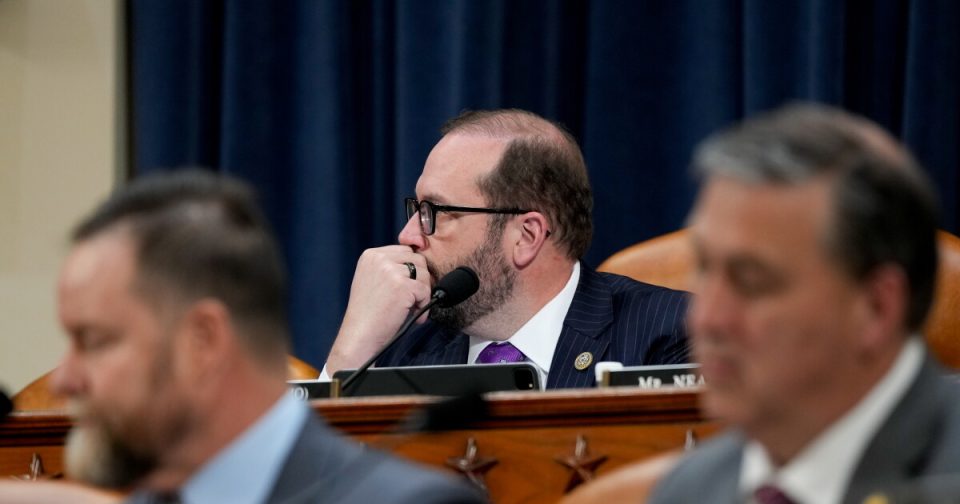
The use of tax-exempt bonds for professional sports stadiums took a beating Tuesday at a four-hour House Ways and Means Committee hearing where lawmakers from both sides of the aisle said they’re interested in changing the tax code to halt the practice.
Processing Content
It’s the latest congressional effort to ban tax-exempt financing of professional sports facilities, a
“It’s long past time to fix this egregious practice,” said Rep. Don Beyer, D-Va., who has
Chair Rep. Jason Smith, R-Mo., singled out public funding packages that include tax-exempt debt as driving the recent decision by the Kansas City Chiefs
The Chiefs’ decision is an example of “corporate greed triumphing over community benefit,” Smith said.
“But it’s not just the Chiefs. Tax incentives are being used by teams around the country to leverage the communities they’re in for the most favorable deals possible — often without any public benefit,” Smith said.
The
Smith said 43 of 57 new stadiums built over the past 20 years tapped tax-exempt municipal bonds, costing taxpayers $4.3 billion.
“And the numbers only climb,” he said, citing $850 million for the
“Different cities, different leagues, but the same unfortunate playbook: leverage, threaten, relocate, repeat. And send the bill to the taxpayer,” Smith said.
Even well-known municipal bond advocates on the powerful tax committee didn’t defend tax-exempt stadium bonds during the hearing titled “The growing business of sports: reviewing federal tax policy in the multi-billion dollar industry.”
The hearing also focused on name, image and likeness activity in college athletics and compensation and tax policy for college athletes.
Only one lawmaker, Rep. Mike Carey, R-Ohio, defended the practice by highlighting a new project from the city of Columbus and Franklin County to create a bond-issuing authority for a professional women’s soccer team.
“There are creative ways for local governments to work with professional teams in a public-private partnership to create significant new revenue for local and state governments,” said Carey.
But his was the sole voice defending the use of tax-exempt bonds to finance professional sports stadiums.
Even Rep. Terri Sewell, a Democrat from Alabama who is a former bond counsel and member of the House Municipal Finance Caucus, targeted public financing of professional sports stadiums, though she drew a distinction between professional sports venues and college stadiums and other public projects.
“I share your concern about how public finance and municipal bonds are being used to finance professional stadiums and their construction,” Sewell said to witness Dennis Coates, a University of Maryland-Baltimore County economics professor and editor of the Journal of Sports Economics.
“You said it’s an inefficient subsidy,” Sewell said. “How can we flip the switch so we make sure the communities really do benefit?”
“If it’s a professional stadium, then the owners should pay for it,” Coates said.
“Right,” Sewell said.
Neither Reps. David Kustoff, R-Tenn, nor Rep. Rudy Yakym, R-Ind., both muni finance caucus members and bond advocates who have
While a few lawmakers touted their stadiums as economic generators, they did not directly support the use of tax-exempt bonds as financing tools.
Ranking Democrat Rep. Richard Neal, D-Mass., another longtime public finance advocate, said wealthy team owners “are even willing to rip the team from its fan base when more favorable subsidies are offered over state lines. We cannot continue this endless cycle of bending the knee to the whims of the billionaire class.”
In possible legislative action, Rep. Brendan Boyle, D-Pa., said he is “in the beginning stages” of crafting a bill that would “disincentive states and localities from engaging in this sort of practice.”
One proposal would be a federal excise tax, he said.
“I am very concerned that we have a system today that’s a race to the bottom, where you have municipalities and states that are falling over themselves to give billions of dollars of taxpayer subsidies in order to lure franchises away,” Boyle said. “I’m open to any ideas on how to end this practice once and for all,” he said.
“I would recommend first to get rid of the tax exemption for state and local bonds used to finance stadiums,” responded Coates.
Unrealistic economic projection reports are part of the problem, said Rep. Beth Van Duyne, R-Texas. Van Duyne was the mayor of Irving when the Dallas Cowboys decamped to Arlington, she said.
“I saw all the economic impact studies and they were very let’s just say generous at best — we are actually getting more money now on game days than we were when stadium in the city,” she said. “Tax exempt municipal bonds subsidize these projects based on optimistic projections and federal taxpayers help underwrite outcomes that frequently fall short.”
State and local government advocates say eliminating tax-exempt stadium bonds would punish the wrong entity.
“[Take] sports out of the discussion — this is a federal government preemption of the local government’s decision to issue tax-exempt bonds,” Emily Brock, federal liaison of the Government Finance Officers Association,
Under current tax code, a bond is considered a private activity bond if more than 10% of the bond proceeds are used for any private business and more than 10% of the bond proceeds are secured directly or indirectly by interest in property used for a private business, or more than 10% of the bond proceeds are derived directly or indirectly from payments in respect of property used for a private business use, according to IRS code.
Stadium bonds generally are eligible for the tax exemption by structuring the deal so that no more than 10% of its debt service is secured by interest in the stadium and no more than 10% of its proceeds are from payments derived from the stadium.
It’s not clear whether a bill will emerge from the session.
“Sports have always evolved. Our tax code should keep up, and it should evolve in a way that supports communities, protects taxpayers, promotes fair competition, and gives young athletes every opportunity to succeed both on and off the field,” said Rep. Mike Thompson, D-Calif.
“This has been an interesting hearing, Mr. Chairman, but what it tells me is we need a lot more,” Thompson told Smith.