
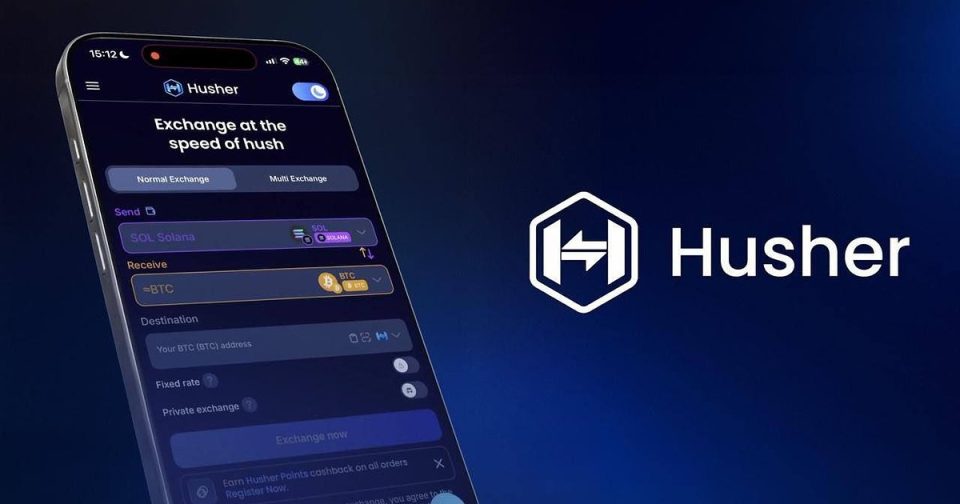
DUBAI, United Arab Emirates – June 26, 2026 – In the world of digital assets, where fortunes can shift in minutes, a new player claims to operate in seconds. Husher, a non-custodial crypto exchange, has emerged from Dubai with a bold proposition: instant crypto swaps with 2-second settlement, rock-bottom fees, and a staunch no-KYC (Know Your Customer) policy. The company backed its claims with on-chain data showing it outperforms established rivals by orders of magnitude, positioning itself as a challenger to the status quo.
This isn’t merely an incremental improvement; it’s a shot across the bow of the entire instant swap industry. By promising to eliminate the friction of sign-ups, identity verification, and high fees, Husher is targeting the core tenets of crypto purists: speed, privacy, and self-custody. But in doing so, it wades directly into the crosscurrents of regulatory pressure, forcing a critical question: is this the future of decentralized finance, or a model on a collision course with global regulators?
A New Standard for Speed and Cost
The central pillar of Husher’s market entry is its audacious performance claims. According to benchmark tests released by the company, a ~$1,000 swap of the Solana (SOL) cryptocurrency was completed in just two seconds. This is a staggering figure when compared to the performance of its competitors in the same test session. ChangeNOW, a popular swap service, took 43 seconds. SideShift clocked in at 55 seconds. Others, like SimpleSwap and HoudiniSwap, took over seven minutes to settle the identical transaction.
For active traders, this time differential is not trivial. It represents a significant reduction in exposure to price volatility. In a market where asset prices can swing wildly in minutes, a 2-second settlement window means execution prices are far more likely to match quoted prices. The firm’s on-chain data, verifiable on public explorers like Solscan, provides a transparent look at these results. The value proposition is clear: faster execution means less risk and more capital preserved.
Beyond speed, Husher attacks the cost structure of its rivals. The same benchmark test registered a 0.34% all-in fee, totaling just $3.37 on the ~$1,000 swap. This figure stands in stark contrast to competitors like ChangeNOW (1.01%), SimpleSwap (1.34%), and HoudiniSwap (1.76%), whose fees were three to five times higher. Husher states its fee structure ranges from 0.1% to 0.4%, a tight band that, if sustained, could fundamentally disrupt the economics of the swap market. This efficiency is reportedly achieved through a sophisticated smart-routing architecture that integrates liquidity from over ten exchanges, including major players like Bybit and KuCoin, to find the optimal price and execution path in real-time.
“When evaluating a crypto swap platform, traders should prioritize settlement speed first, all-in fees second, and everything else after that,” stated Husher.io’s Director of Marketing in the announcement. “Privacy should be built in by default without sacrificing speed.”
The Gambit on Anonymity
While speed and cost are powerful drivers, it is Husher’s unwavering commitment to privacy that defines its strategic positioning. The platform is non-custodial, meaning users never relinquish control of their private keys, and it requires no registration or identity verification. This no-KYC stance directly addresses a growing segment of the crypto market that is increasingly wary of centralized surveillance and data collection.
Transactions are described as “private-by-default,” but the platform goes a step further by offering optional enhanced privacy routing. With a single click, users can route their swaps through privacy-centric cryptocurrencies like Monero (XMR) or Zcash (ZEC). This technique effectively breaks the on-chain link between the input and output assets, making the flow of funds exceptionally difficult to trace. It’s a feature that places Husher in direct competition with privacy-focused services like HoudiniSwap, which it claims to outperform on speed by a factor of 20.
This approach resurrects the early cypherpunk ethos of crypto, prioritizing user sovereignty and anonymity over institutional compliance. By providing these tools without friction, Husher is making a clear bet that demand for financial privacy will not only persist but grow, even as the regulatory walls close in.
The Regulatory Elephant in the Room
Operating out of Dubai, a jurisdiction actively building a comprehensive regulatory framework under its Virtual Assets Regulatory Authority (VARA), Husher’s no-KYC model appears audacious. Global financial watchdogs, led by the Financial Action Task Force (FATF), have been aggressively pushing for the implementation of the “Travel Rule,” which requires Virtual Asset Service Providers (VASPs) to collect and share originator and beneficiary information for transactions.
While the technical definition of a VASP is still debated, particularly for non-custodial services, regulators are showing little patience for platforms that could be perceived as enabling anonymous transactions at scale. The key question is whether Husher’s non-custodial architecture is enough to shield it from these requirements. Legal experts suggest that any entity facilitating swaps, even without taking custody of funds, could fall under the VASP umbrella, especially if it operates as a centralized business entity.
By planting its flag so firmly in the no-KYC camp, Husher is navigating a high-stakes legal grey area. Its success will depend not only on its technology but on its ability to either remain outside the jurisdictional reach of stringent regulators or successfully argue that its model does not fall under their purview. This high-risk, high-reward strategy makes the platform a fascinating test case for the future of decentralized services in an era of centralized oversight. The tension between the user’s right to privacy and the state’s demand for transparency is playing out in real-time, and Husher has placed itself at the epicenter of that conflict.