
image:
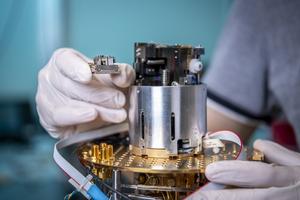
Quantentechnologie: Diese optische Schnittstelle für einen Quantenspeicher wird ein wesentlicher Bestandteil von zukünftigen Quantennetzwerken sein. (Foto: Markus Breig, KIT)
Credit: Markus Breig, KIT
More information on KIT’s exhibits can be found in KIT’s digital press kit for Hannover Messe 2026 .
“How we get around, communicate, or generate energy – much of this is currently being rethought. At KIT, we find answers to these fundamental changes in our everyday lives,” says Professor Jan S. Hesthaven, President of KIT. “ At the world’s largest industry trade fair, we will therefore showcase groundbreaking technologies for the future. Visionary modes of travel, new options in robotics, decisive steps on the way towards the first nuclear fusion reactor, or secure communication via quantum networks: KIT will demonstrate what is possible when the best minds from around the world use our excellent research infrastructures.”
On Tuesday, April 21, 16.15 to 17.00 hrs, Hesthaven will participate in a panel discussion on “European Defence: How We Build the Industrial Landscape We Need” in Hall 25, Center Stage.
Technology Developments Presented by KIT
Tritium Breeding Blanket – The Heart of a Nuclear Fusion Reactor
Nuclear fusion is deemed a key technology for the secure, climate-friendly energy supply in future. KIT researchers contribute to it by working on the heart of the reactor, the tritium breeding blanket (TBB). It is located between the plasma having a temperature of 150 million degrees Celsius and the near-zero superconducting magnets confining the plasma. This temperature difference poses a big technical challenge. At the same time, the TBB has to generate the tritium fuel that is indispensable for nuclear fusion. Development of the components opens up new perspectives for industry, examples being the production of durable materials and precision manufacturing technology.
photreon – Hydrogen from Nothing but Water and Sunlight
A photoreactor panel developed by KIT allows to produce hydrogen from nothing but water and sunlight. photreon’s patented design is suitable for mass fabrication of large batches and enables scalable production of low-cost green hydrogen. In this way, photreon makes the use of green hydrogen economically efficient and strengthens the competitiveness of companies and industry locations in Germany.
Compressorless Gas Turbine – Record Runtime for Green Electricity Generation
An innovative compressorless gas turbine is setting new standards for the use of hydrogen in energy supply. The detonation burner based on pressure-gain combustion technology achieved a record runtime of 303 seconds, which surpasses the previous NASA record of 250 seconds. No additional energy is required to compress the air prior to ignition. Unlike natural gas, hydrogen can be produced using renewable energy. With the compressorless gas turbine, KIT has taken an important step towards efficient, high-performance technology for green electricity generation using hydrogen.
Calibration of Vision-guided Industrial Robots – Fully Automatic, Fast, and Accurate
Use of industrial robots is standard in manufacture. When they are equipped with cameras, they can react flexibly to their environment. Robot calibration is essential in applications requiring a high accuracy: The robot’s geometry is determined, which means that the kinematic parameters are calculated. A new calibration method developed by KIT in cooperation with MVTec Software GmbH utilizes therobot’s existing camera for calibration – a fast and inexpensive method to reach high accuracy for vision-guided robots.
Precise Collaborative Robotics – With Optimally Distributed Forces
Through collaboration in production, physically coupled industrial robots enable complex manufacturing processes that have only been realized with conventional machine tools so far. Researchers of KIT, in cooperation with FZI Research Center for Information Technology, have developed a new control system that couples two robots, distributes the forces between them optimally, and regulates internal stresses. As a result, high manufacturing accuracies are achieved.
Multi-material Ceramics – Additive Manufacture for High-tech Applications
A material system developed by KIT allows to combine two different ceramic materials in a single part printing process. This is the basis for multi-material additive manufacturing (MMAM). In this way, various functional, mechanical, electrical, or thermal properties can be merged specifically. Highly precise hybrid ceramics with locally varying properties, such as a hard edge and a porous core, are obtained. No additional mechanical finishing steps, such as milling or drilling, are required.
Open Flow Electrolysis Cell – For the More Sustainable Production of Chemicals
Partners from research and industry have established the ETOS innovation network to work on new processes making chemical production more sustainable. The focus lies on the power-to-chemicals concept, i.e., on using electrical energy, ideally from renewable sources, to produce chemicals. This will enhance the cost efficiency, safety, and ecological compatibility of chemical production processes. The open flow electrolysis cell is based on electrochemical synthesis processes in the flow mode. The reaction solution continuously flows through the cell and passes two electrodes. The electrical power applied there triggers the desired chemical reaction.
Quantum Networks – Secure Communication
Secure communication is indispensable in modern digital infrastructures. Quantum networks offer entirely new possibilities: They distribute secret keys for encryption by means of individual photons, with the laws of quantum physics ensuring security. Quantum key distribution encodes information into the quantum states of light. Any attempt to intercept communication inevitably changes these states and is therefore detected immediately. At KIT, researchers develop central technologies needed for the practical implementation of quantum communication.
mu-zero HYPERLOOP e.V. – Students Working on Future Mobility
Transport capsules move at high speed through largely evacuated tubes – this is the hyperloop concept. Initiatives all around the world focus on the hyperloop, among them the student club mu-zero HYPERLOOP e.V. at KIT. Hyperloop may establish itself as a fifth mode of transportation for future mobility along with road, rail, water, and air vehicles. Hyperloop considerably reduces travel time, energy consumption, and land use compared to conventional means of transportation.
KIT at Other Stands
The latest generation of the KIT-developed ARMAR robot family will present itself at Stand B59 of the Federal Ministry of Research, Technology, and Space (BMFTR) in Hall 11. The humanoid robot ARMAR-7 learns from humans and from own experience, and even understands language.
At the “German Pavilion – Baden-Württemberg“ in Hall 12, Stand E63, CELEST, a research platform for electrochemical energy storage, presents itself. CELEST is operated by KIT and partners. In addition, the Karlsruhe Mobility High Performance Center (KAMO), in which KIT is involved, will be presented. It focuses on forward-looking mobility and logistics solutions.
KIT-Gründerschmiede (KIT’s Founder Forge), one of the biggest university-based startup centers in Germany, will showcase ten startups in Hall 11, Stand D40. Every day, two KIT startups will present themselves at the trade fair: BEnergy GbR and SciValon GbR, nanoshape GmbH and smada GbR, Spotium GmbH and SuperHeated GbR, adjusted flow GmbH and KCM GbR, Photreon GbR and OSS Onsite Solutions GbR.
KIT in the Conference Program
Spotlight Stage at the “Solution Lab”, Hall 12, Stand F56
Monday, April 20, 15:20 hrs: Lecture “The Sun as a Source of Hydrogen – How Hydrogen Is Produced from Nothing but Water and Sunlight”
Paul Kant, Institute for Micro Process Engineering, KIT
Center Stage in Hall 25
Tuesday, April 21, 16:15 hrs: Panel discussion “European Defence: How We Build the Industrial Landscape We Need”
Professor Jan S. Hesthaven, President of KIT; Dr. Michael Schöllhorn, Chief Executive Officer, Airbus Defence and Space; Sven Weizenegger, Head of Cyber Innovation Hub der Bundeswehr, BWI GmbH; Robert de Groot, Vice-President European Investment Bank
Expert Stage at the “Solution Lab“, Hall 11, Stand B69
Wednesday, April 22, 10:50 hrs: Lecture “Calibration of Vision-guided Industrial Robots“
Professor Markus Ulrich, KIT Institute of Photogrammetry and Remote Sensing
Thursday, April 23, 15:20 hrs: Lecture “Versatile Binders for the Next Generation of Additively Manufactured High-performance Ceramics“
Professor Frederik Zanger, KIT wbk Institute of Production Science
For information, click KIT’s Digital Press Kit for Hannover Messe 2026
Information on Hannover Messe 2026
In close partnership with society, KIT develops solutions for urgent challenges – from climate change, energy transition and sustainable use of natural resources to artificial intelligence, sovereignty and an aging population. As The University in the Helmholtz Association, KIT unites scientific excellence from insight to application-driven research under one roof – and is thus in a unique position to drive this transformation. As a University of Excellence, KIT offers its more than 10,000 employees and 22,800 students outstanding opportunities to shape a sustainable and resilient future. KIT – Science for Impact.