
Pulse Alternative
Bonds

Bond Strategists Warn Yields to Stay High Even If Iran War Ends


(Bloomberg) — For all the hand-wringing over war-related inflation fears, there are signs that other drivers are having as much a bearing on longer-term borrowing costs.

Most Read from Bloomberg

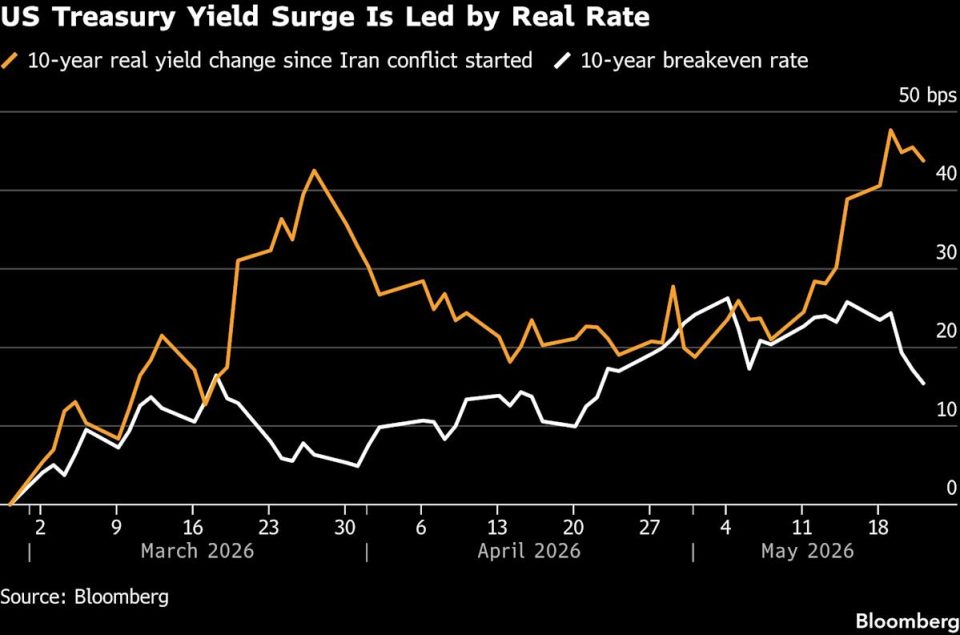
In the US, so-called real yields, which strip out inflation, have had a greater impact, indicating bond investors aren’t just worried about price pressures from the Iran war.

Other culprits include signs already large public debt burdens will swell even further, fallout from the AI investment boom and the mounting chance central banks such as the Federal Reserve will raise rather than cut interest rates.

The speculation, underscored by a Bloomberg analysis and highlighted by strategists at ING Bank NV, Goldman Sachs Group Inc. and Barclays Plc, is that the recent jump in some long-term yields will not fully reverse even if the inflation spurred by costlier oil retreats.

That risks keeping market borrowing costs elevated around multi-year highs even after the conflict ends, maintaining pressure on governments and economies.

“The argument that duration is selling off globally due to inflation fears is hard to square with market pricing of medium- and long-term inflation risk,” said Jonathan Hill, head of US inflation strategy at Barclays. “Instead, the interaction between rising debt levels, potentially higher neutral rates, and AI could be driving real rates higher.”

The so-called neutral rate is the level which neither spurs nor slows the economy.

While the surge in oil prices may be capturing headlines, breakeven rates that measure the inflation expectations of bond-markets haven’t risen as far as overall rates in the US and UK.

Hill notes even with the war underway, 10-year breakevens in the US are 50 basis points below where they were in the first half of 2022, when the Fed was jacking up rates. And the so-called 5-year, 5-year breakeven rate, a proxy for market-based measures of medium-term inflation expectations, are around where they were in December, at 2.2%.

At Bank of America Corp., economists Claudio Irigoyen and Antonio Gabriel are monitoring shifts in the yield curve to determine what’s moving bond markets. That’s the gap between long- and short-term yields.

“In an environment where Fed could potentially be on the table and become a driver of even larger fiscal deficits amid rising debt servicing costs, the long end of the curve becomes more sensitive to what should be primarily a move in short-end rates,” they said.

Subtracting inflation-adjusted yields from nominal rates leaves real yields, seen by some in the market as a truer measure of borrowing costs. A Bloomberg analysis shows rising real yields explains most of the move higher in overall yields in the US, while inflation is to be the major influence in Japan and Germany.

Such trading means that even if the Strait of Hormuz, a critical chokepoint for global energy flows which has been closed by the war, is eventually opened, long-term rates “could find themselves a tad stranded at elevated levels” as real yields stay high, said Padhraic Garvey, regional head of research for the Americas at ING.

He reckons the “entire” break in 10-year US yields beyond 4.5% has come from higher real yields. The US benchmark neared 4.70% on Tuesday before pulling back to 4.56% on Friday.

“A reopening of the Strait would cap inflation expectations, but could leave real yields elevated, and if so, then Treasury yields don’t collapse lower as many currently anticipate,” said Garvey.

“The bond market is not reacting to one headline,” Mark Malek, chief investment officer at Muriel Siebert & Co. wrote in a note to clients. “It is repricing a structural problem that cannot be solved with a press release or diplomatic pause.”

Reasons to expect yields to stay lofty in the US include President Donald Trump’s push to cut taxes, adding to an already large debt burden and subsequent need to sell Treasuries, as well as his ongoing trade war stymieing supply chains.

In an interview last week with Bloomberg Television, Jamie Dimon, chief executive officer of JPMorgan Chase & Co., said US interest rates may climb much further, citing concern about government borrowing and demand for the debt.

To Phillip Lee, head of real money rate sales at Goldman Sachs, persistent fiscal deficits, more Treasury issuance and concerns over debt sustainability increasingly explain why investors are demanding extra compensation to own long-term debt.

“I think rates are going higher,” he said on a Goldman podcast.

Having begun the year betting the Fed would cut rates, traders now wager it will have to hike this year, even with Kevin Warsh having become chair.

While AI may eventually help ease inflation by spurring productivity, bond traders fret its short-term impact is to fan inflation as tech companies suck up semiconductors and open massive data centers, while also flooding the market with their own debt.

Higher economic growth from an AI boom would also likely leave investors favoring equities, leading asset allocators to look for higher yields from bonds to compensate.

Hill at Barclays says the neutral rate might have risen, which would also justify higher yields with 5% rates on 10-year Treasuries no longer reflecting a “bargain.”

What Bloomberg Economics Says…

“At a fundamental level, interest rates are determined by the balance between global saving and investment. For five decades, the desire to save was increasing and the need to invest was trending down – that helped push global borrowing costs lower. Now, the reverse appears to be true, and we should expect higher interest rates than we became accustomed to in the post global-financial crisis era”

— Jamie Rush, director of global economics

Click here for more

In Japan and Germany, rising breakeven rates have accounted for most of the increase in 10-year yields since the start of the war, the data show.

While Europe is facing higher gas prices, inflation pressure in Japan mounted even before war broke out. Now, the Bank of Japan reluctance to hike rates is forcing investors to demand more compensation for inflation risks, the analysis suggests.

In the UK, Keir Starmer faces mounting challenges to his premiership which could result in more expansive fiscal policy and gilt issuance just four years since the market witnessed a dramatic selloff under then Prime Minister Liz Truss.

“You want to take a long-term thesis on it, but you almost have to be tactical trading gilts” just because of the rise in political uncertainty, John Sidawi, a senior portfolio manager at Federated Hermes said in an interview. “There’s always going to be an embedded premium in gilts relative to other developed markets.”

–With assistance from Ye Xie and Alice Gledhill.

Most Read from Bloomberg Businessweek

©2026 Bloomberg L.P.


Source link

Related posts

Fat Brands’ lenders demand immediate payment on $1.3B in debt

George

Mega muni bill explored | Bond Buyer

George

What Actually Makes A Muni 'High Yield'? – Seeking Alpha

George

Leave a Comment