
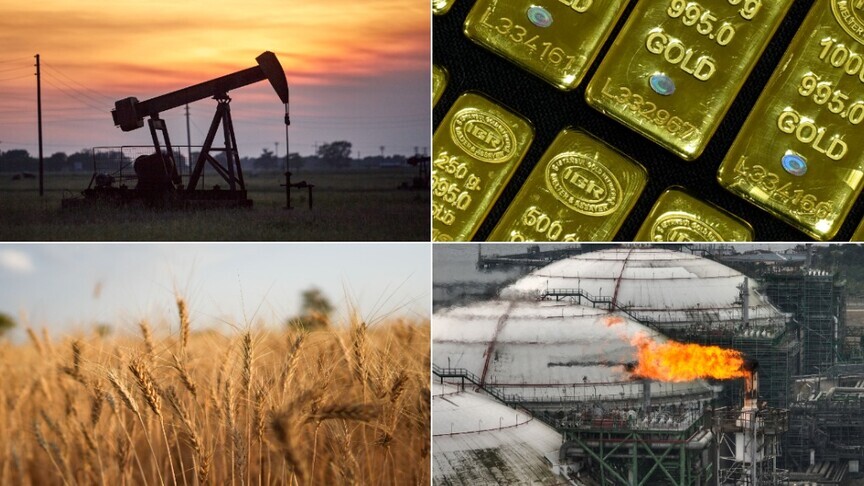
- Precious metals volatile as investors shift between gold and US dollar
- Agricultural markets rise as fuel, fertilizer costs ripple through supply chains
Commodity markets diverged sharply in the first quarter of the year, as the US-Israel war on Iran and rising geopolitical tensions reshaped global supply chains and investor behavior.
While energy and some industrial metals surged on supply fears, precious metals saw volatile swings and agricultural commodities reacted to rising costs and disrupted trade flows.
At the center of the shift was the disruption of the Strait of Hormuz, a critical chokepoint for global energy and industrial supply.
Energy, aluminum surge on supply shocks
Energy markets recorded the strongest gains.
Brent crude reached $119.5 per barrel, up 47.2%, its highest since June 2022, while US benchmark West Texas Intermediate surged 76.6%.
Natural gas prices also spiked, with Dutch TTF contracts rising 96.2% to €50.3 ($58.73), the highest level since January 2025.
The gains were driven by disruptions to maritime traffic in the Strait of Hormuz, as well as production outages across the Gulf.
Qatar’s suspension of output alone removed around 20% of global liquefied natural gas (LNG) supply from the market.
Among industrial metals, aluminum stood out, jumping 18.3% to a four-year high as supply concerns intensified.
Around 10% of global aluminum production is concentrated in the Persian Gulf, leaving the market highly exposed to regional instability.
An Iranian strike on Emirates Global Aluminum’s Al Taweelah smelter further tightened supply. The plant, with an annual capacity of 1.6 million tons, is expected to remain offline long term, potentially shifting the already tight global market into a deficit of 1.3 million tons.
Precious metals volatile despite safe-haven demand
Precious metals posted mixed performance, reflecting competing pressures from safe-haven demand, rising bond yields and a stronger US dollar.
Gold rose 8.2% in the first quarter, while silver gained 5.7%. However, both metals saw sharp declines in March as higher oil prices fueled inflation concerns and pushed bond yields upward.
Gold hit a record high of $5,598.09 per ounce before retreating to $4,099.52 – its lowest level since November 2025. Silver showed even greater volatility, rising to $121.7 before falling to $61.
Tensions between Europe and the US over the potential annexation of Greenland, trade uncertainties, concerns over high valuations in technology and artificial intelligence stocks and strong central bank demand all supported gold and silver earlier in the quarter.
Silver, which has both industrial and safe-haven uses, remained especially sensitive to supply constraints, including falling inventories in the US COMEX market and expectations that mined supply may fall short of demand.
However, after the Iran war broke out, investors increasingly turned to the US dollar as a safe haven, limiting further gains.
Platinum and palladium, which also saw price spikes at the beginning of the quarter, ended up declining 4.6% and 7.3%, respectively, weighed down by a stronger dollar and expectations that interest rate cuts may be delayed.
Base metals mixed on economic concerns
Base metals showed a more uneven performance.
Copper edged down 0.2%, as a stronger US dollar and concerns over slowing global economic activity due to geopolitical risks dampened demand.
Nickel fell 2.5% following signals from Indonesia that it may ease production quotas, increasing supply expectations.
Lead dropped 11.3%, while zinc rose 16.7% despite high inventory levels in China, as supply pressures outweighed weak demand signals.
Agriculture tracks energy shock
Agricultural commodities largely followed energy markets, as rising fuel and fertilizer costs fed through to prices.
Around one-third of global trade in fertilizer inputs passes through the Strait of Hormuz, making the sector particularly exposed to the disruption.
Wheat surged 21.5% to $6.5175 per bushel – its highest since June 2024 – due to the logistical disruptions in the Gulf.
Corn rose 4%, driven in part by increased demand for biofuels as oil prices surged.
Meanwhile, soybeans gained 11.8% per bushel as US farmers shifted planting decisions in response to higher fertilizer costs.
Rise also saw a 11.4% rise per bushel over the same period.
Cotton rose 8.9% amid drought concerns in Texas, while sugar increased 3.4% due to seasonal production risks in Brazil.
Not all agricultural commodities followed the upward trend.
Coffee fell 14.3% on improved supply conditions following rainfall in Brazil, while cocoa plunged 45.6% due to strong harvest expectations in West Africa and weaker demand.
*Writing by Emir Yildirim