
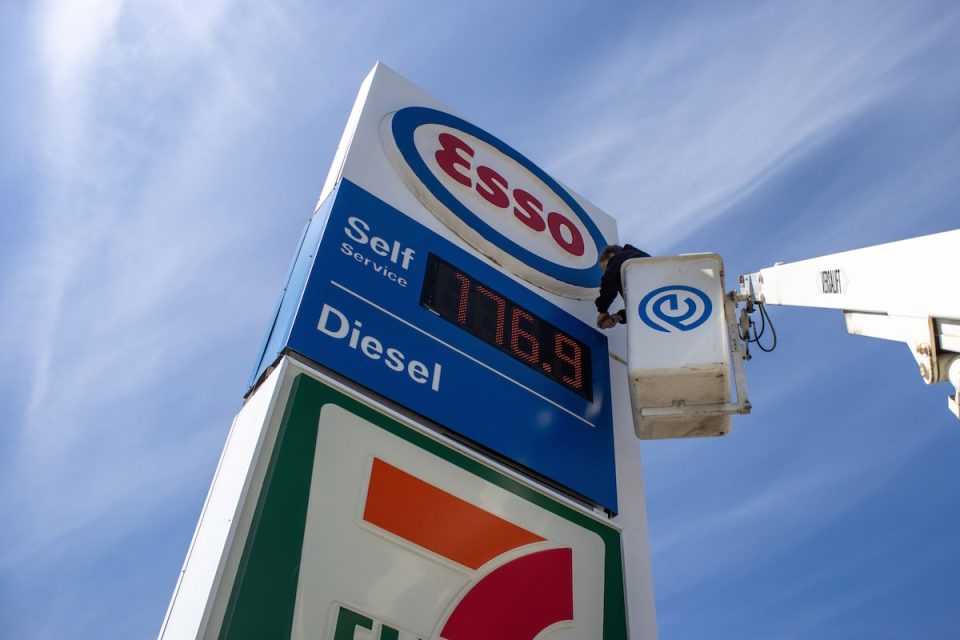
Higher prices for gas and other items have money managers thinking about inflation-proofing portfolios.Amanda Erickson/The Globe and Mail
Investors may be worried about a rerun of the high inflation and low growth experienced in the 1970s, leading to defensive allocations in their portfolios.
“It’s a bit of a similar story,” says Brent Joyce, chief investment strategist and managing director at BMO Private Wealth, pointing to the war in Iran spiking energy prices today as conflict in the Middle East did in the 1970s.
Yet, 2026 is a very different world from 50 years ago, he adds.
“We may use more energy in aggregate because the world economy is bigger, but we’re much more efficient,” he says about concerns over another energy crisis.
Other inflation drivers today weren’t around in the 1970s. A recent report from Purpose Investments Inc. says the build-out of artificial intelligence is pushing the price of semiconductors and related components – as well as energy – significantly higher than two years ago.
All of that gives advisors pause, reflecting whether portfolios require inflation-proofing.
Yet, that’s challenging because “there is no silver bullet,” Mr. Joyce says.
What’s more, there’s no consensus on the outlook for inflation.
Among those seeing a potential rerun of 1970s inflation is retired fund manager Jonathan Baird, editor of the Global Investment Letter.
“Inflation is being underestimated regarding how enduring it could be,” he says.
It may not be as high as 50 years ago, but it could be a drag on growth for a long time.
“Bond markets are certainly saying inflationary pressures are rising.”
Yields are as high as they were when inflation spiked in 2022, but today’s drivers, present before March, are less transitory, and the “war is gas on that fire,” he adds.
What’s more, “because the global economy is so heavily indebted, rising interest rates are likely to be even more painful,” leading to slow growth.
He says the 1970s experience can be instructive for portfolio design.
Mr. Baird holds gold, copper and silver, among other commodities, in his portfolio. Gold is less an inflation hedge than one against fear.
Yet, it has seen rising demand from central banks amid concerns about inflation and geopolitical risks.
Silver has greater industrial use than gold (in AI and battery technology) and has “been in [supply] deficit now for years.” Copper has the same tailwinds and supply constraints, he adds.
All commodities generally fare well during high inflation, but “they don’t rise because of it,” says Tim Pickering, founder and chief investment officer at Auspice Capital Advisors Ltd. in Calgary.
“They’re often the source of inflation,” says Mr. Pickering, whose firm manages commodity strategies including CI Auspice Broad Commodity ETF CCOM-T, an alternative fund offering exposure to commodities using futures contracts and derivatives.
That was less true in 2022, when demand-pull inflation emerged from post-pandemic revenge spending, he says. Today, higher wages and inputs (i.e. commodities) are driving cost-push inflation.
This situation is more challenging for central banks to manage, he says, and likely to be an issue for the next decade.
Mr. Pickering also says the global economy is entering another commodity super-cycle, driven by rising demand and a lack of production capacity.
The challenge for investors is that commodities are exceptionally volatile and each has its own sub-cycle. “Getting the right mix is important,” Mr. Joyce says.
He agrees that commodities are an inflation hedge but is less convinced a super-cycle is coming, at least not one like in the 2000s that was driven by China’s economic growth.
Active strategies and shorter durations
Mr. Pickering says passive exposure through commodity indexes can be risky, as some indexes “react brilliantly to an event like Iran and the Strait of Hormuz, but then drop violently.” He says the commodity sleeve in a portfolio requires active management.
Grant White, portfolio manager and investment advisor with iA Private Wealth Inc., says client portfolios have a 10 per cent allocation to commodities, actively managed by a third party. The allocation is more for diversification than inflation-proofing.
“We haven’t altered portfolios because of inflation,” says Mr. White, who is also managing partner of Endeavour Wealth Management in Winnipeg.
Still, clients’ fixed-income allocations, which are also managed by subadvisors running actively managed strategies, hold shorter durations to protect against rising interest rates.
Non-benchmark-constrained active strategies are better than passive approaches at adjusting duration in response to changing conditions, says Andrew Norelli, managing director at J.P. Morgan Asset Management.
The U.S. asset manager recently launched JPMorgan Income Active ETF JPIE-T in Canada, which has “a lot of freedom to adjust” to inflationary pressures, he says, noting the portfolio’s average duration is 2.7 years.
Although Mr. Norelli does not foresee a 1970s repeat, the strategy is positioned for inflation higher than 2 per cent because of several factors.
Even before the war, the U.S. had “some heat from demand-pull inflation from a more resilient economy than many economists thought,” he says. “And then a war is inflationary on top of that.”
Although shorter durations can mitigate the risk from interest rate hikes, Mr. Joyce says the best tool to fight higher inflation, generally, is equities.
“Companies are inside the inflation machine” with the ability to raise prices, he says. “Even a broad basket of stocks has historically kept up real purchasing power net of inflation.”