
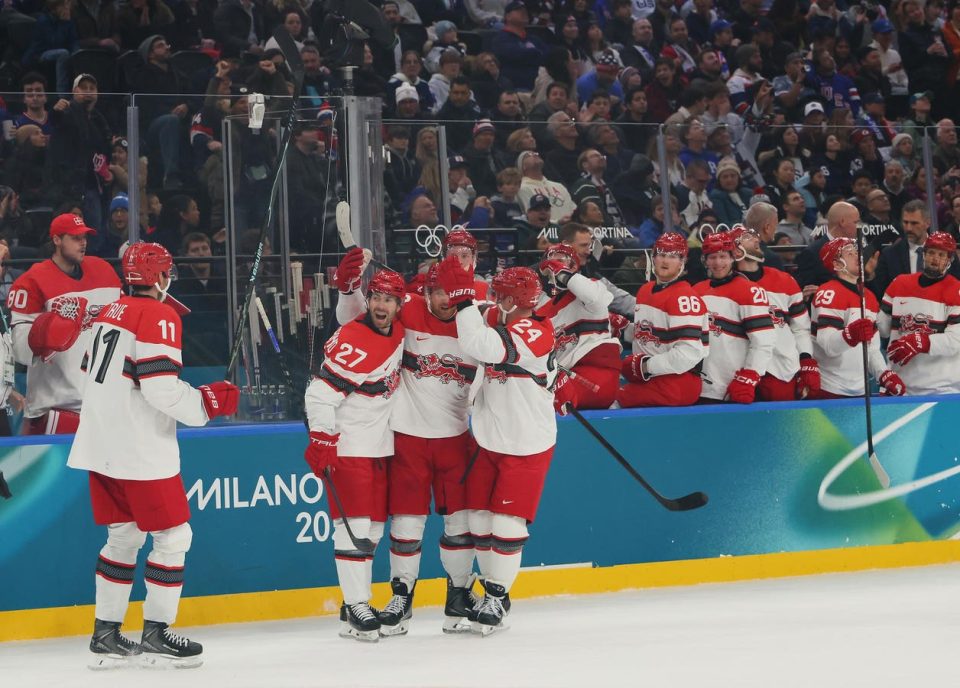

MILAN, ITALY – FEBRUARY 14: Phillip Bruggisser #42 of Team Denmark celebrates with teammates after scoring a goal in the second period during the Men’s Preliminary Group C match between the United States and Denmark on day eight of the Milano Cortina 2026 Winter Olympic games at Milano Santagiulia Ice Hockey Arena on February 14, 2026 in Milan, Italy. (Photo by Bruce Bennett/Getty Images)
Getty Images
“This was not just a matter of getting the logo on a jersey,” said Michael DuPont, chief executive of the Danish Ice Hockey Union, on the On The Margin podcast. “This was something we could build a product on top of, together, that we could use for the future, mostly for the fans.”
His new partner is the blockchain company Concordium, and it is paying its sponsorship fee in CCD, its own token, not a stablecoin. The federation is holding the coins. According to Concordium’s announcement, unveiled around the 2026 IIHF World Championship and repeated across outlets including the National Law Review and Cryptopolitan, the fee settles on-chain with a 12-month protocol-level lock-up and full self-custody by the federation, which becomes the team’s official AI partner with category exclusivity and branding on the helmet and jersey. “It settled in our native token, CCD,” said Varun Kabra, Concordium’s chief growth officer. The size of that payment was not disclosed, in the announcement or in any of the coverage that followed.
What the federation agreed to hold is worth a look. CCD trades about 94% below its all-time high of roughly nine cents, set in February 2022, according to CoinMarketCap. Its market value sits near $66 million, outside the top 300 cryptocurrencies, and daily volume runs around $400,000, thin by any standard, with most of it on the exchange MEXC. This is the asset whose price the payout now tracks for a year.
DuPont said the federation went in with eyes open. “We have been having a long dialogue with Concordium regarding the payment,” he said. “We feel quite confident, with the response that we had to our questions, that this is a safe investment. What we invest is the brand of the association.” The one-year frame is deliberate. “That’s why we do this as a one-year partnership in the beginning,” he said. “We want to see what this technology can create for the fan experience. And we are building this together as we go.”
Branded crypto deals in sport carry a warning label. DigitalBits’ roughly 85-million-euro shirt sponsorship of Inter Milan unraveled in 2022 after the company missed a 16-million-euro payment and the club pulled its logo mid-season, according to Ledger Insights. FTX’s $135 million naming-rights deal for the Miami Heat arena was torn up after the exchange’s 2022 bankruptcy, leaving the local county owed millions. Crypto broker Voyager’s deal with the Dallas Mavericks ended in its own collapse. Regulators have noticed the pattern. On June 3, days before this season’s marquee events, the UK’s Financial Conduct Authority warned about crypto firms sponsoring football clubs. “Clubs should not let unauthorised financial firms exploit that loyalty by putting potentially dodgy products in front of millions of fans,” said Lucy Castledine, the FCA’s director of consumer investments. Kieran Maguire, a football finance lecturer at the University of Liverpool, has put it more bluntly, describing crypto investing as “gambling with a small g.”
The pilots underneath the deal are the reason DuPont says he signed. The first is a “verified fan” program. The second is what Concordium calls agentic commerce, where an AI agent buys tickets and pays for a fan it can prove is a real person. Both are announced plans, not deployed systems.
Kabra explained the identity idea with a pub. “Imagine you go into a pub and they ask to see your ID. You show your driver’s license, and the person checking gets to see your name, where you live, all the other details, which they don’t need to. All they need to understand is, are you allowed in the pub.” He sells the version where you prove only that. “You give the person outside a blue ticket. The blue ticket proves you’re above 18. And because it’s a blockchain, it’s an auditable proof,” he said, so a regulator can confirm the checks happened without learning who showed up. He does not call it tracking. “There is a term called selective disclosure,” he said.
Sport has tried blockchain ticketing before, with mixed results. The Royal Dutch Football Association ran a pilot in 2019, and UEFA trialed it from 2018. “While blockchain ticketing is still in its early stages, it holds great potential for the future,” Stefan Van Hoof, the Dutch federation’s head of ticketing, said at the time. Researchers later found the catch. A blockchain ticket on its own “can be bypassed by simply transmitting the private key,” a 2022 study from Germany’s Fraunhofer Institute and the University of Bayreuth concluded. Tying a ticket to a verified identity, which is what Concordium proposes, is the binding layer those earlier experiments lacked.
DuPont’s problem is the absence of any binding at all. “We don’t have any information regarding who is actually entering the rink, who is buying the tickets,” he said. “We saw an example in soccer a couple of weeks ago in Denmark,” where fans got in “with some fireworks, which is not allowed,” and “managed to stop the game for several minutes.” Was he comfortable keeping people out? “We only want the real fans to enter,” he said.
Is this a surveillance ID by another name? Kabra has heard it before. “I always think of privacy and anonymity as completely different things,” he said, pointing to his years at the privacy company Proton. “We believe at Concordium in the business of privacy, not in anonymity.” Every account is tied to a verified human, “but because there is selective disclosure, nobody knows it is you.” A separate provider holds the IDs, not Concordium, and prying one loose takes “a Swiss court order.” “Anonymity attracts bad actors. Privacy does not attract bad actors,” he said. “Privacy is a fundamental right, but it means you are in control and at the same time answerable to law.”
The agent pilot reaches well past the rink. “AI assistants are booking your travel, managing your calendar. The next step is that the agents start transacting on your behalf,” Kabra said. “When an AI agent books a flight, buys a ticket, the counterparty, the airline, has no way to verify whether a real accountable human is behind the transaction. That creates the classic trust gap, and it could open a door to fraud, bots acting as humans, agents operating with no accountability.” His answer is to make the agent carry a verified human credential. “You cannot build two different worlds. Humans on one internet, AI agents on another internet,” he said. He put a clock on it too, predicting agent transactions “might overtake the human-to-human transactions” in “six to twelve months.” Treat that as his bet, not a forecast.
The pitch leans on where Concordium came from. Lars Seier Christensen, a co-founder of the Danish bank Saxo, started it in 2018 and built identity into the chain, so “you cannot get onto the chain unless you go through an ID process,” Kabra said, with the ID shielded by zero-knowledge proofs. The company drew on academic cryptographers rather than the usual crypto crowd, among them Ivan Damgård, who heads its research center at Aarhus University, Torben Pryds Pedersen, its chief technology officer and the creator of a widely used cryptographic commitment scheme, and Ueli Maurer of ETH Zurich. “Concordium didn’t come out of crypto culture,” Kabra said. “We came out of academic cryptography and institutional finance.”
DuPont is two months into the job, after a career running Danish retail. “Other sports are in front of us on digitalization,” he said, listing handball, soccer and golf. “We are maybe a little bit behind, and this maybe moves us forward.” The world championship was the announcement. The verified tickets, the agent payments, the proof that any of this makes a fan’s night easier, all of it still has to be built over the season ahead, on a budget that rises and falls with one thinly traded coin.