
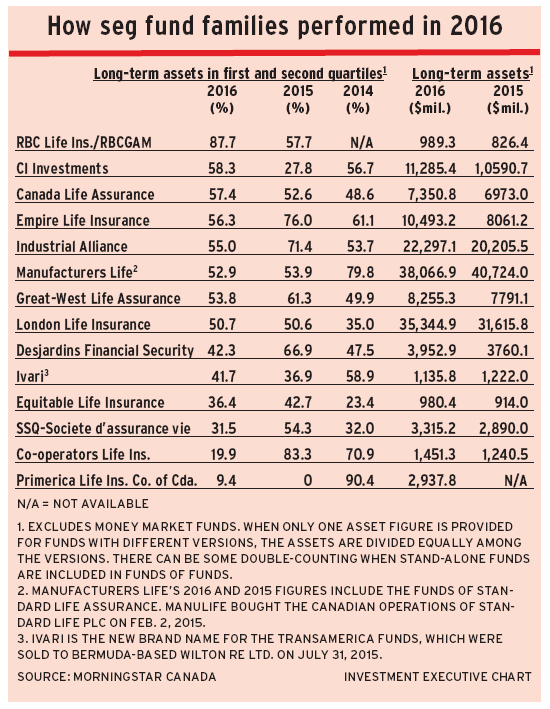
Good stock-picking was an essential ingredient in the strong performances of the segregated fund families sponsored by Mississauga, Ont.-based Primerica Life Insurance Co., Waterloo, Ont.-based Manufacturers Life Insurance Co. (Manulife) and Kingston, Ont.-based Empire Life Co. in 2014.
Primerica and Manulife are ranked first and second on Investment Executive‘s (IE) list of seg fund family performance last year, with 90.4% and 79.8%, respectively, of long-term seg fund assets under management (AUM) in the top two performance quartiles as of Dec. 31, 2014, according to data from Toronto-based Morningstar Canada.
Flexibility in asset allocation also was an important ingredient in superior performance. Empire Life is a case in point. Although its stock-picking produced excellent results, some of the firm’s funds had fixed-asset allocations – and those funds struggled last year, says Gaelen Morphet, Empire’s senior vice president and chief investment officer in Toronto.
For example, Empire Balanced Fund posted below-average performance because its mandate does not allow for shifts in asset mix. In that fund’s case, the component parts – specifically, Empire Bond Fund, Empire America Value Fund and Empire International Equity Fund – all had above-average performance; but the fixed-asset mix meant that the return for Empire Balance Fund itself was below average.
However, only some Empire funds have fixed-asset allocations; portfolio managers of the other Empire funds were able to adjust asset mixes to reflect the macroeconomic environment. Morphet points to Empire Asset Allocation Fund’s first-quartile ranking in 2014. That fund was significantly overweighted in equities; within that equities allocation, the fund was significantly overweighted in U.S. equities.
The result was strong overall performance for Empire’s seg funds, with 61.1% of long-term seg fund AUM in funds with first- or second-quartile performance.
Primerica’s funds are managed by Caterina Prato and Tristan Sones of Toronto-based AGF Investments Inc., who have a “growth at a reasonable price” investment style. Prato and Sones begin their investing process by looking at securities of individual companies to find those with good business models that can generate solid cash flow, then overlap those with an equities asset allocation.
Meanwhile, portfolio managers at Manulife are aware of the macroeconomic environment but primarily are bottom-up stock-pickers. Many of Manulife’s seg funds are duplicates of Manulife’s mutual funds with an insurance wrapper. Thus, when the mutual fund family performs well, so does the seg fund family. For 2014, the mutual funds did even better, with 82.5% of long-term AUM in above-average performing funds vs 79.9% for Manulife’s seg funds family.
This divergence reflects differences in the two lineups, says Steve Parker, Manulife’s assistant vice president for guaranteed investment products, investments and insurance. The main difference is that Manulife offers a number of seg funds managed by third parties that aren’t offered in the Manulife mutual fund lineup. These third-party portfolio managers include Fidelity Investments Canada ULC of Toronto, whose mutual funds had 85% of AUM in above-average performing funds, and Toronto-based 1832 Asset Management LP’s Dynamic Funds, which had quite weak performance in 2014, with just 32% of AUM in above-average performing funds.
The majority of the portfolio managers at Quebec City-based Industrial Alliance Investment Management Inc. (IA) also are stock pickers first and foremost, says Pierre Payeur, director of fund management. He adds that IA’s U.S. and international equity funds performed particularly well over the past year.
In addition, Payeur adds, IA has an asset mix committee, chaired by chief economist Clément Gignac, which has been able to add “good value” through its asset-allocation calls.
IA Bonds Fund, one of IA’s biggest funds with $2.6 billion in AUM, was a second-quartile performer, thanks to the agility of its portfolio managers in positioning the average duration appropriately – “Sometimes neutral, sometimes defensive,” as Payeur notes.
Last year, IA had 53.7% of its long-term seg fund AUM in the top two performance quartiles.
In contrast, the seg fund family of London Life Insurance Co., a subsidiary of Winnipeg-based Great-West Lifeco Inc., suffered because of restricted fund mandates. Much of London Life’s seg fund AUM is in “pure” funds that invest only in specific asset classes.
For example, London Life Canadian Equity Fund invests solely in Canadian equities. However, this fund is compared with funds that can invest up to 49% of their AUM in foreign stocks. In a year such as last year, when U.S. stocks outperformed Canadian stocks, the performance of “pure” funds is almost certain to lag. London Life Dividend Fund, also a “pure” fund, faced a similar problem last year.
Because these two funds are among the biggest in the London Life seg fund family, with $1.8 billion and $2.4 billion, respectively, in AUM as of Dec. 31, 2014, the fund family as a whole had only 35% of long-term seg fund AUM in funds with above-average performance.
However, that fact doesn’t disturb George Turpie, senior vice president, investment funds, product and market development, wealth management, in London, Ont. Turpie holds that title not just London Life but also for the fund families of two other Great-West Lifeco Inc. subsidiaries: Winnipeg-based Great-West Life Assurance Co. (GWL) and Toronto-based Canada Life Assurance Co.
The pure funds are designed for use both in London Life’s asset- allocation funds and to give clients and financial advisors the ability to create their desired asset allocation mix easily, Turpie says. Achieving a specific geographical equities allocation is difficult – as is the case with asset-allocation funds and individual client portfolios – by employing Canadian equity funds that include U.S. and/or other foreign equities, particularly if the amount of foreign content can change as the macroeconomic environment changes.
Rather than making mandates more flexible, London Life is focusing on broadening its product lineup. For example, the firm launched a number of funds this past January. These include a floating-rate fund, managed by Mackenzie Financial Corp. in Toronto; a global dividend fund to complement London Life’s Canadian and its U.S. dividend funds, managed by in-house manager Setanta Asset Management; and a U.S. low-volatility fund that uses derivatives to minimize volatility, managed by Putnam Investments LLC in Boston. (Putnam is owned by GWL.) All three new funds also are offered by Canada Life and GWL.
GWL’s and Canada Life’s seg funds, which don’t contain as many pure funds as London Life’s do, performed better than London Life’s seg funds, with 49.9% and 48.6%, respectively, of AUM in above-average performing funds.
Turpie attributes the better performance to the stock-picking by in-house managers Laketon Asset Management and Setanta, both bottom-up stock-pickers, and by GWL Investment Management, which combines stock-picking with a macroeconomic overlay.
© 2015 Investment Executive. All rights reserved.