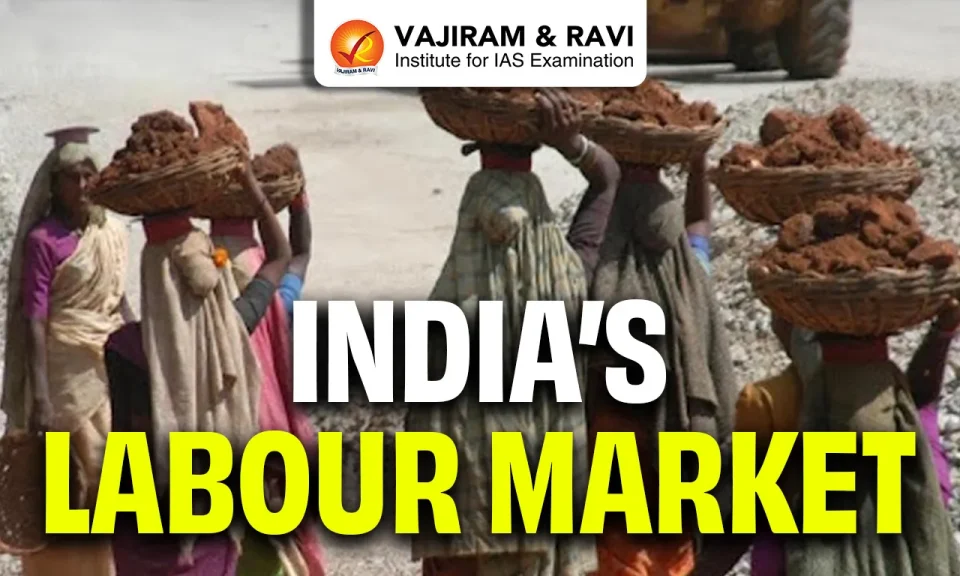
India’s labour market shows improving employment trends, rising women’s participation, but challenges in skills, job creation, and youth employment remain.
India’s Labour Market Latest News
- India adds 7–10 million young workers to its labour force each year, many of them better educated and with higher aspirations than previous generations.
- This creates a major opportunity—but also a challenge—for the economy to generate enough productive jobs, especially for youth and women.
- The Periodic Labour Force Survey (PLFS) 2025 report shows encouraging improvements in India’s labour market, while also highlighting persistent structural issues that must be addressed to fully realise the country’s demographic dividend.
India’s Labour Market Shows Positive Momentum
- Strong Employment Indicators – India’s labour market shows encouraging headline numbers, with labour force participation at 59%, workforce participation at 57%, and unemployment at a low 3%, indicating overall improvement in employment conditions.
- Youth and Women’s Participation Improving – Youth unemployment has declined since 2024, while women’s labour force participation—especially in rural areas—has steadily improved, reflecting stronger workforce inclusion across successive survey rounds.
- Shift Towards Better Quality Jobs – The share of regular salaried employment has increased, while self-employment has declined. This suggests a gradual move toward more stable jobs that offer better income security and social protection.
- Women’s Earnings Are Rising Faster – Women’s wages have grown faster than men’s across salaried, self-employed, and casual work categories, indicating improving economic opportunities, though significant gender pay gaps still remain.
- Structural Shift Beyond Agriculture – Agriculture’s share in employment is declining, while manufacturing and services are expanding. More young workers, especially women, are entering these sectors, signalling gradual structural transformation in the economy.
- Greater Social Inclusion in Employment – Occupational segregation based on caste and gender is lower among younger workers, suggesting that better education access and rising social mobility are making the labour market more inclusive.
Key Challenges in India’s Labour Market
- Weak Education-to-Employment Transition – Although more young Indians are accessing higher education, job absorption remains inadequate. A significant gap persists between the number of graduates entering the labour market and those actually finding employment.
- For instance, between 2004 and 2023, roughly 5 million graduates entered the labour market annually, but only about 2.8 million secured employment of any kind.
- Limited Skill Training – Formal vocational and technical training remains scarce, with only a small share of the working-age population receiving it. However, those with such training show much higher workforce participation, highlighting the urgent need for skill expansion.
- Only 4% of individuals aged 15-59 have received formal vocational or technical training.
- Structural Barriers to Women’s Employment – Despite improving participation, women continue to face constraints due to childcare and household responsibilities. The unequal burden of unpaid domestic work limits their ability to remain consistently engaged in paid employment.
- Yet among those who have, workforce participation is substantially higher — 83% for men and 51% for women .
- Persistent Gender Workload Inequality – Women often work fewer paid hours than men because they shoulder additional unpaid labour at home, reflecting the continuing double burden that restricts their economic participation and earning potential.
- For instance, urban self-employed men work approximately 17.5 hours more per week than women, and in regular salaried employment, the gap is about 7.9 hours per week.
Large NEET Population
- NEET stands for “Not in Education, Employment, or Training” and refers to young people (typically aged 15-24 or 15-29) who are economically inactive, jobless, and not enhancing their skills through schooling or vocational training.
- A sizeable share of young people remain outside education, employment, and training.
- Since they are excluded from unemployment statistics, the scale of youth disengagement may be larger than headline data suggests.
The Way Forward for India’s Labour Market
- While India’s labour market is showing positive momentum, sustaining this progress will require focused policy action.
- Key priorities include expanding industry-relevant skill training, promoting women’s workforce participation through supportive measures, creating more stable jobs with stronger social protection, and encouraging employment in emerging sectors such as green industries.
- Special interventions like apprenticeship programmes will also be essential to bring NEET youth back into productive economic activity and fully harness India’s demographic potential.
Source: TH
India’s Labour Market FAQs
Q1. What does the PLFS 2025 report reveal about India’s labour market?+
Q2. What are the major challenges in India’s labour market?+
Q3. How is women’s participation changing in India’s labour market?+
Q4. Why is skill training important for India’s labour market?+
Q5. What policy measures can strengthen India’s labour market?+
Tags: India’s Labour Market mains articles upsc current affairs upsc mains current affairs

Vajiram Mains Team
At Vajiram & Ravi, our team includes subject experts who have appeared for the UPSC Mains and the Interview stage. With their deep understanding of the exam, they create content that is clear, to the point, reliable, and helpful for aspirants.Their aim is to make even difficult topics easy to understand and directly useful for your UPSC preparation—whether it’s for Current Affairs, General Studies, or Optional subjects. Every note, article, or test is designed to save your time and boost your performance.
Related Posts
Courses