
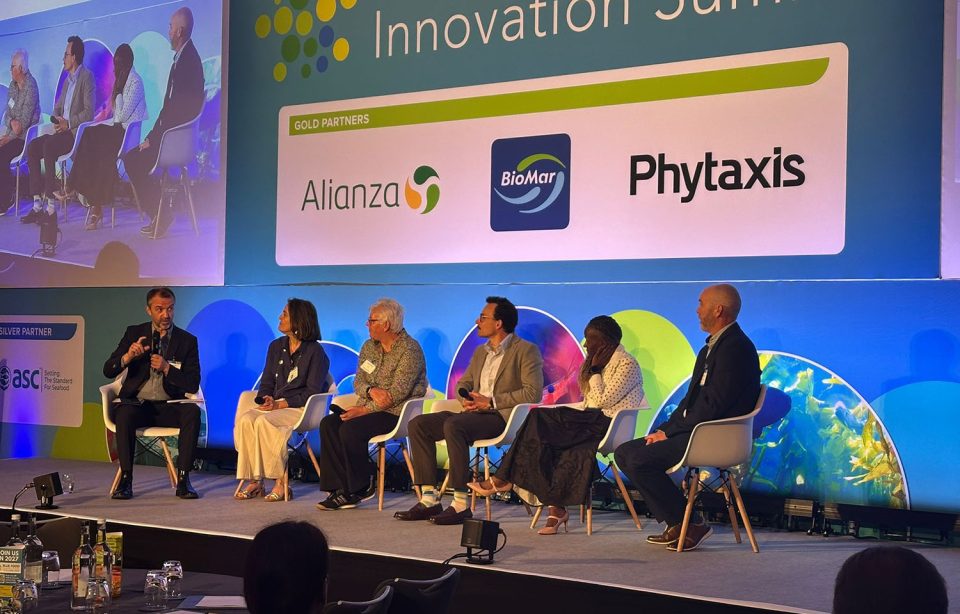
From AI-powered monitoring to genetics programs and alternative feed ingredients, aquaculture is experiencing innovative breakthroughs across the globe.
However, at the recently held Blue Food Innovation Summit in London, U.K., panelists highlighted how the challenge still lies in transitioning innovations into commercial reality.
In the session “Mind the Innovation Gap: Building Blue Food Ecosystems for Breakthroughs,” panelists focused on how to bridge that chasm, determining that it requires something the aquaculture sector often struggles to secure: investment capital willing to absorb risk and wait for returns.
According to Damian Toner, aquatech director at Ireland’s seafood development agency Bord Iascaigh Mhara (BIM), the problem is particularly acute in aquaculture because technologies often require years of testing before they generate meaningful revenue.
“Most companies can probably access seed funding through existing mechanisms,” he said. “The gap comes once you get your technology to a certain stage and you’re maybe pre-Series A [funding]. You’re trying to raise funding, and you’re probably about a year away from revenue.”
Unlike software startups, aquaculture technologies must prove themselves in the real world, Toner said.
“Developing prototypes is not cheap. Deploying them at sea for trials is not cheap. You need to run it through multiple generations to get the data you need to prove to companies that it’s worth paying you for this technology,” he said.
Toner explained BIM is currently working with around 60 Irish companies, developing technologies for salmon, shrimp, and tilapia farming worldwide, with focus areas including genetics, sensor technologies, marine engineering, and functional feeds. It also provides early-stage funding, accelerator programs, and support through partnerships with organizations such as venture capital firm Hatch Blue.
Though BIM is engaged in several projects, Toner conceded that aquaculture remains “quite a challenging investment” because of long development cycles.
“It’s a long payback, a long return,” he said. “We need to figure out how we can de-risk it a bit more.”
In addition to de-risking strategies, to ensure that return, more “patient capital” is needed, according to Gatsby Africa Program Director for Aquaculture Lucy Kimani, arguing that the challenge is even greater in emerging aquaculture regions.
Gatsby Africa has spent the last decade supporting aquaculture development in East Africa, and Kimani explained the organization responds to tensions between traditional investor expectations and the realities of aquaculture development by using charitable funding to absorb some of the early-stage risk associated with new technologies and business models.
“We see ourselves as using our philanthropic capital to bridge the gap between innovation and sector development,” she said.
Rather than focusing solely on individual companies, Gatsby evaluates innovations according to their potential to transform entire sectors.
Kimani described Gatsby’s role as helping companies understand new markets while reducing the financial risks associated with entering them. It uses grants, loans, technical assistance, and co-investment structures to support innovations in areas such as genetics, fish health diagnostics, feed production, and more.
“We see ourselves buying down that risk for market entry,” she said. “We don’t just look at the success of an individual firm. We ask how that innovation contributes to sector growth.”
Kimani highlighted Kenya’s Victory Farms, now one of Africa’s largest aquaculture producers, as an example of a company that has evolved from receiving support into becoming an innovator in its own right.
Another issue lies in investor awareness about the blue economy, with Seafood Scotland CEO Donna Fordyce highlighting that in the U.K., few investors truly understand the sector.
“Many of the investors supporting U.K. seafood innovation come from Nordic countries because they have a deeper understanding of the sector,” she said. “We also face a scale-up challenge. We are good at supporting early-stage innovation, but many companies have to go elsewhere to access test facilities and get commercialization support.”
Underlining that lack of awareness, Fordyce also noted that despite it being the country’s leading manufacturing industry, worth around GBP 103 billion (USD 138.7 billion, EUR 119.1 billion) annually, food and drink has now been “dropped” by the U.K. government as a priority in its industrial strategy.
Canada Ocean Supercluster Director of Engagement Jakub Skrzypczyk said the same issue is playing out in Canada, emphasizing that the issue is not simply the amount of capital available; many investors still struggle to understand blue economy opportunities.
“We need patient capital, but we also need competent capital,” he said. “Often, if you talk to big banks or funds, the ocean economy as a whole is still seen as miscellaneous.”
Without specialist knowledge, investors may be reluctant to support projects that require long development timelines or operate in unfamiliar sectors. As a result, many promising technologies fail to secure backing despite strong technical credentials.
The Ocean Supercluster attempts to address this through co-investment, typically funding around 40 percent of project costs and ensuring industry participation from the outset.
This model has helped support more than 160 projects with a combined value exceeding CAD 600 million (USD 433.2 million, EUR 372.1 million).
Elsewhere, the European Commission is attempting to tackle the challenge through initiatives such as BlueInvest, which connects entrepreneurs with investors, alongside support from the European Investment Bank.
Still, European Commission Deputy Head of Unit for Blue Economy Sectors, Aquaculture, and Maritime Spatial Planning Lorella De La Cruz Iglesias acknowledged that the current innovation landscape remains fragmented.
“Ninety percent of E.U. aquaculture producers are small-scale. The challenge is how to make innovation accessible and affordable for them. We also need innovation in climate adaptation, licensing systems, feed ingredients, energy transition, and species diversification,” she said. “We’ve invested significant effort in collecting and sharing knowledge from E.U.-funded innovation projects and translating that into practical guidance for both authorities and industry. Our objective is sustainable growth in E.U. aquaculture, but growth has averaged only around 2 percent annually over the past decade.”
The commission is now working toward creating clearer pathways from research and innovation to commercial products as part of its future policy framework, she advised.
“One approach we’re taking is greater use of foresight, trying to anticipate where the industry will be in 10 or 20 years and designing policies accordingly. We’re also working on a Vision 2040 for European Aquaculture, which aims to provide a long-term framework for future development,” she said.