
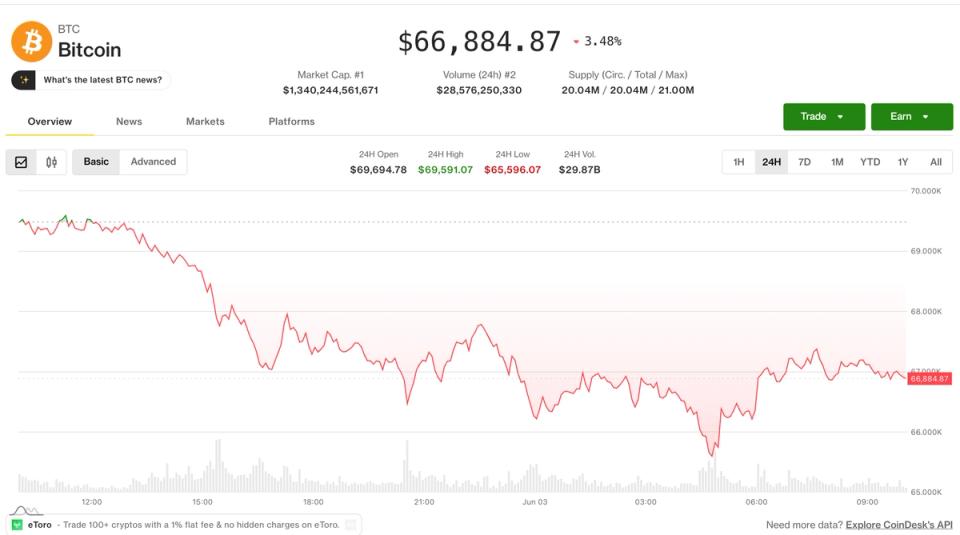
Bitcoin recovered 0.7% on Wednesday, but remains at a crucial crossroads after a 9.5% decline since Sunday.
The largest cryptocurrency traded recently near $67,000, firmly in the middle of a range that persisted between February and April after a failed breakout attempt above $81,000 last month.
If bitcoin tumbles below $60,000 it would probably trigger a wave of liquidations and a possible slide to as low as $54,000, a level of support dating back to both 2024 and 2021.
Ether (ETH), meanwhile, trades at $1,870 after rising by 0.9% since midnight UTC, although the bounce comes after a selloff that saw it tumble to its lowest point since February.
The U.S. stock market rallied to record highs again on Tuesday. The divergence is starting to trigger concerns among some crypto investors because the two asset classes have historically moved in tandem.
AI crypto tokens continued to outperform the peers. NEAR, RENDER and FET all rose by around 9% on Wednesday following Tuesday’s market-wide selloff.
Derivatives positioning
- Over $1.7 billion in leveraged crypto futures bets were liquidated in the past 24 hours, double the day-earlier amount.
- Most liquidations were bullish long positions after BTC slumped to $65,500 earlier today. The 24-hour volume surged 27% to nearly $300 million while cumulative industry-wide notional open interest (OI) fell just over 2%.
- The combination of large liquidations and falling open interest suggests aggressive crowding out of leveraged bullish plays and a reduction in new leveraged exposure.
- Open interest in bitcoin futures hovers at record highs above 800K BTC, up for the third straight day even as spot prices decline. That validates the downtrend and points to an influx of new shorts or bearish positioning.
- The seven-day OI-adjusted cumulative volume delta is negative, indicating bears are leading price action by actively shorting with market orders rather than using passive limit orders.
- Most major tokens, including ETH, ADA, SUI, XRP and SOL, also show negative seven-day and 24-hour cumulative volume deltas, signaling bear leadership across markets. Funding rates for these tokens remain slightly positive to slightly negative, implying the bearish side is not overcrowded and there’s room for further downside.
- Open interest in ZEC futures, however, has risen for the third straight day to 2.43 million ZEC as the token has gained 6.3% over seven days, bucking the broader malaise. ZEC also shows a positive 24-hour CVD alongside HYPE, indicating bullish sentiment.
- Fear is creeping back in. BTC and ETH 30-day implied volatility indices (BVIV and EVIV) jumped sharply Tuesday, posting their largest single-day gains since the Feb. 5 crash. Continued increases in the measure could presage further market pain.
- Options flow on Deribit shows traders paying up for downside protection. The one-week put-call skew climbed to nearly 20% early today, reflecting an outsized demand for puts. The most traded instruments in the past 24 hours were the $70K put expiring June 5 and the $55K put expiring June 26.
- In block flows, BTC call spreads and ETH put spreads were the most favored bets.
Token talk
- Ethena (ENA) is one of Wednesday’s top-performing altcoins, rising by 9.3% since midnight UTC and more than 20% in 24 hours after Coinbase (COIN) said it will integrate Ethena features in a new savings account product.
- There was a notable gain for privacy coin zcash (ZEC). The token has risen 2% since midnight and 12% in the past 24 hours as it attempts to steer itself away from danger.
- CoinMarketCap’s “Altcoin Season” indicator is now at 53/100, the highest since early March as investor appetite for high-risk altcoins remains despite weakness among the crypto majors.
- Humanity protocol (H) appears to be entering a corrective phase after it lost a quarter of its value in 24 hours following a 200% rally in the past week, with clear profit-taking occurring. Daily trading volume dropped 55% to $314 million.