
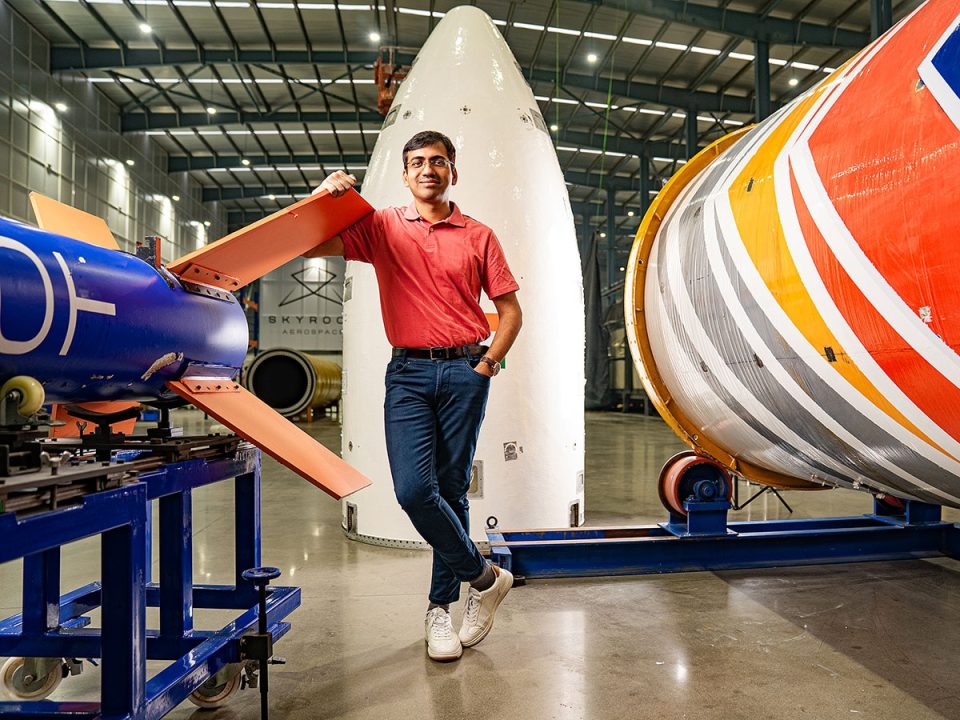
Last week, Skyroot Aerospace became India’s first spacetech unicorn, raising $60 million in fresh funding at a $1.1 billion valuation, backed by Singapore’s GIC, BlackRock and Ram Sriram, a board member of Alphabet. The capital secured goes beyond financing the imminent Vikram-I launch. It is part of a broader, long-term vision.
Skyroot CEO Pawan Chandana explains that the funds will be channelled into building infrastructure to scale Vikram-I operations, supporting a pipeline of future launches, and driving the development of the next-generation Vikram-II rocket.
Vikram-I is India’s first privately built multi-stage orbital vehicle. The four-stage rocket, designed to carry small satellites into space, is expected to lift off in the coming weeks. The heavier-lift Vikram-II will expand the company’s capabilities by ferrying larger payloads across multiple orbits.
“The presence of GIC, BlackRock and Ram Sriram on the cap table implies a thesis that India’s launch market is a multi-decade infrastructure story, not a speculative tech bet,” says Vipul Patel, partner for seed investing at IIMA Ventures.
The Three Pillars
Does India’s first space tech unicorn signal an inflection point for the sector? Six years ago, the country’s space sector had virtually no venture capital willing to underwrite deep-tech risk at scale.
Kushal Bhagia, co-founder and partner at All In Capital, a venture capital firm which has previously invested in spacetech startup PierSight, sees a broader shift in investor psychology.
“Skyroot Aerospace achieving unicorn status marks a tipping point in demonstrating that Indian space technology is a venture-scale opportunity, as opposed to only being an aspiration led by science or government,” he says.
Bhagia adds that the startup ecosystem in India is entering a new phase where deep technology innovation will be more prevalent and from this perspective, Skyroot’s milestone is “critical”. “From the perspective of the venture capital industry, it demonstrates confidence that India’s deep technology sector can produce large outcomes over an extended period of time,” he says.
Historically, India’s deep-tech sectors have struggled to attract mainstream venture capital due to long development timelines. That calculus is now changing.
Patel argues the unicorn status is the product of three converging factors—a regulatory foundation through IN-SPACe, a rapidly densifying space ecosystem, and the structural importance of the upcoming Vikram-1 orbital mission.
By successfully developing the Vikram series of rockets, Skyroot has demonstrated that a private startup can manage the intense capital expenditure and high-stakes engineering previously reserved for national agencies.
“The tag [of unicorn] only increases the expectations on the outside but the target remains the same—to build more rockets and ensure regular launches,” Chandana says.
The implications of this milestone extend far beyond the launch pad. As Skyroot scales, it creates a localised supply chain that benefits hundreds of MSMEs across India.
Dr Balbir Singh, senior assistant professor of Aerospace at the School of Mechanical Engineering and Coordinator of MIT Space Programs, notes that what Flipkart did for ecommerce or Zerodha did for fintech, Skyroot could do the same for the space tech sector. “It signals that investors now see Indian launch companies not merely as experimental startups but as long-term infrastructure businesses capable of serving global markets,” he says.
Price Anchor
The funding ripple effects could be substantial. “Skyroot’s unicorn status definitely creates a price anchor in favour of Indian space tech players,” says Patel. “Sovereign wealth funds and large asset managers tend to move in clusters, the probability that other global peers look at Agnikul or Pixxel’s next round increases,” he explains.
He also points to ANRF’s Research Development and Innovation fund as a potential catalyst for backing space economy ventures across different funding stages domestically.
Bhagia echoes this, noting that what has fundamentally changed is institutional willingness to spend time understanding these companies rather than dismissing them too early.
That patience is being put to the test. Vikram-I has already faced delays in securing a launch date in the past, prompting questions about whether Skyroot’s valuation can hold up against further setbacks or, in the worst case, a launch failure.
Investors, for their part, appear to have already modelled the downside. “GIC and BlackRock are not valuation tourists,” says Patel. “They modelled the failure case and decided the expected value was still positive. A delay is different from hard failure, which may be frustrating but not valuation-destroying.”
Chandana echoes the sentiment, adding that the valuation itself reflects this forward-looking calculus. “The valuation is based on expectations of future launches. So, all scenarios are already accounted for.”
The HAL Question
The global space economy is shifting toward mega-constellations, thousands of small satellites providing global internet, climate monitoring, and Internet of Things services. These companies don’t always need a massive heavy-lift rocket; they need “space taxis” that are agile, frequent, and affordable.
Skyroot’s Vikram-I and Vikram-II rockets are designed specifically for this niche. By targeting high-demand international markets, specifically the US and Europe, the startup aims to secure a significant foothold in a global space economy projected to reach $1.8 trillion by 2035, with India eyeing 8 percent of the total share.
However, the government’s recent transfer of small satellite launch vehicle technology to HAL has raised questions about whether state-backed competition could crowd out private players. Patel is measured when he says: “HAL is a competitor for a specific slice of the market—domestic, government-adjacent launches at the 300 to 500 kg low earth orbit band. It is not a competitor for the commercial global small-sat market that Skyroot is targeting.”