

The amount of money parked in corporate MMDA accounts at the five major banks has surpassed 111 trillion won. As uncertainty over interest rates and exchange rates continues to rise amid the Middle East war, companies are increasingly adopting a volatility-defense strategy by keeping cash in emergency accounts rather than investing it.
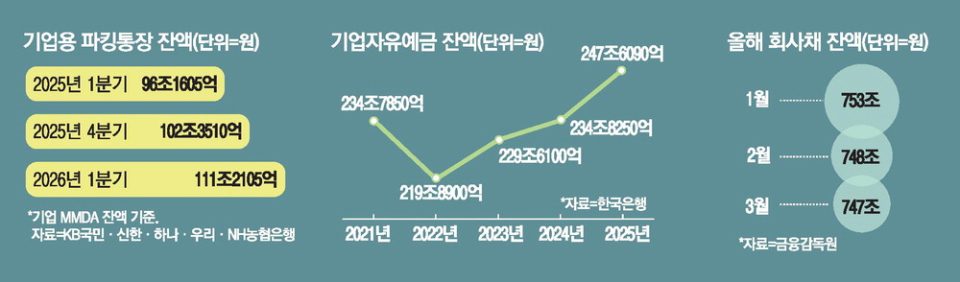
According to the financial sector on the 8th, the corporate MMDA balance at the five major banks — KB Kookmin Bank, Shinhan Financial Group, Hana Bank, Woori Bank, and NH NongHyup — stood at 111.2105 trillion won as of the first quarter of this year. That was up about 15.7%, or 15.05 trillion won, from 96.1605 trillion won a year earlier in the first quarter of last year. All five banks saw their MMDA balances increase over the past year.
MMDA, which is mainly used by corporate clients, refers to a savings deposit that allows deposits and withdrawals at any time. It is commonly used as a corporate parking savings account or emergency account. Interest accrues even if the money is deposited for just one day, and funds can be withdrawn freely at any time. Because the rate is higher than that of ordinary accounts, companies use it to hold short-term funds.
MMDA balances tend to rise during periods of heightened uncertainty. In fact, corporate MMDA balances posted a clear increase in the first quarter of this year, when the Middle East war broke out. Compared with the fourth quarter of last year, when the balance stood at 102.351 trillion won, it rose 8.7%, or 8.8595 trillion won, in just three months.
One bank official explained, “Following the impact of the Middle East war, there are concerns not only about exchange-rate instability but also about the possibility of recent interest-rate hikes.” The official added, “Given the high level of uncertainty, companies appear to be setting aside short-term funds for now as a way to defend against volatility.”
Another factor boosting demand is that MMDA rates can reach around 2%, compared with just 0.10% to 0.15% a year for ordinary commercial bank accounts. Another bank official said, “MMDA reflects rate increases faster than ordinary deposits.” The official added, “When market interest rates are expected to rise, companies use them more actively.”
This concentration of funds is not limited to MMDA accounts and is also visible across Corporate Demand Deposit accounts as a whole. According to ECOS, the balance of Corporate Demand Deposit accounts reached a record 247.609 trillion won at the end of last year. Corporate Demand Deposit is a broader category that includes MMDA and other demand deposit accounts. As MMDA balances surged, waiting funds also flowed into corporate demand deposits overall.
A financial industry official said, “The increase in standby funds may also reflect companies building up cash at the end of last year amid interest-rate uncertainty and external variables such as tariffs.” The official added, “If the Middle East situation and inflation continue for a prolonged period, this trend could continue this year as well.”
Meanwhile, as the possibility of interest-rate hikes to curb inflation is being discussed, more companies are also focusing on paying down debt. According to the FSS, the outstanding balance of corporate bonds stood at 747.3152 trillion won at the end of March, down 0.2%, or 1.1329 trillion won, from a month earlier. This was because companies repaid more bonds than they issued.
This net repayment trend has continued for three consecutive months. After reaching 756.9 trillion won in December last year, the corporate bond balance kept falling in January, when it stood at 752.9 trillion won, and in February, when it dropped to 748.4 trillion won.
Issuance of general corporate bonds also fell 6.5% from the previous month to 4.781 trillion won in March. By purpose, refinancing to repay existing debt accounted for 4.092 trillion won, or 85.6% of the total. The rest was for operating purposes, at 14.4%, and there were no bond issues for new facility investment.
[Lee Hee-soo / Gong Joon-ho / Han Jae-beom]
This article has been translated by GripLabs Mingo AI.