
Market Dependence on Few Stocks
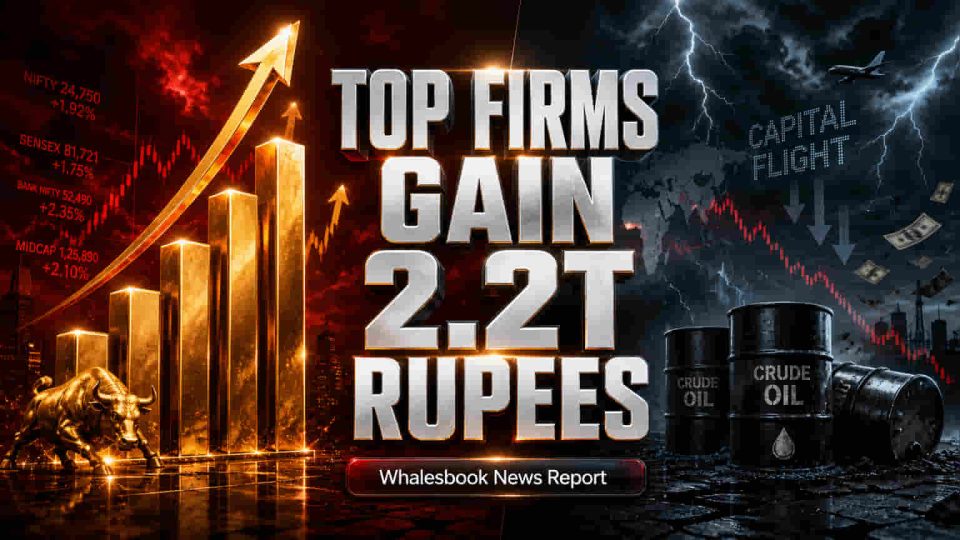
India’s leading companies showed a clear split in recent performance. While benchmark stock indexes managed slight gains, the overall market value changes show a growing reliance on a few major players, especially Reliance Industries. This rise, driven by one company, contrasts sharply with the notable value lost by large banking and consumer goods firms. This suggests underlying sector weaknesses despite the positive headline index figures.
Reliance Drives Gains as Others Slip
Over the past week, the combined market value of four major companies grew by an estimated ₹2.20 lakh crore. Reliance Industries accounted for a significant portion, adding about ₹1.40 lakh crore to its market capitalization, bringing its total valuation close to ₹19.36 lakh crore. Bharti Airtel, Tata Consultancy Services (TCS), and Bajaj Finance also saw substantial gains. However, this growth was offset by a combined loss of roughly ₹1.24 lakh crore from other top companies, including HDFC Bank, State Bank of India (SBI), and ICICI Bank. This created a picture of uneven market performance. Broader market sentiment was influenced by easing geopolitical tensions and steady Q4 earnings reports, but rising crude oil prices and continued foreign institutional investor (FII) outflows limited gains.
Sector Performance and Valuations
- Banking Sector Weakness: ICICI Bank and SBI saw market caps drop by approximately ₹45,365 crore and ₹30,923 crore, respectively. SBI’s P/E ratio is around 12.2, and ICICI Bank’s is about 16.7 (trading at roughly 2.5 times its book value). These valuations, along with general regulatory concerns for bank stocks, signal investor caution. Persistent FII outflows have also negatively impacted sentiment in the financial sector.
- Consumer Staple Slowdown: Hindustan Unilever (HUL) experienced a market capitalization decrease of about ₹18,421 crore. Despite its strong business model, HUL’s P/E ratio remains high at approximately 34.3, while its year-on-year performance declined by 3.89%. Its premium valuation, coupled with recent performance and a reported 6.51% sales growth over five years, suggests it might be overvalued or that consumer demand is slowing.
- Telecom Resilience: Bharti Airtel added over ₹43,503 crore to its valuation, reaching around ₹11.49 lakh crore. Its stock has performed well over the last week, month, and year.
- Conglomerate Strength: Reliance Industries’ significant market cap growth makes it India’s most valued domestic company. Its P/E ratio is around 24.0, higher than banks but lower than consumer staples like HUL.
- Infrastructure and Diversified: Larsen & Toubro (L&T) saw a slight valuation dip of ₹179 crore, ending around ₹5.52 lakh crore. Its P/E ratio is approximately 34.04.
- Financial Services and Insurance: Bajaj Finance maintained its market standing with a valuation around ₹5.83 lakh crore. LIC’s market cap fell by about ₹8,222 crore. LIC’s P/E ratio is notably low at approximately 9.95.
Key Risks: Concentration and Outflows
This market split presents significant risks. The heavy reliance on Reliance Industries for index gains creates concentration risk, leaving the broader market vulnerable if the conglomerate faces any setbacks. Continued pressure on banking stocks, despite solid P/E ratios, is worsened by regulatory uncertainties and ongoing FII outflows, indicating a lack of broad institutional confidence in the financial sector. Hindustan Unilever’s high valuation seems increasingly disconnected from its recent performance and growth, pointing to a potential correction for overvalued consumer staples. Additionally, rising crude oil prices add inflationary pressure and economic uncertainty, which could significantly affect consumer spending and import-dependent businesses. Sustained FII selling highlights foreign investors’ hesitation about the Indian market’s stability beyond a few top performers.
Analyst Views and Market Outlook
Analyst ratings for ICICI Bank are strongly positive, with most recommending ‘Buy’. Bharti Airtel also receives positive analyst coverage, including a ‘Buy’ recommendation from ICICI Securities. However, Citi analysts cautioned that Middle East tensions could impact India’s growth and suggested a lower valuation multiple for the Nifty index. Recent updates on Reliance Industries’ ratings exist, but specific future targets are not widely detailed, requiring close monitoring of its performance drivers.
Disclaimer:This content is for educational and informational purposes only and does not constitute investment, financial, or trading advice, nor a recommendation to buy or sell any securities. Readers should consult a SEBI-registered advisor before making investment decisions, as markets involve risk and past performance does not guarantee future results. The publisher and authors accept no liability for any losses. Some content may be AI-generated and may contain errors; accuracy and completeness are not guaranteed. Views expressed do not reflect the publication’s editorial stance.