
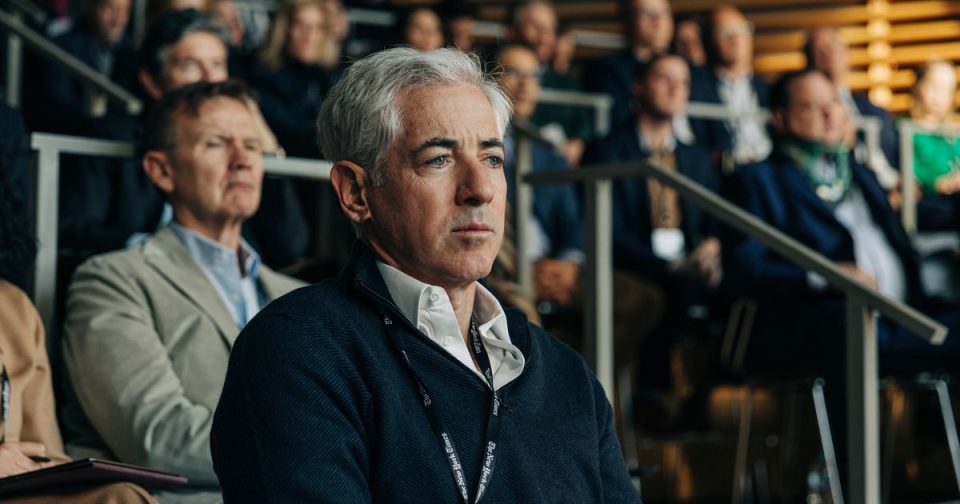

Photo: Jeenah Moon/The New York Times/Redux
For the past few years, it seemed as if everyone on X was making fun of Bill Ackman. Mostly this was because the billionaire investor was on X too much. Even worse, he was posting a lot. Ackman wrote very, very long posts on seemingly everything — protests on college campuses, the scourge of academic plagiarism, the “dangerous” nature of a socialist mayor — with a haughty tone, as if it were up to him to choose the path forward for young Americans.
Considering his recent positioning as a heel for liberals on X, it could be easy to forget that Ackman had previously been good at something: making money. Aside from a few catastrophically bad investments, he has brought in some dizzying amounts at his hedge fund, Pershing Square Capital Management — such as his $2.6 billion return on a $27 million bet on March 3, 2020, that the stock market would crash. Ackman is personally worth $9 billion, and Pershing has around $30 billion in assets under management.
Today, Ackman is about to get a lot more money to play around with — about $5 billion more — when he takes the rare step of a dual initial public offering for Pershing.
The new investment vehicle is Pershing Square USA, Ltd., trading as PSUS. It is a closed-end fund, which means Ackman is raising a fixed amount of money and will not issue new shares after the IPO. At the same time, Ackman is taking the entirety of his hedge fund public as Pershing Square, Inc. This offering, PS, includes Pershing’s three funds: Howard Hughes Holdings, Pershing Square Holdings (which trades in the U.K.), and Pershing Square USA, Ltd.
Other than to confuse members of the public who have been making fun of him for two years, why would Ackman do this? It appears to be a safeguard of sorts. PSUS will be managed more actively (read: aggressively) than a regular exchange-traded fund that tracks the performance of a specific stock index like the S&P 500. It is also more difficult to cash out than an exchange-traded fund and has a highish management fee of 2 percent. In exchange for investors’ trusting PSUS with their money for the long run, Ackman is providing an unusual incentive — giving away one share of his management firm (PS) for every five shares an investor buys of the closed fund (PSUS).
One could argue that a buy-five, get-one-free deal on Wall Street portends either a good buy or a panicked seller. But it appears to have worked: Pershing Square USA, Ltd. is expected to bring in $5 billion in new investment. That number may not be as big as Ackman once hoped; two years ago, he eyed a $25 billion IPO for PSUS but withdrew the paperwork after the company accidentally published a letter to investors showing it was on track to raise about a tenth of that. Still, the launch today is the largest public offering of the year so far — and the largest closed-end-fund IPO ever.
Given Ackman’s profile on X, one might assume that a majority of investors are posters who enjoyed his Musk-like retweets of Babylon Bee articles and charts about crime. Back in 2024, the company even wrote in an SEC filing that the closed-end fund would leverage Ackman’s “brand-name profile and broad retail following” into investment. In reality, Pershing now reports that 85 percent of its commitments come from institutional investors. So Ackman is at least able to convince other rich people to give him billions in hopes that they end up with a prescient bet — as when he bought the dip on Uber — and not another Herbalife.