

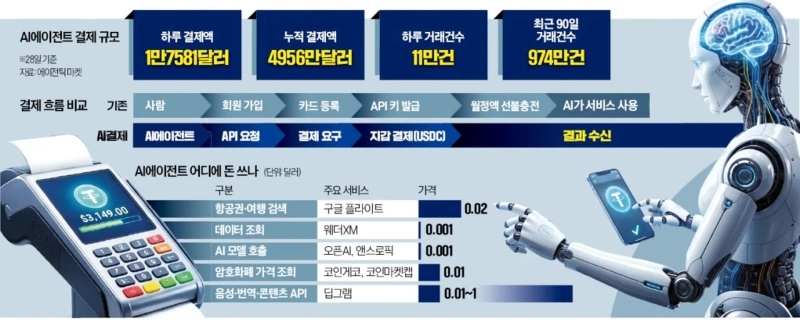
- AI agents processed 2.364 million stablecoin payments in a month, with cumulative volume reaching $49.564 million.
- The spread of AI agents could boost demand for stablecoin payments that support micropayments and real-time settlement.
- Visa and Mastercard are pursuing strategies to bring AI-agent payments into the existing card payment system.
Forecast Trend Report by Period


AI-Agent Payments Emerge as a Global Trend
Stablecoins Enable Real-Time Transactions
Agentic Market Has Processed Nearly $50 Million
Visa, Mastercard Move to Respond
They Aim to Bring AI Payments Into Existing Card Networks
Artificial intelligence agents are making more than 2 million automated payments a month using dollar-backed stablecoins, according to new data. Cumulative payment volume has climbed to nearly $50 million. As AI agents increasingly make small payments each time they use a service, stablecoin-based payments could spread further.
◇ AI Handles Payments in Real Time
Agentic Market said on April 28 that AI agents made 2.364 million payments in stablecoins over the past month. Total payment volume since May 2025 has reached $49.564 million. Daily payment volume is running at about $20,000.
Agentic Market is an AI-agent payment marketplace operated by Coinbase, the US cryptocurrency exchange. In May 2025, Coinbase unveiled x402, a technology that lets AI agents automatically pay with stablecoins when using paid services. Agentic Market shows those payment flows in real time.
Until now, people who wanted to use paid external data typically had to create an account, register a card or bank account, and obtain an access code before connecting to the service. Payments were usually settled at the end of the month after usage was aggregated over a certain period.
AI-agent payments work more simply. When an AI agent requests paid data such as search, weather or pricing information from an external service, payment is processed in real time through a linked crypto wallet. A travel-assistant AI, for example, could request flight information from Google Flights and pay $0.02 in USD Coin, or USDC.
As AI-agent use grows, demand may also rise for stablecoin payments that can handle tiny transactions in real time. AI agents repeatedly perform searches and data queries without asking for human approval each time. Card payments and bank transfers can technically support micropayments as well. But the more transactions are split into small units, the higher the authorization, settlement and administrative costs become. Processing a roughly $0.07 payment 100 times means payment and settlement also occur 100 times. That is why existing payment systems work more efficiently when they process about $7 in a single transaction. In practice, the cost of data used by AI agents is often less than $1. Some functions of voice AI service Deepgram cost about $0.34 per use. Paying by card could add more in fees.
◇ A Threat and an Opportunity for Card Companies
If AI agents increasingly spend directly through stablecoins, traditional payment companies such as card issuers and digital-payments providers may come under greater pressure. Their business models are built on collecting fees while intermediating authorization, authentication, merchant acquiring and settlement when people make purchases. If stablecoin-based payments become more active, however, a growing number of transactions could bypass card authorization networks and digital payment gateways.
A South Korean card-industry official said ordinary merchants have little reason to break payments into small pieces. But if AI agents increasingly move across multiple outside services and pay on a per-transaction basis, that could create demand for billing and settlement systems that differ from the current model.
Payments companies including Visa and Mastercard are responding by trying to bring AI payments into card networks. Under that model, users would set spending limits and conditions in advance, and AI agents would search for and buy goods within those parameters. As AI agents emerge as a new payment actor, the strategy is aimed at absorbing them into existing systems rather than losing them to stablecoin wallets.
Kim Min-seung, head of research at Korbit, said South Korea has yet to establish rules on whether digital assets can be used as a payment method. Discussion has also not begun on liability for AI-agent payments.
Cho Mi-hyun, Korea Economic Daily reporter mwise@hankyung.com