
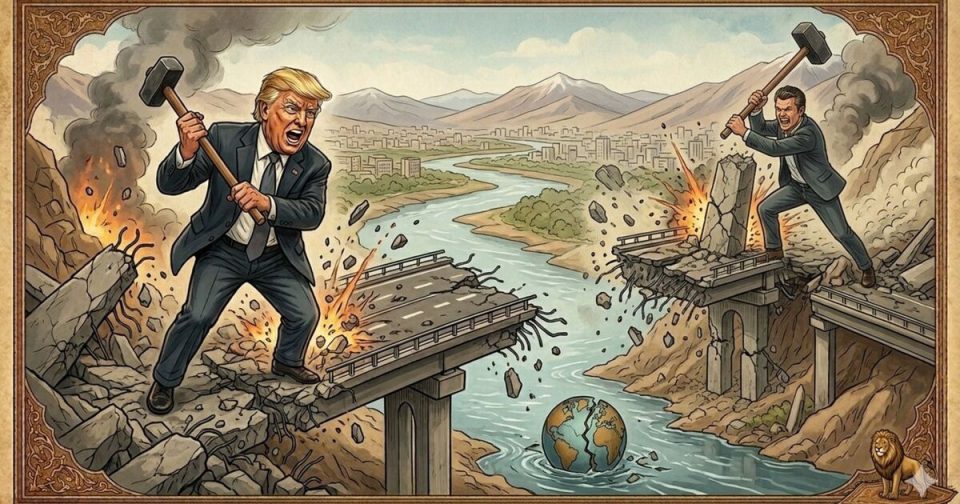

An AI image of Trump smashing a bridge in Iran (Image: @Iran_in_Turkiye/X)
Faced with the terrifying might of the US armed forces, Iran has adopted alternative ways of hitting back, including launching a ‘meme war’ to undermine US legitimacy, a new report claims.
Iranian diplomatic accounts have significantly shifted their online communication style, embracing memes, humor, and pop culture references to expand their global reach, according to recent analysis by the Institute for Strategic Dialogue.
Traditionally characterized by formal language and official statements, these accounts are now increasingly using informal, attention-grabbing content, ranging from parody videos to AI-generated clips, in an effort to engage wider audiences on platforms such as X. In some cases, posts have directly targeted political figures such as former US President Donald Trump through parody and mockery. When Trump was accused of posting an AI-generated image of himself as Jesus, Iranian-affiliated channels shared an AI-generated video of Jesus appearing and punching the US president.

Iran has taunted Donald Trump with viral memes after he claimed ‘good peace talks’ were underway (Image: -)
The change appears to be having an impact. Researchers found that, over a period of roughly 50 days during heightened regional tensions, Iranian diplomatic and state-linked accounts generated approximately 900 million views and 22 million likes. This marks a sharp increase compared to earlier activity, alongside a surge in reposts and comments.
Posting frequency, mostly from Iranian embassies abroad, has also risen substantially. The accounts analyzed produced tens of thousands of posts in a relatively short timeframe, reflecting a more aggressive and sustained digital outreach strategy.
Much of the content moves away from conventional diplomatic messaging. Instead, it incorporates elements of internet culture, including satire, irony and so-called “s***posting”—a deliberately chaotic or irreverent style designed to attract attention and encourage sharing.
Analysts suggest this approach is intended to make official messaging more accessible and relatable, particularly to younger, digitally native audiences. By adopting formats and tones common in online communities, Iranian communicators may be seeking to extend their influence beyond traditional diplomatic circles.

A still from an AI video of Jesus punching Trump down to hell (Image: @IRANinTJ/X)
Read more: Donald Trump’s ex Marla Maples urges fans to ‘pull on Heaven’ after shooting
Read more: Bruce Springsteen offers Donald Trump a rare prayer after shooting
And it seems to be paying off.
The research found that the Iranian embassy in South Africa saw its followers rise from roughly 4,000 before the war to more than 150,000 within 50 days. Similarly, the embassy in Zimbabwe gained more than 71,000 followers in the week following the viral X posts.
The strategy also reflects broader trends in information dissemination, where states increasingly compete for visibility and engagement in fast-moving social media environments. Memes and short-form visual content can spread rapidly across platforms, often reaching audiences that might not engage with conventional political messaging.
At the same time, researchers caution that the blending of entertainment and political communication can blur distinctions between information, persuasion, and propaganda. The use of humor and viral formats may make content more appealing, but it can also complicate efforts to critically assess its intent or accuracy.
The document chillingly concludes: “What’s most startling about the success of this new messaging strategy is the fact that it has helped netizens to forget, or at least ignore, Iran’s past human rights abuses.
“Tehran’s diplomatic accounts and other propaganda channels have helped shift the narrative, with Iran increasingly being framed not as a villain but as an underdog opposing the U.S., a narrative that many online audiences can’t help but want to root for. While US policies have contributed to the shifts in audience perception, Iran’s strategic communication has also seized on the opportunity. This rebranding is arguably Iran’s most notable win in the war thus far.”