
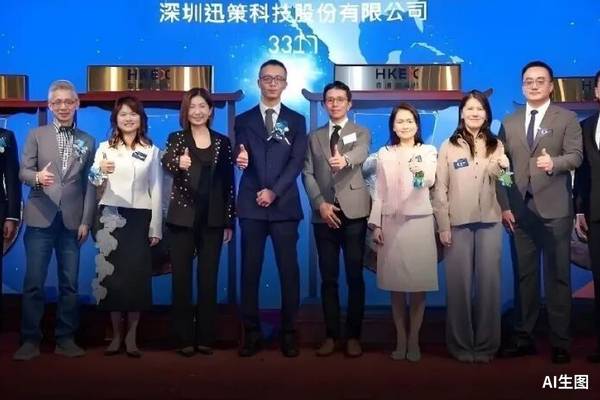
A super return has emerged in the venture capital circle.
It all started four months ago – Xunce Technology, the so – called “first Token stock”, listed on the Hong Kong Stock Exchange. However, its stock price was volatile at that time. Unexpectedly, just over a hundred days later, the company’s market value soared past HK$100 billion, and the cumulative increase in its stock price since listing reached a staggering 500%.
Xunce may sound unfamiliar at first. Behind it stands a father – son duo. Liu Chengxi founded the company in 2016 with his investment, but it was his son, Liu Zhijian, who led the company. After a decade, they finally stepped onto the IPO stage. Along the way, Xunce Technology had a large group of investors. Now, its market value has increased by more than 500 times compared to its valuation in the Series A round.
Among them, Tencent, the largest institutional shareholder, is undoubtedly the biggest winner, with a floating profit of over 5 billion yuan from a single investment. The well – known PE firm KKR reaped a return of over 4 billion yuan. Other early – stage investors often saw book returns of over a hundred times.
This spectacular situation is truly astonishing.
Shenzhen’s Newcomer: The First Token Stock with a Market Value of 100 Billion
It all dates back to a decade ago.
Back in April 2016, Liu Chengxi officially founded Xunce Technology in Nanshan, Shenzhen. He keeps a low profile and rarely appears in the public eye. His personal resume isn’t even mentioned in the prospectus. Although Liu Chengxi is the largest shareholder of the company, he doesn’t hold any position. Instead, he handed the company over to his son, Liu Zhijian, to manage.
Liu Zhijian, now 46 years old, graduated from Tsinghua University with a bachelor’s degree in Electronic Science and Technology in 2004. Then he went on to pursue a master’s degree in Electrical and Electronic Engineering at the Hong Kong University of Science and Technology. After graduation, he joined the Royal Bank of Scotland, starting as an intern and rising to the position of director. In September 2012, he joined China Development International Investment Co., Ltd. as an executive director.
It wasn’t until 2016 that Liu Zhijian became the helmsman of Xunce Technology, serving as the chairman of the board and CEO. At the same time, he invited Geng Dawei, an alumnus from Tsinghua University, to join Xunce as the company’s general manager.
At the beginning of its establishment, Xunce Technology started in the asset management industry. In the following year, it launched the real – time data analysis solution XOne, providing order execution and portfolio monitoring services. Later, it successively released the real – time data infrastructure solutions Done and VOne.
From 2021 to 2022, Xunce Technology launched four more data analysis solutions: Pone, Tone, Cone, and Rone, which provide portfolio monitoring, valuation, risk management, and compliance supervision services respectively. According to the prospectus, in terms of 2024 revenue, Xunce Technology ranks first in the real – time data infrastructure and analysis market of the Chinese asset management industry and fourth in the Chinese real – time data infrastructure and analysis market.
Witnessing the wave of AI sweeping across, Xunce Technology gradually transformed into an AI Agent service provider. Meanwhile, the company adopted the Token payment model, establishing a pricing system of “single – call price × number of Token calls × number of module applications”. That is, when customers use its AI data services, they are charged according to the actual number of Tokens consumed during the model inference process.
As a result, Xunce Technology became the “first Token stock” on the Hong Kong Stock Exchange.
Actually, Xunce Technology’s IPO journey was full of twists and turns. In 2024, the company submitted its listing applications to the Hong Kong Stock Exchange twice, in March and September, but both applications lapsed. After a year, it submitted its third listing application and finally successfully listed on the Hong Kong Stock Exchange in December 2025. Unexpectedly, it started a soaring journey.
Tencent: The Big Winner, 500 – fold Return for Series A Investors
Actually, Xunce Technology’s start in the Hong Kong stock market wasn’t very good.
In the pre – listing dark – pool trading, Xunce Technology’s stock price tumbled by more than 35% compared to the issue price of HK$48, in sharp contrast to several other new stocks on the same day. Although the stock price rebounded after the opening on the listing day, it only closed with a slight increase of 1.04%, and the market value on the first day was fixed at HK$15.6 billion.
After that, Xunce Technology’s stock price often hovered around HK$60, and there were constant doubts in the secondary market.
However, a turning point soon appeared.
The emergence of OpenClaw across the ocean not only ignited an AI frenzy but also detonated the stock prices of the “Three Lobster Brothers” – Xunce, MiniMax, and Zhipu. The three companies reached market – value peaks with the OpenClaw concept.
Riding on this wave, Xunce Technology’s market value first reached HK$50 billion in March and then soared past HK$110 billion. Only 100 days had passed since its IPO. Based on the closing price on April 24, the cumulative increase in Xunce Technology’s stock price since listing compared to the issue price reached 500%, and its market value fluctuated around HK$100 billion.
This significant increase also affected the mood of Xunce Technology’s investors.
Looking back, Xunce Technology caught the attention of first – level market investors early on, especially in 2017 when it had a Series A financing. In July of that year, Yunfeng Xincheng under Yunfeng Fund, Shenzhen Saida Ren, Beijing Innovation Works, Wuxi Haiyingjia, Zhongnan He Duo, Xingluo Jingyou, Nanchang Haichuangsheng, and Zhuhai Chenghao jointly invested 76 million yuan. At that time, the pre – investment valuation was only 150 million yuan.
Then in April 2019, Xunce Technology completed a Series A+ financing. Wuxi Haiyingjia and Zhongnan He Duo invested 55 million yuan, and GSPSI under Goldman Sachs subscribed for new registered capital of 2.8124 million yuan at a total cost of 33.7487 million yuan. The post – investment valuation of this round reached about 690 million yuan.
Soon, Tencent also stepped in. In June 2020, Xunce Technology received a Series B financing of 211 million yuan. The investors included PAC Capital, Greater Bay Area Fund, Zhongshan Torch, Shenzhen Tencent, Yuxin Capital, Shenzhen Zhongtou, and Yunfeng Qitai. At this time, Xunce Technology’s valuation had doubled to 1.2 billion yuan.
Less than a year later, in May 2021, Xunce Technology completed a Series C financing with a total scale of about 654 million yuan. Old shareholders Tencent and Yuxin Capital increased their investments, and new investors included Shidai Baifu, Sunshine Family Investment, Shanghai Pufa Bank, Guangzhou Youshan, CPE Yuanfeng, Heli Investment, Yuecai Venture Capital, Beijing Zhongguancun, Beijing Gehua, Tongrui Changying, and Taikang Life Insurance. Subsequently, Shanghai Yukai invested 64 million yuan as a Series C+ investor.
In April 2022, Xunce Technology completed a Series D financing of 798 million yuan. The investors included KKR, Tianjin Xihua, CICC Pufa, Jinpu Investment, Yuxin Capital, Hengdian Capital, and Goldman Sachs. In November of the following year, Hongtai Fund invested 220 million yuan in a cross – round financing, and Xunce Technology’s pre – IPO valuation reached 6.22 billion yuan.
By now, Xunce Technology’s market value has increased by more than 530 times compared to its pre – investment valuation in the Series A round.
Looking back on this nearly – decade – long journey, some investors left regretfully in advance, while those who stayed reaped the rewards of time. According to the prospectus, Innovation Works, Nanchang Haichuangsheng, Zhuhai Chenghao, and Zhongshan Torch exited before the IPO. As the largest institutional shareholder, Tencent still holds 7.02% of the shares after the IPO, corresponding to a market value of about 5.7 billion yuan. Based on this, the floating profit exceeds 5 billion yuan. KKR’s stock market value is about 4.7 billion yuan, and the floating profit has also exceeded 4 billion yuan.
In addition, most of the other early – stage investors also reaped substantial returns. Yunfeng Fund invested about 43 million yuan in total before the IPO, and the return is about 100 times. Shenzhen Saida Ren, an investor in the Series A round, invested 5 million yuan and holds 0.76% of the shares, with a return as high as 120 times… Of course, the real winner is Liu Chengxi, the founder of Xunce Technology. He still controls 26.84% of the shares of Xunce Technology after the IPO, and the market value of his shares is nearly HK$25 billion.
However, in the Hong Kong stock market, returns without unlocking and cashing out may just be illusory. The market value after the bubble has subsided is the true measure of strength.
The AI Wealth – Creating Era
This situation is the most vivid portrayal of “Token economics”.
First, we need to figure out what a Token is. As the smallest basic unit for a model to process information, a single Chinese character, word, or punctuation mark can be regarded as a Token. From a simple AI query to enterprise – level model training, all settlements are based on Tokens.
Data from the National Data Bureau shows that by March this year, the average daily Token call volume in China has exceeded 140 trillion, a 1400 – fold increase compared to 100 billion at the beginning of 2024. Compared to 100 trillion at the end of 2025, it has increased by more than 40% in three months.
The popularity of AI agents at the beginning of the year has directly become the catalyst for the exponential growth of Tokens, because each interaction such as task planning and tool – calling significantly increases Token consumption. Tokens are no longer just a counting unit. The greater the consumption, the more frequently AI is used, and the higher the degree of commercialization.
In other words, the underlying narrative logic of the AI era has quietly changed. As Jensen Huang emphasized at the NVIDIA GTC Conference in March this year, in this new AI era, Tokens are the new basic currency. The cost and efficiency of generating Tokens directly determine the revenue and survival of technology companies.
He even proposed, “In the future, each engineer in our company will need an annual Token budget. Their basic annual salary may be hundreds of thousands of dollars, and I will allocate about half of that amount as Token quota to them to achieve a 10 – fold efficiency improvement.”
Not long ago, the official announced the Chinese translation of Token – “Ciyuan” – and clearly stated that it is the value anchor in the intelligent era and the “settlement unit” connecting technological supply and business demand. This means that Token has transformed from a technical term into an economic factor with standardized measurement attributes.
If the “hard currency” in the industrial era was kilowatt – hours (electricity) and that in the Internet era was GB (mobile data), then in the AI era, it is Token. After all, this is still a battle in the AI era that cannot be lost.
Recently, we have witnessed many such spectacular scenes: Zhipu has a market value of 400 billion in the Hong Kong stock market, and MiniMax’s market value once exceeded 400 billion. In the A – share market, represented by Zhongji Xuchuang, its market value once exceeded 1 trillion this week, and Dapu Micro’s market value also exceeded 100 billion on its IPO day. As the saying goes, nothing is more attractive than AI. This is an unprecedented era of wealth.
This article is from the WeChat official account “Investment Circle” (ID: pedaily2012), written by Liu Bo and published by 36Kr with authorization.