
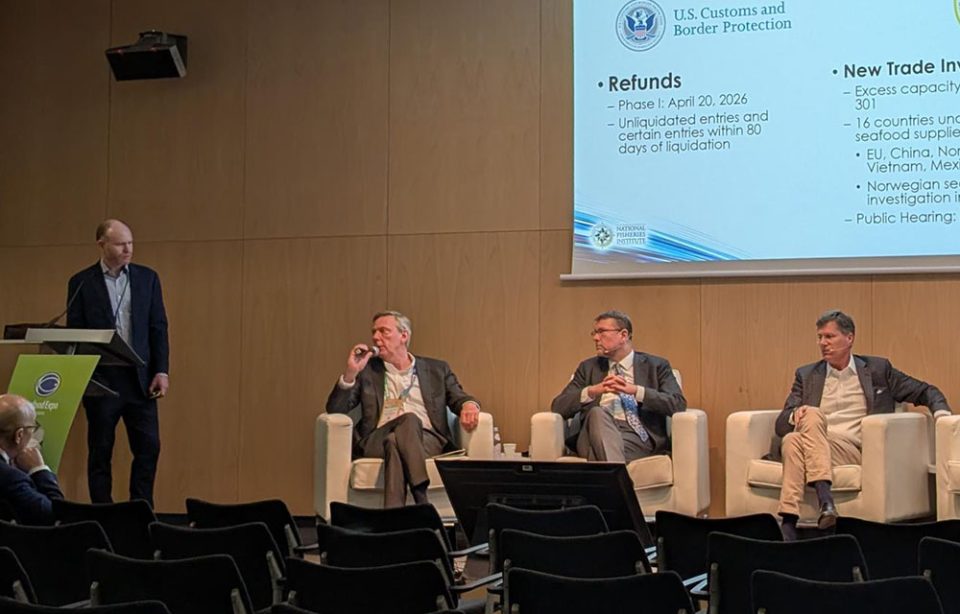
U.S. President Donald Trump’s efforts to restructure global trade – and his inability to do so cleanly and consistently – has created uncertainty in the seafood sector and hurt trade between the U.S. and the E.U., according to seafood industry stakeholders speaking at a panel at the 2026 Seafood Expo Global (SEG).
“No matter what you think of the policy overall, the up and down nature of it and the uncertainty that that generates is crippling for businesses that I represent, and I think for even domestic U.S. producers it creates uncertainty and doubt,” National Fisheries Institute Executive Vice President for Government Affairs and General Counsel Robert DeHaan said. “It’s harder to innovate. It’s harder to expand your payroll. It’s harder to know what’s going to happen in six [or] nine months. This sector of farmed and wild [fish] is very tough in good conditions, and introducing this level of uncertainty about the policy execution process creates uncertainty and makes the U.S. market less appealing.”
DeHaan’s comments came during a SEG panel titled “Seafood Trade in the Tariff Era: An Analysis of Challenges and Opportunities Between the E.U. and U.S.”
Since returning to office in January 2025, Trump has pushed to aggressively renegotiate the U.S.’s trade relationship with other countries, including those that make up the European Union. Early on, the president threatened a tariff rate of 50 percent on goods from the bloc. That threat was then lowered to 30 percent, and the two parties eventually negotiated a tariff of 15 percent on European goods in August 2025. In March 2026, the European Parliament gave initial approval to that trade framework.
Around the same time the E.U. gave its intital approval, Trump’s aggressive trade policy faced a major setback earlier this year when the U.S. Supreme Court ruled that the tariffs Trump set using the International Emergency Economic Powers Act (IEEPA) were illegal. Trump responded by quickly setting a global 10 percent tariff on global goods, which is set to expire this summer.
Simultaneously, the U.S. Office of the Trade Representative also launched Section 301 investigations against 16 countries, including major seafood trading partners like the E.U., China, Norway, Indonesia, Thailand, and Vietnam. Section 301 authorizes the president to take tariff and other retaliatory actions against governments that violate international trade agreements or have policies that unjustifiably hurt U.S. commerce.
Those investigations are set for a public 5 May hearing and could further upheave U.S. trade relationships with more than a dozen countries.
According to DeHaan, Section 301 investigations are meant to target foreign malfeasance such as state-sponsored technology theft but are being used as a blunt trade tool that could hurt the seafood sector.
“We have eight years of experience of Section 301 China tariffs. You can read those reports over and over again, and you will not find a single mention of food at all,” DeHaan said. “301 is a very aggressive law that uses the leverage of unrelated product sectors to attack, retaliate, or remedy a sin that is committed by some other group of producers. That is what’s going to happen here.”
All together, the shifting tariff threats on the E.U. and other nations, as well as the Supreme Court ruling, have created an aura of uncertainty around seafood trade with the U.S., and many companies are looking for more predictable options.
“My expectation is that a couple of companies who are exporting to the U.S. will be looking for new markets because it’s getting too complicated. In economic terms, it’s not the best deal anymore,” Seafood Europe President Guus Pastoor said. “This is the reality, and I think that companies will be looking around to see if they can find other markets to supplement the U.S. I don’t think they’ll leave the U.S. right away, but the volume that we’ve just been seeing – and it was quite a lot of volume and was growing – I think will now be flat or even go the other way.”