

The bond market has seen some wobbles in early 2026. Stresses have appeared in the private debt market, and credit spreads have generally widened. Yields have risen on Treasuries, which are supposed to act as a safe-haven asset during periods of financial market volatility. Since the start of the Iran war in late February, the Morningstar US Core Bond Index has been negative.
It’s reminiscent of 2022, when bonds also failed to diversify stock market risk. That was the year Russia invaded Ukraine, disrupting energy markets and stoking inflation. The “death of diversification” was declared that year when both major asset classes fell by double digits in 2022.
But we are in a very different place in 2026 than we were then. Yes, fixed income faces some very real risks today, in terms of credit, inflation, government debt levels, and more. Those risks help explain why investors are pouring record amounts of money into ultrashort bond funds. Still, the long-term case for a fixed-income allocation within a diversified portfolio remains strong.
A Double Whammy of Credit Risk and Inflation Fears for Bonds
Coming into 2026, credit spreads were unusually tight. A number of factors have contributed to their widening in the early months of the year. Concerns about the disruptive impact of artificial intelligence have prompted a major reassessment of software and business-services companies. The private debt space is under pressure, as defaults rise and some investors head for the exits (to the extent they can). With the Iran war raising oil prices, economic slowdown and inflation are both fears.
In fact, inflation is far from theoretical. The US Consumer Price Index rose 3.3% in March, an acceleration from previous months. The last time inflation was at or below the Federal Reserve’s 2% target was 2020.
Recent inflation has helped push Treasury yields higher. The 10-Year Treasury yield, which dropped below 4.0% before the war started, rose to 4.3%. Investors have gone from expecting Fed rate cuts in 2026 to considering the possibility of a rate hike.
Also contributing to upward pressure on prices, and casting a massive shadow over the bond market, is US government debt. The national debt load is marching toward a stunning $40 trillion. As a result, Treasuries represent a growing share of the fixed-income universe. With that much debt on the books, some investors are understandably losing confidence in the “full faith and credit” of the US government.
So, What’s the Bright Side for Bonds?
Today’s bond market looks very different from 2022. The 10-Year Treasury yielded less than 2% at the start of that year, thanks to rock-bottom pandemic-era interest rates. CPI hit 9.1% in 2022. Higher oil prices related to the Russia-Ukraine war were part of the inflation story, but so too were massive government stimulus and lingering supply chain distortions. The Federal Reserve raised interest rates by a total of 4.25 percentage points in 2022, helping cause the “worst bond market ever.” Although today’s inflation is elevated and interest rate hikes are possible, a repeat of 2022 looks unlikely.
Fixed-income yields today exceed the inflation rate and tower above the stock market’s paltry 1.2% dividend yield. As you’d expect, areas of the bond market with elevated credit risk, such as high yield, emerging markets, and bank loans compensate investors accordingly. But even the Treasury-heavy Morningstar US Core Bond Index throws off a more than 4% yield.
In addition to providing income, today’s bond yields provide a far better starting point for total returns than before 2022. The core bond index gained more than 14% in total-return terms from the start of 2023 through the end of 2025. Cash may offer reasonable yields, but it lacks capital appreciation potential.
Of course, with that potential also comes risk. “Cash won’t gain in value, but it won’t necessarily decline in value, either,” says Morningstar’s Christine Benz. Bond yields could keep rising. Credit spreads have far more room to widen.
Do Bonds Still Diversify a Portfolio?
But fixed income still offers diversification benefits. Bonds can act as shock absorbers to a portfolio. In the first exhibit of this column, you see stocks and bonds falling at the same time, but at a far different magnitude. The old saying “a bad day for stocks is like a bad year for bonds” comes to mind.
One of the key lessons from 2022 is that bonds don’t always diversify equity market risk. Periods of rising inflation and interest rates have been bad for both major asset classes. Unsurprisingly, in the 1970s, in 2022, and so far in 2026, commodities investments have been the best-performing asset class.
But correlations are always shifting. In fact, in 2025, stocks and bonds were negatively correlated, as seen below. “Bonds have regained some of their status as portfolio ballast,” wrote Morningstar’s Amy Arnott, a co-author of the 2026 Diversification Landscape report.
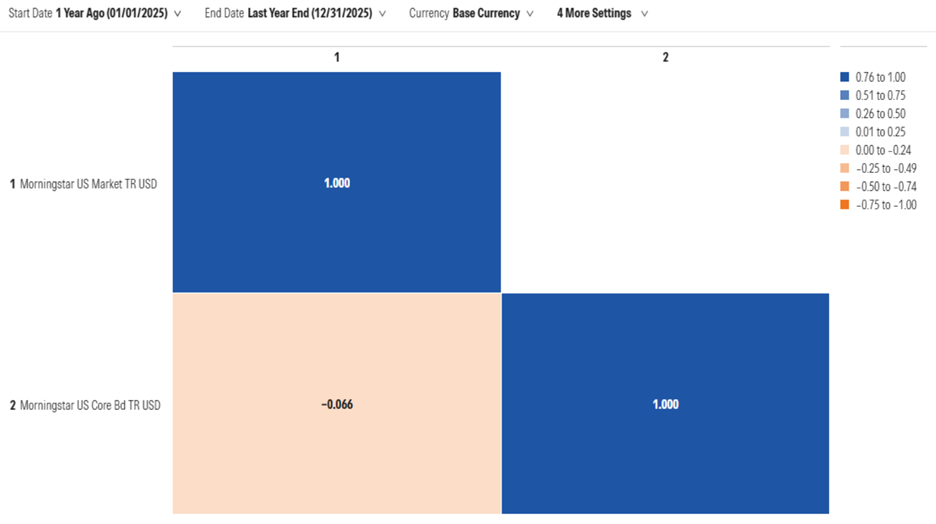
As for the remainder of 2026, anything can happen. We’ve seen recent spikes in Treasury yields that didn’t last, including after the US elections of November 2024, then again during the tariff turmoil of March-April 2025. Despite jitters early in the year, the Morningstar US Core Bond Index ended 2025 with a total return of more than 7%.
Investors in cash or ultrashort bond funds avoided those ups and downs. But they also missed out on gains. That’s worth considering for the many investors today favoring super short durations in fixed income.
As always, feel free to drop me a line at dan.lefkovitz@morningstar to let me know how you’re approaching your fixed-income allocation (or other investments). I read all my emails, even if I can’t reply to all of them.
Morningstar, Inc., licenses indexes to financial institutions as the tracking indexes for investable products, such as exchange-traded funds, sponsored by the financial institution. The license fee for such use is paid by the sponsoring financial institution based mainly on the total assets of the investable product. A list of ETFs that track a Morningstar index is available via the Capabilities section at indexes.morningstar.com. A list of other investable products linked to a Morningstar index is available upon request. Morningstar, Inc., does not market, sell, or make any representations regarding the advisability of investing in any investable product that tracks a Morningstar index.