

- Kimchi bonds totaling 829.1 billion won ($572 million) have been sold so far this year, with card issuers, capital companies and manufacturers actively entering the market.
- Yuan-denominated kimchi bonds offer borrowing costs at least 0.3 percentage point lower than domestic won bonds, with solid Chinese demand helping reduce funding costs.
- Issuance of dollar-denominated kimchi bonds is also increasing, and if highly rated card issuers secure favorable terms, manufacturers may begin entering the market in earnest.
Forecast Trend Report by Period


$572 million sold so far this year
Demand for yuan-denominated bonds remains strong
Shinhan Card weighs $48 million sale
Alternative as won-bond funding costs rise

South Korea’s kimchi bond market — foreign-currency debt sold domestically by local companies — is expanding rapidly. Issuance has reached 829.1 billion won ($572 million) so far this year. Card issuers and capital companies have driven the growth as they diversify funding channels. Lotte Property & Development and LG Electronics have also joined the market. Yuan-denominated issuance has risen notably.
Chinese-backed investors dominate the kimchi bond market
Shinhan Card is preparing to issue 70 billion won ($48.3 million) of kimchi bonds this month, according to the investment banking industry on June 16. The company is weighing whether to sell the debt in yuan or dollars.
Woori Card issued 64.9 billion won ($44.8 million), or 300 million yuan, of kimchi bonds last month. The bonds mature in two years and three months and were sold at about 2.15%. After swapping the proceeds, its effective funding cost was in the mid-3% range, market participants said. That compares with Woori Card’s fair-value rates of 3.8% for two-year debt and above 4% for three-year notes, meaning the kimchi bond priced at least 0.3 percentage point lower.
Hyundai Capital also issued 135 billion won ($93.1 million), or 660 million yuan, of yuan-denominated kimchi bonds, while KB Kookmin Card sold 88 billion won ($60.7 million), or 400 million yuan. LG Electronics issued 148.6 billion won ($102.5 million), or 700 million yuan. Four of the five kimchi bond deals sold last month were denominated in yuan.
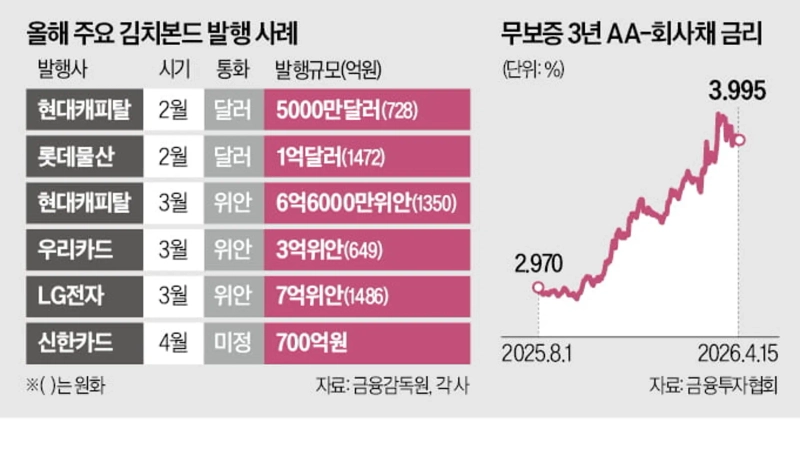
Yields on three-year AA-minus local corporate bonds in South Korea have climbed to 4% this month from about 2.9% in August last year. That has raised borrowing costs for companies seeking funds. Yuan kimchi bonds can ease that burden because strong Chinese demand has pushed pricing below levels available in the domestic won bond market. Major investors include Industrial and Commercial Bank of China and HSBC.
Kimchi bonds also help support the won. Issuers typically use swap contracts to sell the foreign currency raised through kimchi bonds and buy won in the foreign-exchange market. As issuance increases, foreign-currency selling in the FX market rises as well.
Yuan bonds come back into favor
The kimchi bond market was once much larger. Annual issuance reached 10 trillion won ($6.9 billion) in 2011. But sales were halted from 2013 after authorities moved to curb issuance over concerns about weakening export competitiveness. At the time, the won traded around 1,050 per dollar.
With the won-dollar exchange rate hovering around 1,400, the Bank of Korea eased restrictions last June on institutional investment in kimchi bonds to stem dollar outflows. Commercial banks, securities firms and insurers can now invest in the notes. The move was aimed at preventing dollar assets brought into South Korea from flowing into overseas bonds and other foreign investments.
Dollar-denominated kimchi bond issuance is also increasing. Hyundai Card sold $20 million of the notes, Hyundai Capital sold $50 million, Woori Card sold $50 million and Lotte Property & Development sold $100 million. An investment banking industry official said that if highly rated card issuers continue to secure favorable terms and lower funding costs through kimchi bonds, manufacturers will likely enter the market in earnest.
Bae Jeong-cheol, Hankyung.com reporter, bjc@hankyung.com