
-
Cross-border remittance and emerging-market FX both suffer high costs and long delays, driven by complex procedures, banking-hour constraints, and dollar liquidity shortages.
-
KiiChain combines local-currency stablecoin liquidity across countries into an uninterrupted, 24-hour on-chain FX settlement layer.
-
Rather than eliminating intermediaries, KiiChain consolidates them into a borderless on-chain settlement platform, a practical use of blockchain technology to address the problem.
-
KiiChain has surpassed $500 million in cumulative transaction volume and 350,000 users. What remains to be seen is whether it can secure deep liquidity in emerging markets and execute the rest of its roadmap.

On a Friday afternoon, the treasury manager at an exporter in Bogotá sends a payment to a supplier in the United States, and the screen returns nothing but a flat “processing” message.
A complicated process sits behind every cross-border transfer. The payment has to move through eligibility screening, verification of foreign currency accounts, currency conversion, and final settlement. Global financial infrastructure still functions by working around inefficiencies such as banks in different countries keeping different hours and operating under different regulatory regimes.
News from the other side of the world reaches us in real time. Technology has dissolved the borders around information and culture, yet the financial infrastructure that underpins the economy remains inefficient.
This market structure bears down harder on emerging market countries. Their local currencies carry a lower international standing, which makes immediate liquidity difficult to source and adds delay and cost at every stage of a transaction.
In some FX transactions, dollar liquidity is not deep enough to absorb the local currency on offer, so the conversion costs considerably more and takes considerably longer to complete.
KiiChain began with practitioners who had met these market inefficiencies at the front line.
Founders Danyel Arenas and Alex Cavallero previously ran a digital asset OTC desk and Inmersion Capital, a market making fund, across Latin America. Daily work at the OTC desk amounted to a continuous struggle with the structural defects of the traditional financial system, because they had to bridge shallow liquidity between local currencies and the dollar while filling two-way orders under inconsistent bank operating hours and strict capital controls.
Having absorbed the cost of that inefficiency with their own capital, they began to draw up a blueprint for an on-chain FX layer to address it.
KiiChain aims to serve as an on-chain FX layer for stablecoins and real-world assets (RWAs). The intent is to consolidate liquidity for dollar stablecoins and for local currency stablecoins onto a single chain, so that swaps and settlement run without interruption 24 hours a day, including the hours when banking systems are closed.
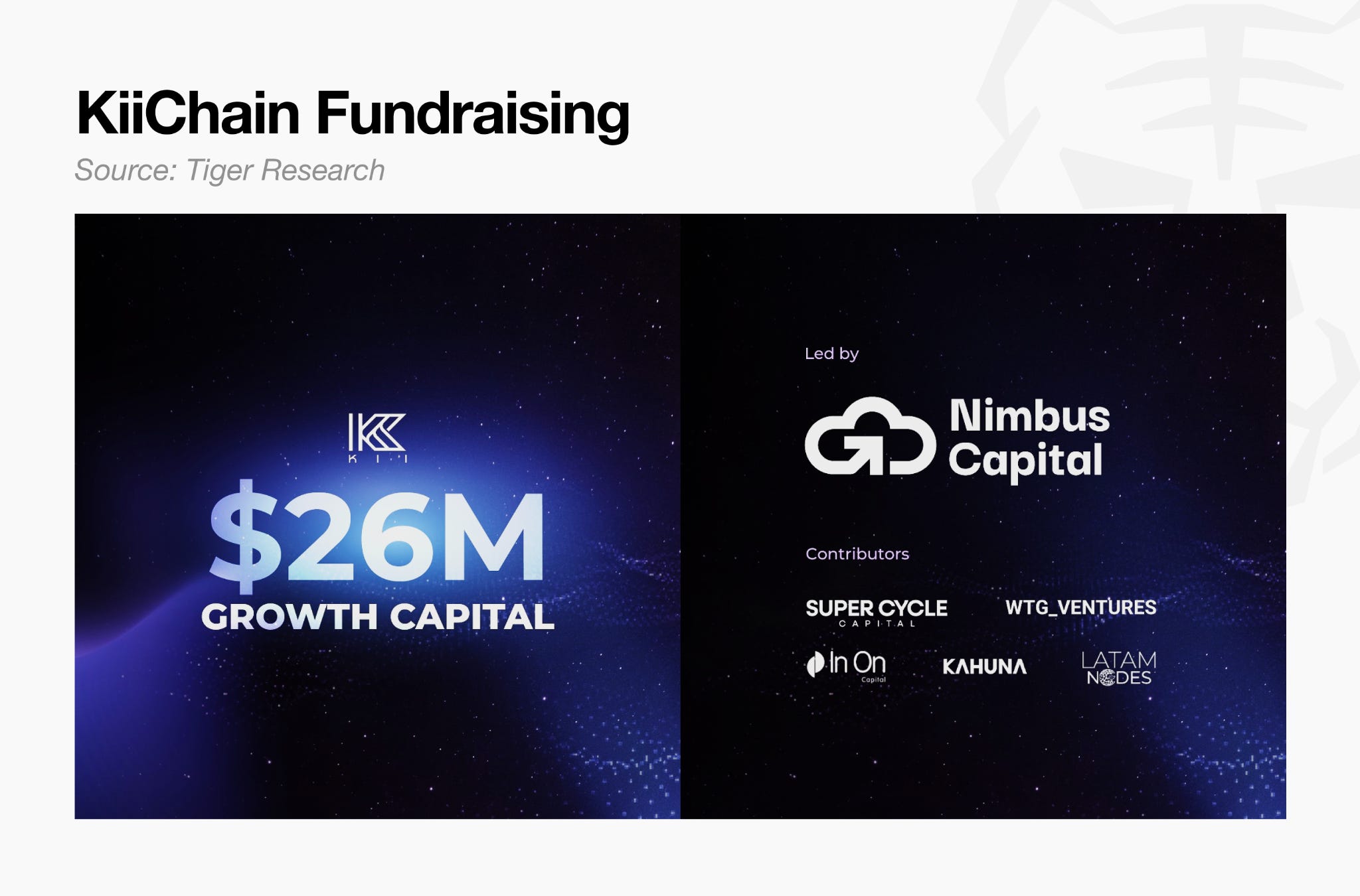
That vision has drawn market support, and the company has raised a total of $26 million from investors including Nimbus Capital.
Delivering the global on-chain FX layer that KiiChain describes requires infrastructure that consolidates fragmented liquidity across multiple national stablecoins and supports real-time settlement without a break in service. Four components carry that load:
-
KiiChain App: a hybrid marketplace that combines partnerships with institutional participants to execute trades across different assets and currencies.
-
Kii Oracle: a data hub that connects real-time price data from external financial markets in a decentralized manner, based on a consensus mechanism among network validators.
-
RWA Protocol: a tokenization gateway that brings the value of real economy assets into the on-chain ecosystem under a strict regulatory framework.
-
KiiChain Pay: the core gateway that removes the technical barriers between fiat currency and on-chain assets, supporting uninterrupted, round-the-clock liquidity transfer through a unified API
These four components work together to lower the entry barriers of the traditional financial system and accelerate the shift toward an efficient on-chain financial base.
Emerging-market currencies are classified as peripheral assets within the global financial system, and that classification leaves them with a persistent structural weakness: thin liquidity and exposure to the risk of settlement delay. Existing foreign exchange trading methods, RFQ (request for quote) and CLOB (central limit order book) trading, do not resolve this problem.
A standard decentralized finance automated market maker (AMM) model is not a suitable alternative either, because the core of foreign exchange trading is currency exchange and genuine arbitrage demand rather than value storage or investment. Liquidity providers end up exposed to losses from price fluctuations, with little prospect of return from ordinary trading flow, a structural flaw in the model.
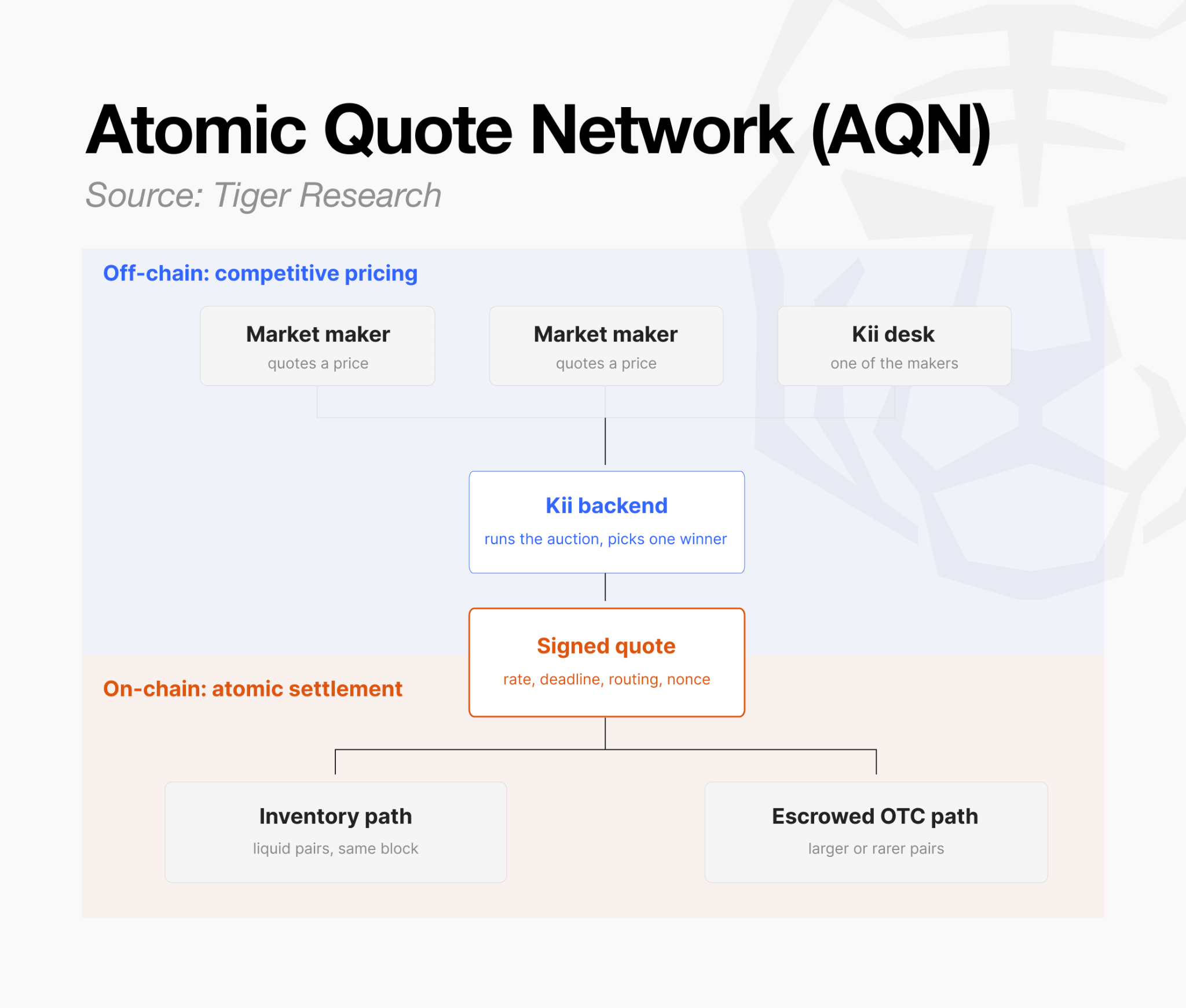
To address this, the KiiChain app adopted a model it calls the Atomic Quote Network (AQN), combining the immediacy of on-chain technology with the proven mechanics of traditional finance.
In this structure, the process of finding the most favorable exchange rate for the user follows the efficient method used in traditional finance’s RFQ system, while the actual settlement, the movement of money, happens instantly on the blockchain. The model draws on the price competitiveness of traditional finance and the fast, transparent settlement of blockchain, combining the strengths of both.
This resolves the settlement-delay risk characteristic of emerging markets, but liquidity risk is not a problem the model itself can solve. That is an external factor, and it will remain a task for KiiChain: continuing to build out a broad base of institutional market-making partners.
Traditional FX transactions cannot verify collateral directly, so they have relied on proxies for trust between banks, such as letters of credit and correspondent accounts.
KiiChain replaces that arrangement by tokenizing the collateral itself on-chain. The T-REX standard (ERC-3643) embeds identity and eligibility rules in the token programmatically, blocking transfers to addresses that do not qualify. Licensed off-chain operators handle sensitive identity verification, and only revocable cryptographic attestations are recorded on the chain.
Eligible asset classes range across real estate, bonds, and commodities, though regulated financial products can be distributed only through licensed issuers. Every function operates within a legal perimeter, so the entities that issue attestations remain subject to regulation and jurisdictional control.
Price discovery in the traditional FX market takes place in the interbank market, which a small number of large dealer banks lead. Restricted access secures trust in that market, but it also means currencies that are not deeply integrated into the network, such as emerging market currencies, face opaque pricing that a handful of dealer quotes can determine.
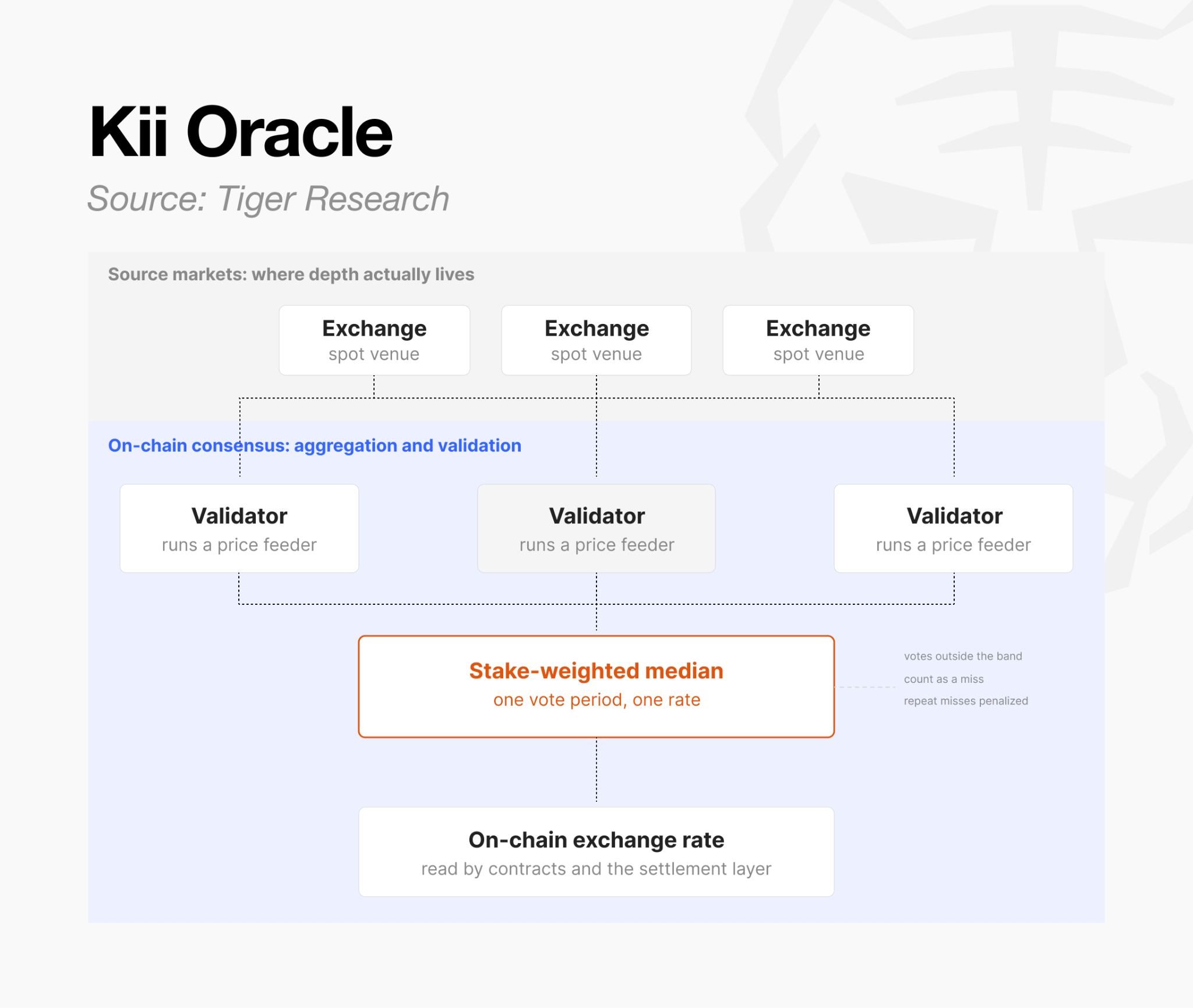
On-chain, the approach is to replace that closed interbank trust with open consensus among validators. Kii Oracle has trusted validators collect prices independently from multiple exchanges, then reaches consensus by computing a median weighted by each validator’s staked share. Values that fall far outside a predefined standard deviation are excluded automatically, which prevents a small group from moving the price by submitting extreme quotes.
The consensus mechanism aggregates and validates fragmented price data, which is a technical remedy rather than a source of the liquidity depth the interbank market holds. When the source market for a referenced local currency stablecoin is itself thin, the structure remains exposed to sharp price swings and distorted quotes regardless of how refined the oracle’s computation logic is.
Bottlenecks in traditional FX settlement arise mainly at the points where money enters and leaves the banking system, including account opening, compliance review, and limits on operating hours. Speeding up the middle of the process changes little if a transaction is blocked at the initial stage and cannot move to the next one.
KiiChain Pay does not remove those contact points. It bundles four routes for moving funds between fiat currency and digital assets, covering on-ramp, off-ramp, and swaps, into a single integrated API interface.
-
On-ramp: converts fiat currency into digital assets following KYC.
-
Off-ramp: withdraws digital assets to a bank account following KYC.
-
FX swap: a custodial digital asset exchange completed either through a contract or through provider processing.
-
DEX swap: a permissionless on-chain exchange with no KYC, routed through the LiFi router.
This integration improves access without resolving the bottleneck itself, because the on-ramp, the off-ramp, and FX swaps still depend on externally licensed operators, KYC, and the operating hours of off-chain providers.
The only segment that actually bypasses the banking bottleneck is the DEX swap, where fiat currency plays no part. Pricing carries a comparable limitation: the market API adds a spread to quotes from external liquidity providers, which amounts to resale at a margin rather than independent price discovery.
What KiiChain has built is not finance without intermediaries but something closer to a settlement layer where intermediaries can meet without regard to borders or business hours.
Some may ask what difference that makes. Building a new system that removes every intermediary is not realistic, however, because funds processed within a regulatory perimeter still require operators that hold KYC obligations and licenses.
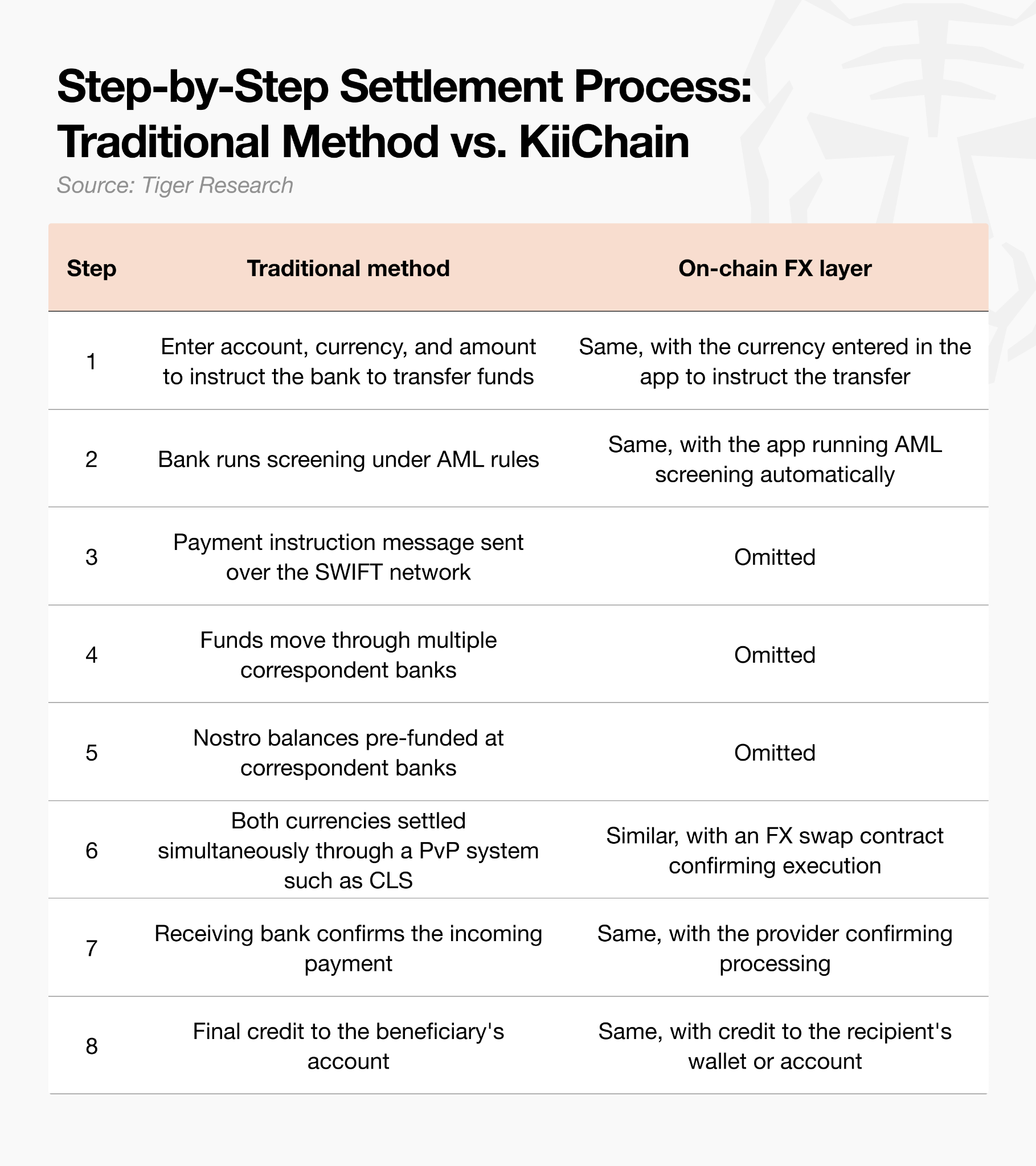
The actual reduction in the process is limited. Only three of the eight steps described disappear entirely, and the remaining five keep their basic structure, with a change in who performs them and in what they are called rather than the disappearance of the procedure itself.
The change resembles the consolidation of scattered currency exchange points into a single center. Converting pesos into dollars once meant visiting and waiting at different exchange houses in each country, each constrained by its own operating hours. KiiChain gathers these intermediaries onto one on-chain platform rather than removing them. The operational capacity that handles settlement remains, and convenience and speed improve because the parties interact in a single space where physical and temporal distance no longer applies.
Consolidating liquidity for local currency stablecoins from multiple countries onto a single chain carries real market value. Swaps between digital assets on the platform run automatically through smart contracts around the clock. The points at which actual fiat liquidity enters or exits, however, remain tied to the operating conditions of off-chain providers.
KiiChain’s effort therefore reads less as a full dismantling of the intermediary structure than as a process of refining and optimizing the persistent inefficiencies of the traditional financial system by moving the underlying infrastructure on-chain.
According to KiiChain, cumulative transaction volume has passed $500 million, with roughly 350 B2B2C corporate clients and a user base above 350,000. User growth has held at about 10% per month, gradually expanding the company’s position in the market.
The larger items on the roadmap remain at the concept stage, including an on-chain debit card, a payment network across 50 countries, stablecoin deposit products, unsecured lending, US virtual accounts, and an AI-driven automated settlement system. What KiiChain delivers in practice today is concentrated in its initial function as FX settlement infrastructure.
The company has only just reached the starting line.
Moving beyond a payment tool to an on-chain financial hub depends above all on drawing participants in the ecosystem together. Network effects emerge only when liquidity partners, multinational companies, and individual users interact within a single network, and that is what makes the shift to next-generation financial functions possible.
Whether that network effect materializes is still an open question, and execution is what will settle it. If KiiChain can turn its roadmap into working products and secure deep liquidity in emerging markets, it would move beyond a single blockchain built for FX settlement and toward a broader layer for how these markets move money on-chain.
Read more reports related to this research.This report was partially funded by KiiChain. It was independently produced by our researchers using credible sources. The findings, recommendations, and opinions are based on information available at publication time and may change without notice. We disclaim liability for any losses from using this report or its contents and do not warrant its accuracy or completeness. The information may differ from others’ views. This report is for informational purposes only and is not legal, business, investment, or tax advice. References to securities or digital assets are for illustration only, not investment advice or offers. This material is not intended for investors.
Tiger Research allows the fair use of its reports. ‘Fair use’ is a principle that broadly permits the use of specific content for public interest purposes, as long as it doesn’t harm the commercial value of the material. If the use aligns with the purpose of fair use, the reports can be utilized without prior permission. However, when citing Tiger Research’s reports, it is mandatory to 1) clearly state ‘Tiger Research’ as the source, 2) include the Tiger Research logo following brand guideline. If the material is to be restructured and published, separate negotiations are required. Unauthorized use of the reports may result in legal action