

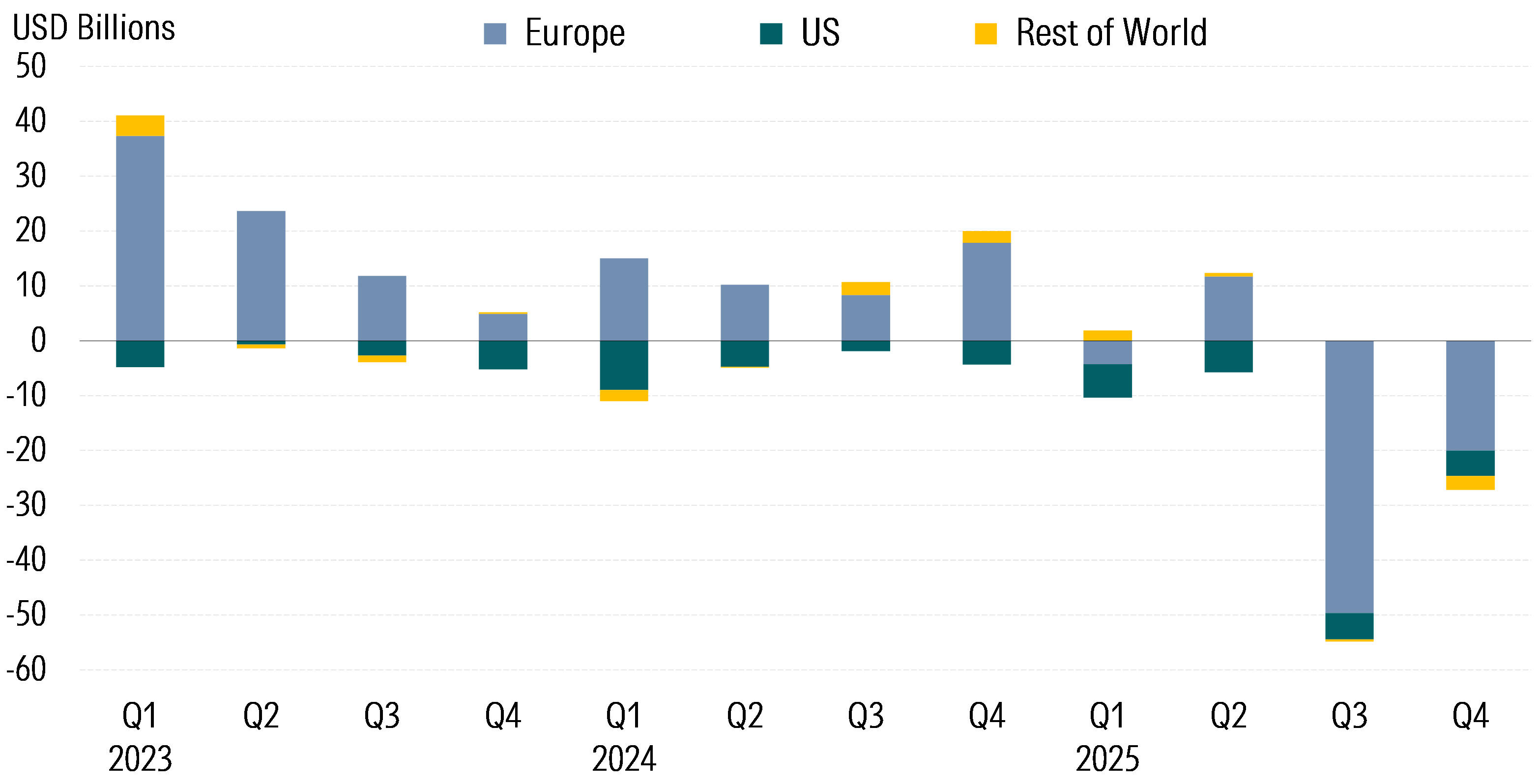
The global universe of sustainable mutual funds and exchange-traded funds recorded an estimated $27 billion in net outflows in the fourth quarter of 2025, compared with outflows of nearly $55 billion in the previous quarter.
Much of the outflows in both quarters came from redemptions by large UK institutional investors who reallocated their assets from standard, off‑the‑shelf ESG funds to bespoke ESG segregated accounts that give them more control over how their money is invested. Yet, the broader backdrop remained challenging, with persistent headwinds continuing to weigh on investor appetite.
As seen from Exhibit 1 below, all three geographies—Europe, US, and the rest of world—saw net outflows in the third and fourth quarters of the year.
The universe comprises open-end funds and ETFs focused on sustainability, impact, or ESG factors.
Global Fund Flows Over the Years
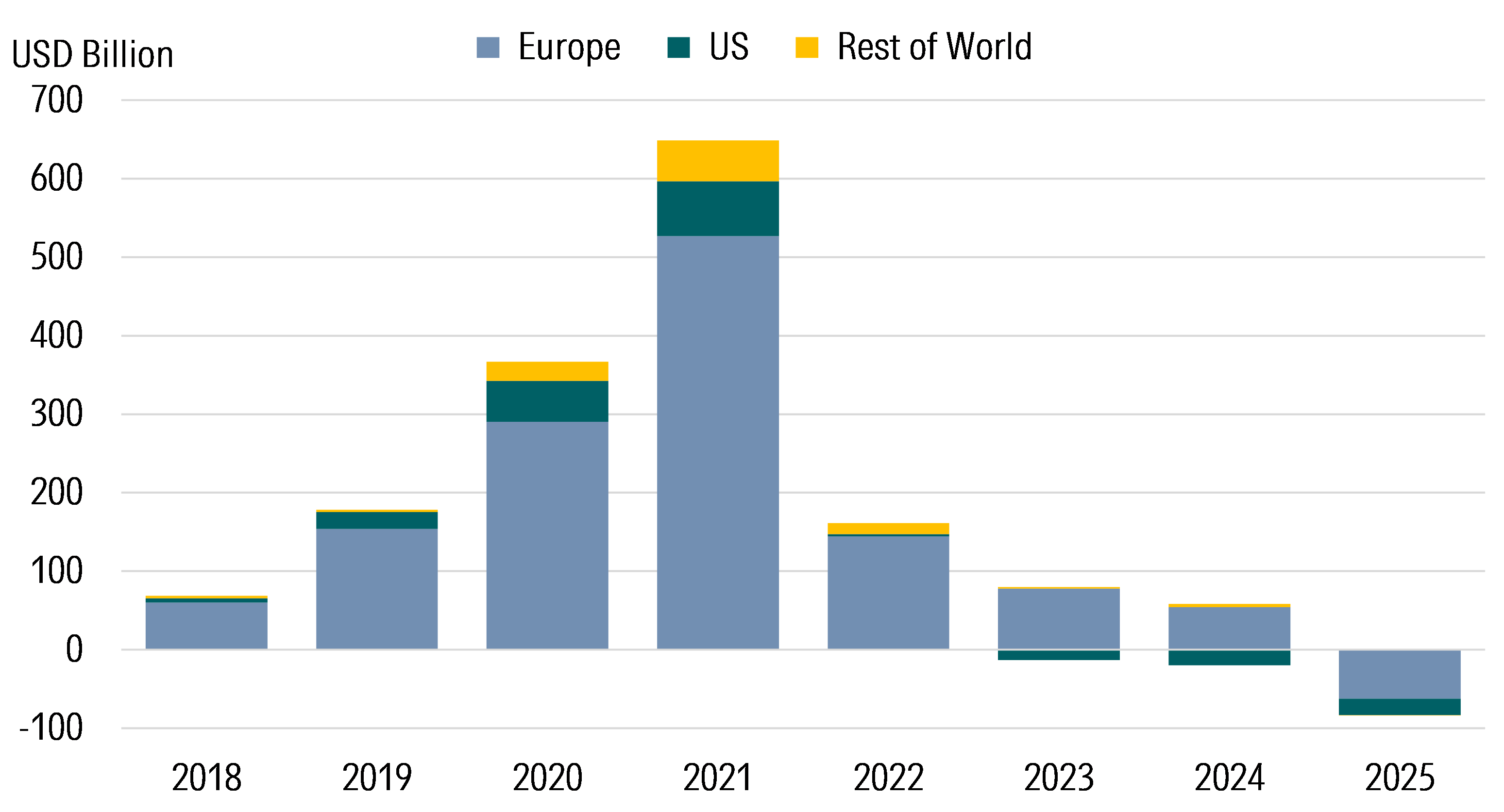
For full-year 2025, global sustainable funds saw $84 billion in net outflows, contrasting with the $38 billion in inflows recorded in 2024. This made 2025 the first year of annual redemptions since Morningstar began tracking the segment in 2018. It was also the first year of outflows for Europe and the rest of world, while being the third for the US.
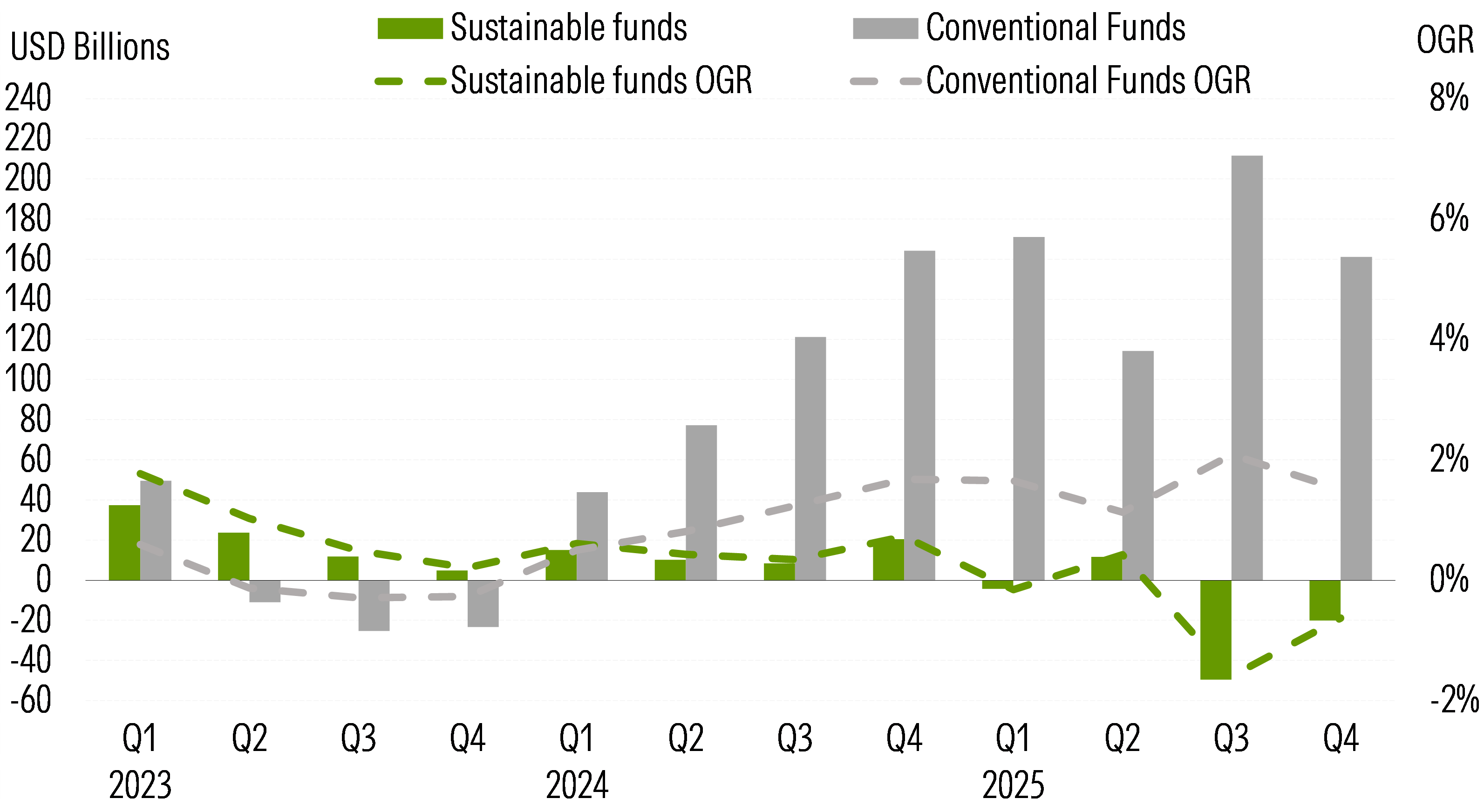
By contrast, the global open-end fund and ETF universe experienced inflows of almost $1.7 trillion over the last year.
The year 2025 was undeniably challenging for sustainable investing. Factors affecting investor appetite for sustainable funds include geopolitical tensions, anti-ESG sentiment, regulatory uncertainty, and mixed performance.
The outflows in 2025 and lower inflows experienced by sustainable funds in previous years contrast with several surveys showing continuous investor interest in sustainable investing. According to one conducted by the Morgan Stanley Sustainability Institute, 88% of global individual investors are interested in sustainable investing. Among these retail investors, the younger generation shows the greatest interest, signaling that sustainability will become an even stronger focus as their financial influence grows. Similarly, 86% of asset owners expect to increase allocations to sustainable investments in the next two years.
For more insights on sustainable investing, read: Sustainable Investing Trends to Watch in 2026.
Global Assets Edge Higher to $3.9 Trillion in an Up Market
Despite the continued outflows, global sustainable fund assets edged up by about 4% to over $3.9 trillion in the fourth quarter. The growth was primarily driven by stock market appreciation. For broader context, the Morningstar Global Markets Index advanced 3.3% over the fourth quarter and the Morningstar Global Corporate Bond Index inched up by 0.17%.
Since the end of 2018, global sustainable fund assets have grown more than sixfold, from roughly $600 billion, driven by growing investor interest in sustainability issues (particularly climate change), but also by supportive regulation (especially in Europe), improved ESG data, and product innovation.
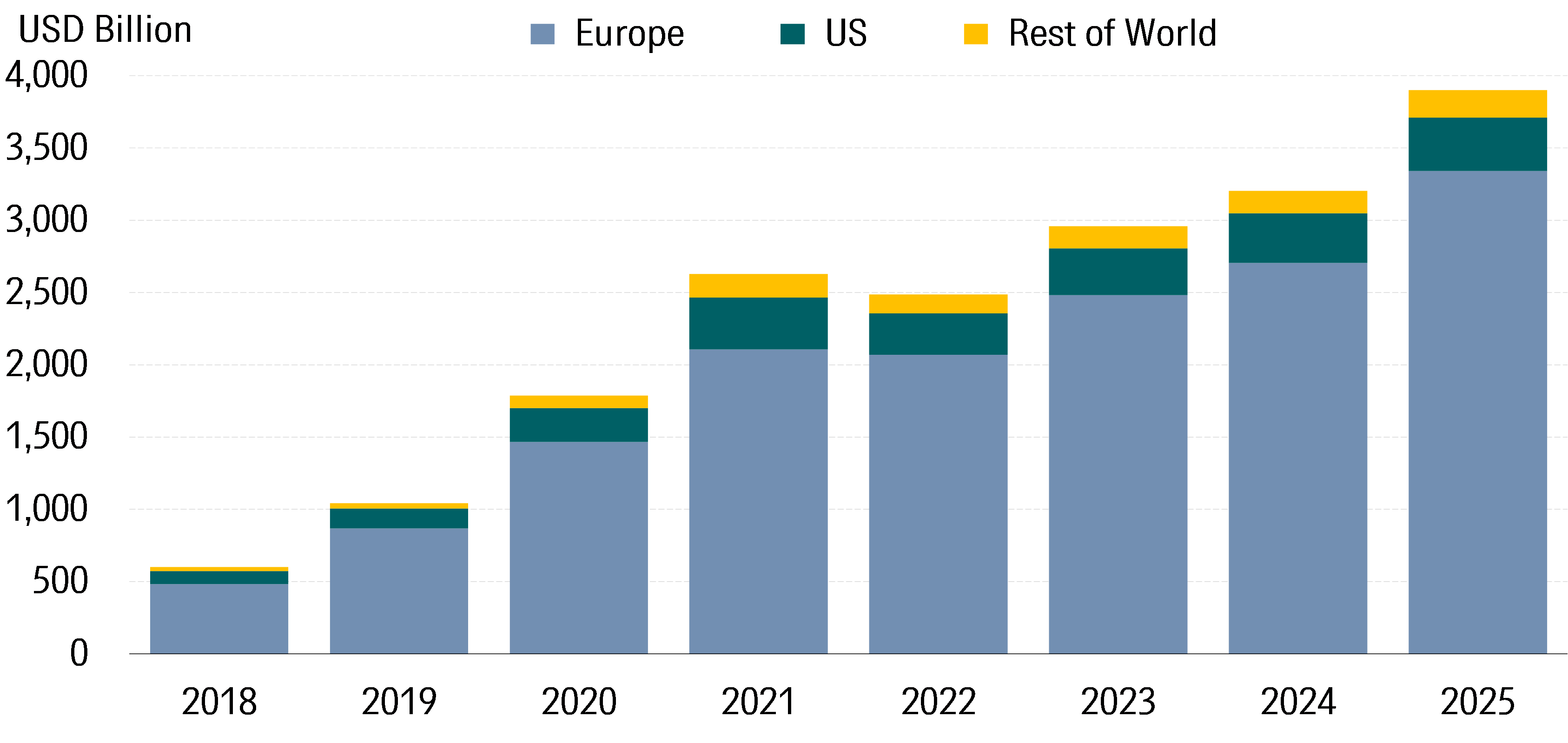
Europe accounts for almost 86% of global sustainable fund assets, followed by the US with 9%, and the rest of the world makes up the remainder. Sustainable funds represent approximately 20% of the overall European open-end fund and ETF universe, compared with just 1% in the US and varying shares across other regions.
European ESG Fund Outflows Driven by Large Asset Reallocations
The Europe-domiciled sustainable fund market experienced another quarter of net redemptions, totaling $20.0 billion in the final three months of 2025, following restated record outflows of $49.6 billion in the preceding quarter. A substantial share of the outflows over the past two quarters came from large UK institutional clients—such as BlackRock, Northern Trust, Scottish Widows—redeeming from pooled ESG funds and reallocating into bespoke ESG mandates (which are not accounted for in the Morningstar database).
Besides these in-house money reallocations, European sustainable funds faced significant headwinds in 2025 amid a complex geopolitical environment, where sustainability concerns were overshadowed by priorities such as economic growth, competitiveness, and defense. The political backlash against ESG investing in the US—and its spillover effects in Europe—have prompted asset managers to adopt a more cautious stance toward ESG initiatives, with some even scaling back their commitments. The situation was further complicated by lingering regulatory uncertainties as policies affecting sustainable investing continued to evolve, including the EU Omnibus Package and the review of the Sustainable Finance Disclosure Regulation.
Persistent performance challenges also damped investor appetite for sustainability-focused strategies. However, there was one bright spot in 2025: renewable energy stocks, which rebounded, ranking among the best-performing sectors. The Morningstar Global Markets Renewable Energy Index posted an annual gain of 24.8%, compared with a 17.4% return for the Morningstar Global Target Market Exposure Index and a 13.8% rise for the Morningstar Global Energy Index. The renewable energy sector’s outperformance in 2025 follows four years of poor stock returns, primarily due to elevated interest rates, materials inflation, and supply chain disruptions.
US ESG Funds Experience Outflows for the 13th Consecutive Quarter
Investors in the US continued to withdraw money from sustainable funds for the 13th consecutive quarter. Net redemptions reached $4.6 billion in the fourth quarter of 2025, following restated net outflows of $4.8 billion in the previous quarter and bringing the total annual outflows to $21 billion.
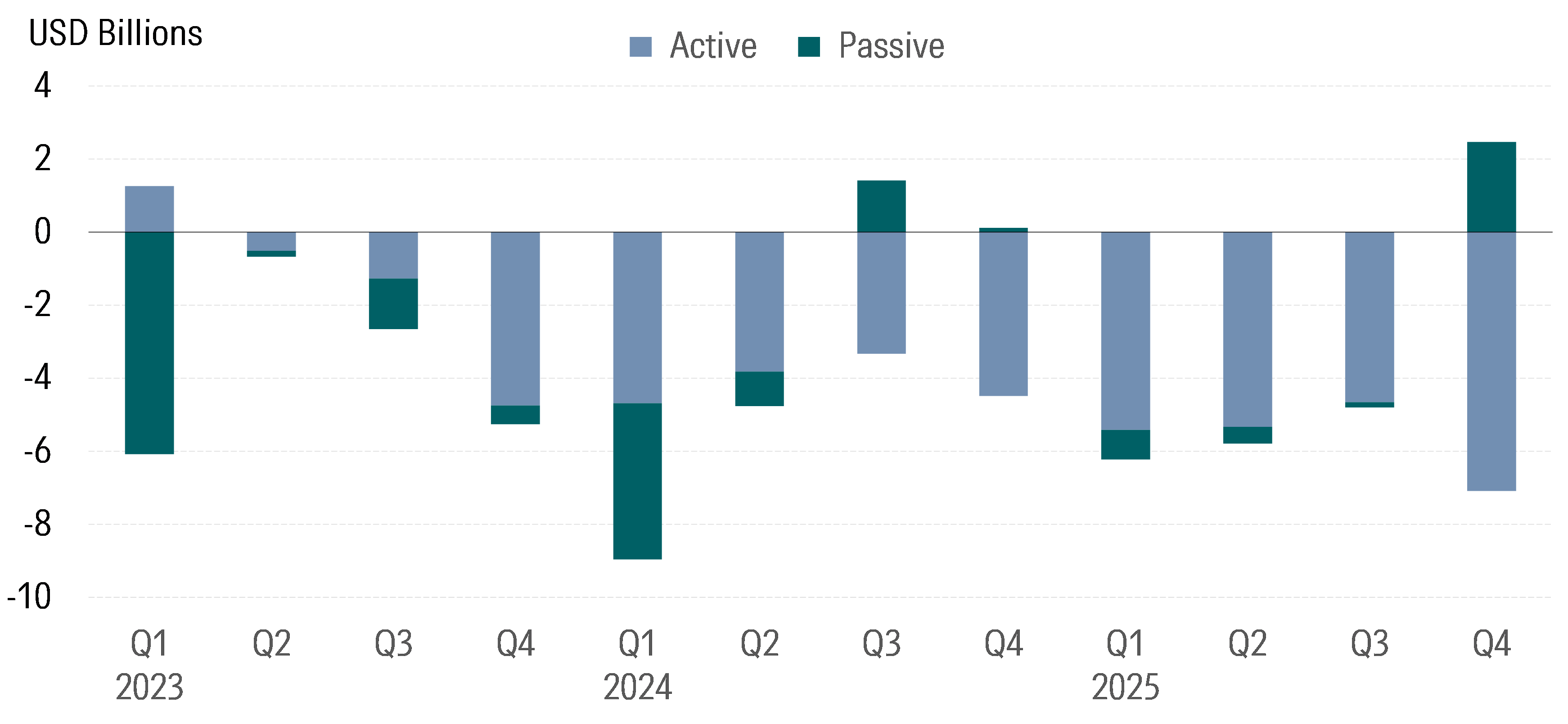
The reduced appetite among US investors for sustainable funds can be mainly attributed to the anti-ESG sentiment, which appears to have intensified in the wake of the new administration. The Donald Trump administration has taken several actions that aim to eliminate or weaken climate change-related and ESG initiatives. In this environment, many US asset managers have scaled back their ESG commitments and adopted a more cautious approach to promoting their sustainability credentials and sustainable-investment products.
Despite investors withdrawing money for three consecutive years, assets in US sustainable funds reached a record high at the end of 2025, driven by stock market appreciation. The record of $368 billion surpasses the previous peak registered in 2021. Asset growth in 2025 was primarily led by passive strategies, which now represent 46% of the total assets.
Asia Ex-Japan ESG Funds Record Third Quarterly Outflows in 2 Years
The Asia ex-Japan region posted $1.4 billion in net redemptions in fourth-quarter 2025, marking the third quarterly outflows in two years.
South Korea led the withdrawals, with $1.6 billion in outflows, while Taiwan registered $300 million in outflows, its first negative quarter since third-quarter 2023. Thailand remained a bright spot, attracting $452 million in inflows in the last quarter.
Meanwhile, China-domiciled sustainable funds recorded $2.2 billion of outflows in the third quarter of 2025 (fourth-quarter flow data was not available at the time of writing), their largest quarterly loss since the second quarter of 2022.
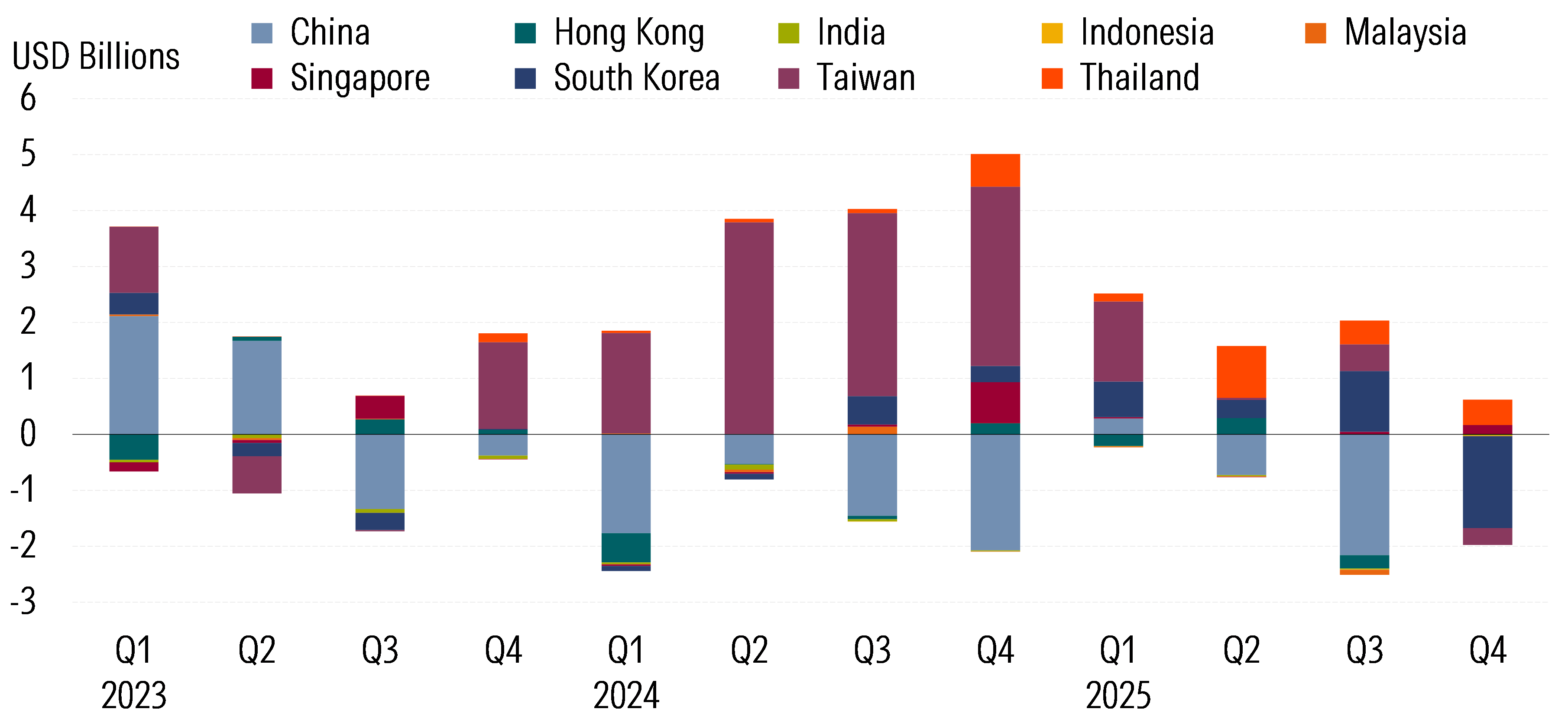
Total sustainable fund assets in Asia ex-Japan (including China) closed 2025 at approximately $90 billion, down 1.2% from the prior quarter’s assets under management. Passive funds represented $52 billion (58%), while active funds accounted for $38.2 billion (42%).
After China, Taiwan remains the second-largest market at roughly one-third of total Asia ex-Japan AUM. South Korea follows at 7.4% of total Asia ex-Japan assets, with Southeast Asian markets Thailand (3.5%) and Singapore (2.2%) rounding out the top five.
To check out the full report on fourth-quarter 2025 global ESG fund flows, click here.