
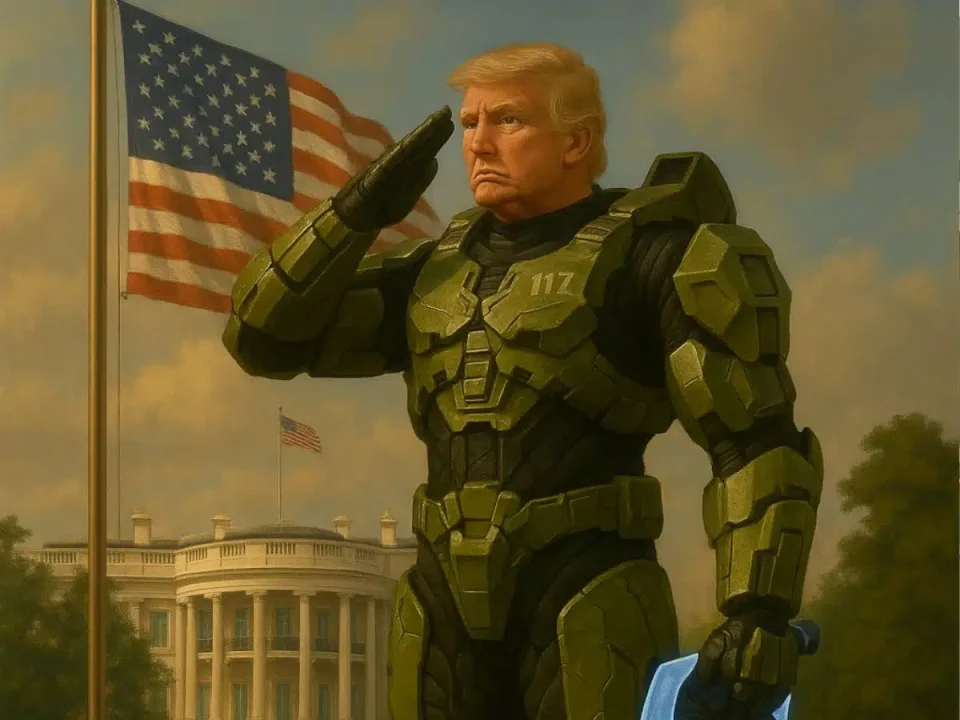
As the Canary reports, the White House spent last October recruiting ICE agents by using Halo video game memes. It cast agents as space marines and migrants as an alien invasion to be destroyed.
Last Friday, at the White House Correspondents’ Dinner, Trump wore his signature red cap, this time reading “Trump 2028,”, announcing his intention to run for president for a fourth time, which would break the USA’s two-term constitutional limit. He also insisted he had already won three elections, continuing to deny he lost the 2020 election to Biden.
The Guardian‘s write-up that night ran under the headline “Donald Trump dons ‘Trump 2028’ hat and jokes about ‘fourth term’.” But is it really a joke?
Trump’s 2028 campaign
Trump’s official store has sold the hat since April 2025, alongside a t-shirt that drops the joke format entirely and reads “Rewrite the Rules.” This October, Steve Bannon told the Economist that a third term was already mapped out, regardless of the Constitution:
Trump is going to be president in ’28, and people ought to just get accommodated with that.
When pressed for details, he offered only the following statement:
at the appropriate time, we’ll lay out what the plan is, but there is a plan.
In 2025, when Zelensky explained in a public meeting with Trump that Ukrainian law makes wartime elections difficult, Trump laughed and said:
So you’re saying if we happen to be in a war with somebody, no more elections?
This is how the 21st-century right normalises anti-institutional politics: performing it as a joke first.
Trump didn’t invent the impulse to break institutions, but he has innovated doing it with a wink, and now European radical-right figures are running the same play.
Meme as Method
Twentieth-century fascism performed solemnity, which allowed for it to be satirised by figures like Chaplin. Contemporary reactionaries instead beat satirists to the punch by pre-emptively satirising themselves.
Trump’s White House, for instance, reworked the viral travel-ad meme into “When ICE books you a one-way Jet2 holiday to deportation,” soundtracked over people being loaded onto a removal flight. The situation becomes laughably ridiculous – whether you think the meme is funny or absurd.
The meme then becomes the method. Whether entertained or outraged, it becomes almost impossible to tackle the situation with the due solemn discourse. ICE’s transgressions against American institutions are then scrolled past.
ICE’s constitutional violations
For example, the Fourth Amendment stipulates law enforcement need judges to issue warrants before entering people’s homes, but a DHS memo told agents they can enter homes to make arrests using “administrative warrants” signed by ICE’s own supervisors. Footage of these violations has since spread across social media.
Ohio State law professor Ric Simmons claimed the practice is “essentially authorizing a violation of fundamental rights we’ve had as Americans since the Bill of Rights was passed” in 1791 for citizens and non-citizens alike. The material for the meme is then fundamental violations of century-old legal rights, proving how unconservative the radical-right has become.
Of course, pointing out constitutional violations seems stuffy, humourless, and is a lot harder to fit into meme-format. The pearl-clutching critic then embodies the solemnity of the dysfunctional establishment, which is exactly what the right’s transgressive joke was designed to short-circuit.
Who is ‘in’ on the joke?
There’s a deeper social implication to refusing the joke too. If you laugh, you’re in. Objecting means you’re out.
Humour efficiently and implicitly delineates the in-group and out-group, who the joke is for and who it is against, who will go along with things and who will resist. That is the exact frame and information necessary for far-right politics. The left’s universalist politics cannot quite replicate that same tactic without undermining its own values.
The right also builds broad-based solidarity through this practice. Nearly everyone has told an off-colour joke and been corrected for it. When a politician gets hammered for “just a joke,” plenty hear an echo of that same telling-off, and side with the joker against what looks like the same finger-wagging authority.
American Wrongs for the European Right
The European right is replicating the Trumpian play. Rupert Lowe, leader of Restore Britain, offers the clearest case of the joke as cover. In a leaked recording, Lowe commented on a camera:
In days gone by, you’d call it a Jewish camera because it’s so small.
When Lowe received backlash, he trotted out the routine defence:
clearly a joke.
Later that year, however, Lowe advocated for banning kosher slaughter, referring to ‘two-tier slaughter’, adding that:
The British people have no idea that this is happening.
Presumably, of course, the British people who are Jewish, who eat kosher meat, are very aware this is happening. Here then, Lowe might be delineating Jews, whether British or not, as an out-group that the “British” in-group should no longer tolerate. His leaked joke then disguised a belief he would later state openly.
German humour, extra dry
Maximilian Krah, a leading figure in Germany’s far-right party AfD, replicates this posture on Al Jazeera‘s Head to Head with Mehdi Hasan. Throughout the interview, Hasan was trying to nail Krah on whether the AfD is an extremist organisation or not.
The stakes behind that label come from a German intelligence agency classifying the party as extremist. If accepted, the designation would open the door to surveillance powers, affect its state funding and the party’s standing before elections. For now, those consequences are suspended as a Cologne court has paused that classification pending appeal.
With respect to this situation, Hasan pressed Krah on whether the AfD was committed to remigration – a fringe far-right concept of ethnic cleansing via mass deportation. To do so, Hasan brought up a statement by Krah’s AfD colleague Björn Höcke – who has been twice convicted for using a banned Nazi slogan – suggesting that Germany could lose “20 to 30% fewer people” without problem.
When asked how you’d get there without deporting people with German citizenship, which arithmetically would have to happen for that kind of drop, Krah laughed it off:
I don’t know. He’s a sports teacher, not a math teacher. Ask him.
The joke meant the crowd laughed, Krah never answered the question, and Hasan had to move on.
Hasan built his name on an interviewing style that has caught out plenty of public figures, but Krah’s slippery posture helped him avoid answering questions that might incriminate his party in German courts.
The Sinner Who Repenteth
Lowe and Krah are still practicing their material out of office, and for their followers it’s still just fun. Nick Fuentes, the young online right’s closest thing to a spokesperson in Trump’s America, indicates how those followers might react when these far-right humourists get into power.
In a Channel 5 interview with Andrew Callaghan, Fuentes described how his white supremacist edgelording prior to Trump’s second term was a reaction to an America where, according to him, anybody “to the right of John McCain” got “no-platformed, censored, banned.” Now, however, Fuentes has dropped that posture, admitting:
Now that my kind of humor has become mainstream and popular, I don’t even think that’s funny anymore.
Fascist humour turns out to be a phase. Once the position it was smuggling in has arrived, there seems to be nothing left to laugh at anymore.
Featured image via X