
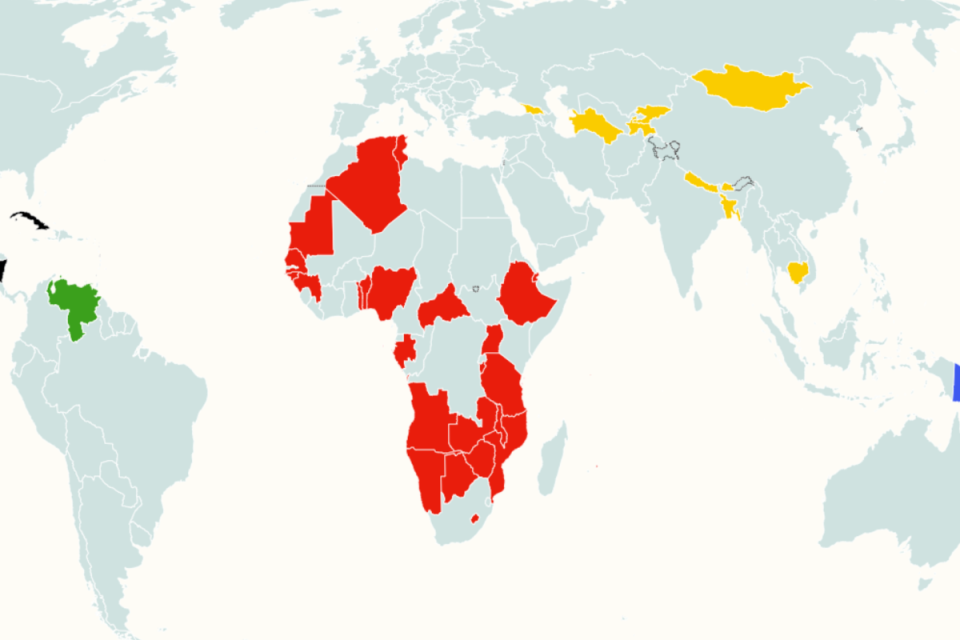
Visa applicants from 50 countries, most of them in Africa, will be forced to pay up to $20,000 in bonds in a program that is now being made permanent.
U.S. President Donald Trump’s administration launched the Visa Bond Pilot Program last August, requiring certain tourist and business visa applicants to post refundable bonds intended to discourage them from overstaying their visas.
The U.S. State Department said in a draft notice published Friday that the rule will be made permanent, after the yearlong program “provided sufficient data to suggest that a visa bond program is an effective tool for enforcing compliance among bonded visa holders.”
Under the permanent program, consular officers may set bonds at $10,000, $15,000 or $20,000 based on an applicant’s circumstances. Officers are generally expected to impose a $15,000 bond, lowering it to $10,000 when an applicant cannot afford that sum or raising it to $20,000 when the person’s ties to the U.S. suggest the standard amount may not be enough to ensure a timely departure.
That marks an increase from the pilot program, under which bonds were set at $5,000, $10,000 or $15,000. The money is intended to discourage travelers from remaining in the country after their authorized stay and is returned when the bond’s conditions are met, including leaving the U.S. on time.
The 50 affected countries accounted for 45,488 overstays in the financial year 2024, compared with fewer than 50 during the pilot’s first 10 months, the State Department said.
Visa issuance to their nationals also fell 83 percent compared with the same period a year earlier, partly because thousands of otherwise eligible applicants did not pay the required bond.
Which Countries Are Subject to Visa Bonds?
The rule applies to people traveling on passports issued by those countries, regardless of where they submit their visa application. The State Department may revise the list on a rolling basis. Newly designated countries must generally receive at least 15 days’ notice, while removals may take effect immediately.
- Algeria
- Angola
- Antigua and Barbuda
- Bangladesh
- Benin
- Bhutan
- Botswana
- Burundi
- Cabo Verde
- Cambodia
- Central African Republic
- Côte d’Ivoire
- Cuba
- Djibouti
- Dominica
- Ethiopia
- Fiji
- Gabon
- The Gambia
- Georgia
- Grenada
- Guinea
- Guinea-Bissau
- Kyrgyz Republic
- Lesotho
- Malawi
- Mauritania
- Mauritius
- Mongolia
- Mozambique
- Namibia
- Nepal
- Nicaragua
- Nigeria
- Papua New Guinea
- São Tomé and Príncipe
- Senegal
- Seychelles
- Tajikistan
- Tanzania
- Togo
- Tonga
- Tunisia
- Turkmenistan
- Tuvalu
- Uganda
- Vanuatu
- Venezuela
- Zambia
- Zimbabwe
How Much Will Applicants Have To Pay?
Consular officers will generally set the bond at $15,000, but they can adjust it after considering the applicant’s individual circumstances.
The amount may be lowered to $10,000 if the person cannot afford the standard bond but can still finance their planned trip. It may be raised to $20,000 if factors such as the applicant’s ties to the United States suggest that $15,000 would not provide sufficient assurance that they will leave on time.
Officers may consider the purpose of the trip as well as the applicant’s employment, income, skills and education. The amount is not automatically determined by the person’s country of origin.
The bond is refundable. The money will be returned to the person who paid it if the traveler complies with the terms of the visa and leaves the United States by the end of their authorized stay. It will also be refunded if the visa holder does not travel before the visa expires or is denied admission at a U.S. port of entry.
Contact Newsweek editors on this story: Matthew Robinson and Trevor Davies.