
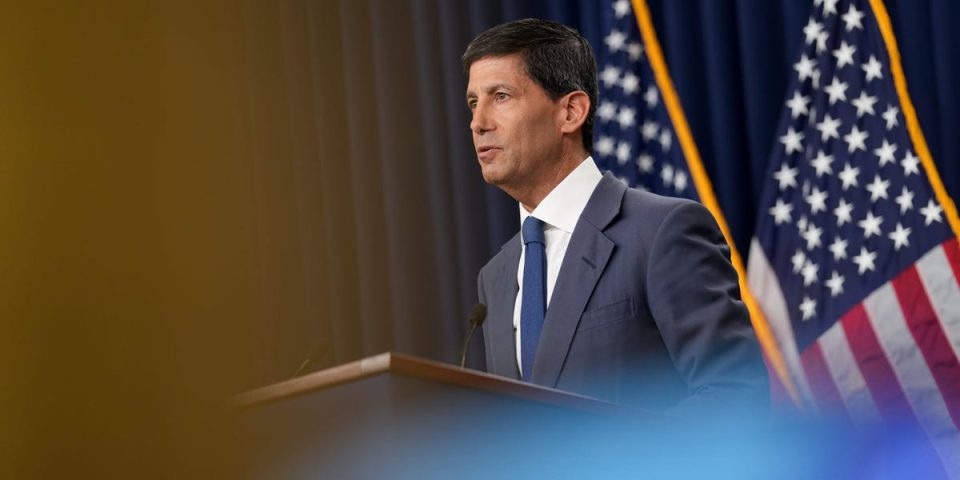
The bond market is sending another warning on inflation. This time, it’s directed at Kevin Warsh.
The newly appointed Fed Chair struck a dovish tone following the central bank’s July policy meeting on Wednesday, announcing that the Fed would keep interest rates unchanged, and would continue withholding forward guidance on where rates were headed through the end of the year.
It was the last thing investors wanted to hear, causing a sell-off in US Treasurys to accelerate as the market fretted about inflation running out of hand.
The 30-year US Treasury yield, a reflection of the market’s long-term rate expectations, spiked as high as 5.24% Thursday morning, its highest level in 19 years. Since May, the yield has hovered around its highest level since 2007, and remained above the critical 5% threshold.
The benchmark 10-year US Treasury yield also jumped post-presser, rising as high as 4.71%. The yield has remained above the key 4.5% threshold for most of the last month.
Stock investors also weren’t happy. All three major indexes sank in the red, with the Nasdaq 100 closing more than 10% off from its record-high. It marked the sixth-straight day of losses for the index, its longest losing streak since 2022.
The market’s logic goes something like this: investors are concerned that rates may not be restrictive enough to contain inflation. That could push price growth swiftly higher — something that would lead to higher rates in the long run.
It’s a sign, in other words, that investors are no longer feeling so confident that the Fed has a firm grip on inflation, especially considering that oil prices reclaimed the critical $100-a-barrel mark earlier this month as conflict heated back up in the Middle East.
Brent crude, the international benchmark, briefly surged to $92 a barrel on Thursday as the US retaliated against Iran’s latest attacks on American forces in Jordan. West Texas Intermediate crude also briefly ticked up to $85 a barrel before giving up its gains.
Warsh reiterated the Fed’s 2% price target, but seemed to offer “little explanation as to why the Committee chose not to raise rates,” Seema Shah, the chief global strategist at Principal Asset Management, said.
“This disconnect — between the Fed’s stated commitment to price stability and its decision to remain on hold — has raised questions about the consistency of the policy message. Market reaction reflected this uncertainty,” she wrote in a note.
Markets are likely taking issue with some of Warsh’s comments in the post-meeting presser, such as his suggestion that markets have already tightened monetary policy on their own, Aditya Bhave, an economist at Bank of America, wrote in a client note on Thursday.
Higher yields in themselves tighten financial conditions, which can help tame inflation, though the jury is still out on whether the tightening effect of higher rates is enough, given inflationary pressures in the economy.
“Markets responded by questioning the Fed’s credibility,” Bhave said. “Ironically, we think the need to re-establish credibility increases the probability that the Fed will hike in September, all else being equal.”
The odds that the Fed will hike rates 25 basis points ticked up to 59% Thursday morning, up from a 57% chance priced in yesterday, according to the CME FedWatch tool.
Kevin Warsh looked like he failed his first “credibility test,” the market veteran Ed Yardeni wrote in a client note Wednesday evening.
“Once again, the Bond Vigilantes are pushing bond yields higher,” the Yardeni President said, referring to investors who stage a sell-off in government bonds to protest inflationary or fiscally lenient policies. “In effect, they are saying that if the Fed won’t be vigilant about inflation, then they will have to maintain law and order in the economy.”
Investors remain acutely aware of the parallels to the 1970s, when oil prices spiked and sent inflation spiraling out of control. Around the time inflation hit its 1974 peak, the Fed cut rates prematurely to boost economic growth, leading price growth to heat up again and hit a higher peak in 1980.
“We believe Fed Chair Warsh is experimenting with ‘Odyssean’ loose forward guidance: loosely promising rate hikes later in exchange for disinflationary effects today,” researchers at BNP Paribas wote in a note on Thursday. “Without a suggestion of imminent action on rate hikes, we think this credibility will keep getting priced out of markets.”