
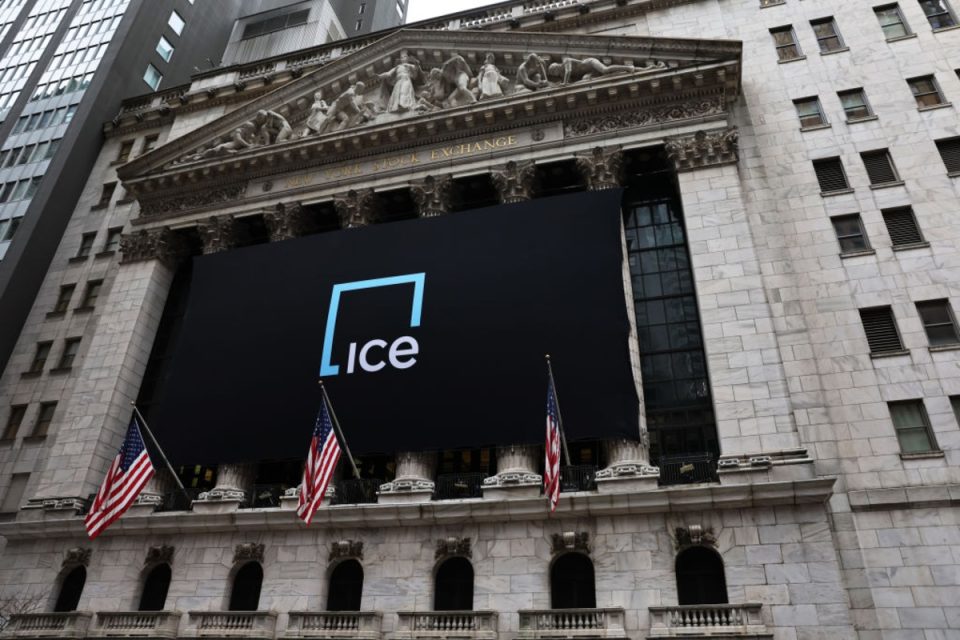
Intercontinental Exchange — the parent company of the New York Stock Exchange — agreed on Thursday to buy MarketAxess Holdings in a $6 billion all-cash deal that will unite the dominant institutional bond-trading platform with ICE’s existing retail fixed income marketplace, pricing data empire, and global index franchise under a single owner. The announcement, timed to ICE’s stronger-than-expected second-quarter earnings, immediately reshaped the competitive landscape for Tradeweb and Bloomberg, the two well-capitalized rivals that MarketAxess had already been losing ground to before the deal was struck.
Under the terms disclosed Thursday morning, ICE will pay $167 per share in cash for all outstanding MarketAxess shares — a 33% premium over Wednesday’s closing price — for an equity value of approximately $6.0 billion and an enterprise value of approximately $5.7 billion, equal to roughly 10.6 times MarketAxess’s last-twelve-months EBITDA on a pro-forma synergized basis. MarketAxess shares surged approximately 28% in premarket trading, clawing back a significant portion of the nearly 31% the stock had shed year-to-date. ICE shares rose roughly 1.7% on the news, buoyed also by the company reporting Q2 2026 net revenues of $2.67 billion — beating the $2.63 billion consensus estimate — with GAAP earnings per share of $1.69, up 14% year over year.
The combined entity will need MarketAxess stockholder approval and standard regulatory clearances before it can close, which is expected to occur in the first half of 2027.
MarketAxess Had Already Fallen Behind Tradeweb Before This Deal
The deal’s backstory is important. MarketAxess spent two decades as the uncontested leader in institutional electronic bond trading after it launched Open Trading in 2012 — the industry’s first all-to-all bond marketplace, which allowed any participant to trade directly with any other participant rather than only routing orders through a narrow set of dealer banks. But in June 2026, the month before the ICE deal was announced, MarketAxess fell behind Tradeweb in the ongoing race for US credit electronic trading market share — a first that underscored how real the competitive pressure had become.
In the second quarter of 2026, MarketAxess reported total revenues of $218.4 million, essentially flat year over year, while average daily trading volume dropped 11%. Total credit commission revenue declined 5% compared with the prior year, driven by lower US credit fees and a shift in protocol mix. By contrast, ICE’s own Fixed Income and Data Services segment posted an 8% revenue jump in Q2 to $645 million. The competitive divergence made a combination more attractive to both companies — and made MarketAxess a more affordable target.
ICE simultaneously increased its quarterly share repurchase authorization to $400 million from $350 million, signaling confidence in its post-deal capital position despite planning to finance the acquisition entirely through newly issued debt — a combination of bonds, a term loan, and commercial paper. Starting gross leverage is expected at approximately 3.4 times EBITDA, with a targeted return to 3.0 times or below within 18 to 24 months.
What ICE Is Actually Buying: Open Trading and the All-to-All Protocol
The strategic prize in this deal is not just MarketAxess’s 2,100 institutional clients across more than 90 countries — it is a specific piece of trading technology that has no direct equivalent at any other firm and that ICE has never owned: a working, scaled, all-to-all bond trading network.
In traditional bond trading, an institutional investor wanting to sell a block of Apple corporate bonds contacts three to five dealer banks, requests competitive quotes (the “request for quote” or RFQ model), picks the best bid, and executes bilaterally with that dealer. The dealer takes on risk, hedges elsewhere, and earns a spread. Information about what anyone else was willing to pay stays private. The result: a market that favored dealers and penalized smaller institutions who lacked the relationships to get competitive quotes.
Open Trading, launched by MarketAxess in 2012 and now covered by multiple patents, breaks that structure. Under the all-to-all model, any participant — institutional investor, global dealer, regional dealer, specialist market maker, or proprietary trading firm — can post or respond to orders in a centralized anonymous pool. MarketAxess itself becomes the matched-principal counterparty to both sides of every trade simultaneously, clearing and settling back-to-back, which preserves anonymity and eliminates bilateral counterparty risk. By 2022, more than 1,700 firms were participating in Open Trading across both sides of every trade.
One critical limitation: research by Hendershott, Livdan, and Schurhoff, and confirmed in a Federal Reserve Bank of New York analysis published in February 2025, found that even with Open Trading in place, dealers have remained by far the most important liquidity providers on the platform. All-to-all protocols supplement dealer intermediation — they do not replace it. That limitation matters for evaluating how much additional liquidity the combined platform can actually unlock, versus simply broadening existing dealer-to-client channels through a larger distribution footprint.
Electronification Has Only Just Passed the Halfway Point in IG Bonds
The deal arrives at a structural inflection point in a market that has long resisted electronification. In 2013, only about 8% of investment-grade corporate bonds traded electronically. By 2025, that share had climbed to approximately 50% — but that means the other half of the market still trades by voice, phone call, and bilateral dealer negotiation. High-yield corporate bonds remained only about 33% electronic as of early 2026. Fixed income trading volumes grew 44% year over year in 2025 as electronification accelerated.
That remaining half of unelectronified institutional bond trading — across a global market with an estimated $145.1 trillion in outstanding debt — represents the growth opportunity ICE and MarketAxess are combining to pursue. US corporate bond issuance reached $1.01 trillion through April 2026 alone, up 28.2% year over year, a pace driven by AI infrastructure spending, corporate refinancing waves from debt issued during the 2020-2021 low-rate era, and M&A activity.
Tradeweb and Bloomberg Can Still Compete — but the Terms Change
Both Tradeweb and Bloomberg maintain formidable positions and neither is sitting still. Tradeweb’s integration with BlackRock’s Aladdin order management system has given it a structural advantage in high-yield institutional credit: orders can be staged within Aladdin and directly executed via Tradeweb without re-keying, reducing friction in a workflow where milliseconds matter. Tradeweb CEO Billy Hult, speaking to analysts on the firm’s Q1 earnings call, described the Aladdin integration as a key component of Tradeweb’s credit market growth strategy.
Bloomberg’s bond platform remains deeply embedded in the terminals that sit on virtually every institutional trading desk globally, giving it a distribution advantage that predates electronic trading entirely.
A Bloomberg Intelligence analysis estimated that before this deal, MarketAxess held approximately 14% share of the addressable fixed income market, while Tradeweb held approximately 24% and ICE approximately 9%. The combined ICE-MarketAxess entity, at approximately 23% share, would pull close to but not necessarily exceed Tradeweb’s position — and Tradeweb’s integration with Refinitiv/LSEG gives it its own data and index resources. Note that this data is from 2023 and current shares have shifted (MarketAxess fell behind Tradeweb in the more recent period).
Antitrust reviewers are expected to consider the continued presence of Tradeweb and Bloomberg as well-capitalized competitors when evaluating whether the combined ICE-MarketAxess entity raises concentration concerns. No DOJ or FTC challenge has been filed as of this writing — the deal was announced this morning — but the regulatory review process will begin when the parties file the required notices.
One Entity Will Run Both the Exchange and the Benchmark
The aspect of this deal that has attracted the least attention in today’s announcement materials is arguably the most structurally significant: what the combined ICE-MarketAxess entity will mean for the relationship between fixed income execution and fixed income benchmarking.
ICE already owns the ICE BofA bond index family — among the most widely used benchmarks for measuring corporate bond portfolio performance globally. When a portfolio manager evaluates whether their trading desk got a good execution price on a bond trade, they frequently compare the execution to an index price derived from ICE’s data infrastructure. After this acquisition closes, that same infrastructure will also own the primary electronic network through which institutional managers execute those trades.
That combination — running the market’s leading index benchmarks and the market’s leading electronic execution platform simultaneously — creates a structural conflict of interest that has no prior parallel in US fixed income. The concern is not that ICE will necessarily exploit this position, but that investors and their clients will have no independent benchmark to evaluate whether execution on the ICE-owned network is priced fairly relative to ICE-owned reference data. Regulatory attention to this vertical integration question will likely accompany the standard antitrust review of the deal’s horizontal concentration effects.
ICE CEO Jeff Sprecher described the acquisition in terms consistent with the company’s long-stated strategy. “For more than two decades, ICE has pursued a clear and consistent strategy: take the largest, least-efficient corners of global finance and apply technology and network effects to improve transparency,” he said. “That is what we did in energy, in credit default swaps, and in mortgage technology. Acquiring MarketAxess is the natural next step in that journey.”
ICE CFO Warren Gardiner called the deal financially disciplined. “We are acquiring a high-quality, cash-generative business,” he said. “Our balance sheet strength allows us to finance this acquisition entirely in cash while maintaining our plans for returning capital to shareholders.” The transaction is expected to be accretive to adjusted earnings per share in the first full year following close, aided by a projected $100 million in annual run-rate expense synergies expected within three years.
MarketAxess CEO Chris Concannon, who joined the company in 2023 after senior roles at CBOE Global Markets and Virtu Financial, framed the deal as a capability combination. “MarketAxess contributes a leading fixed-income trading network and deep market expertise, while ICE brings additional retail and wealth trading protocols, strong data, connectivity, and a broader set of product capabilities,” he said. “Together, we will have the scale to invest more deeply in the areas that matter most to our customers.”
What Concannon’s statement does not say — but what the competitive record implies — is that MarketAxess needed the scale it could not build fast enough on its own. Tradeweb pulled ahead in US credit e-trading in June. The company withdrew its 2026 annual guidance and suspended its monthly volume releases immediately upon announcing the ICE deal. The trajectory made consolidation the rational outcome.
The combined platform, if it clears regulatory review and closes on schedule in early 2027, will serve every segment of the fixed income market through a single interconnected system — from pre-trade analytics and price discovery through electronic execution and post-trade data, benchmarking, and compliance. Whether that integration is primarily good for clients (more liquidity, lower costs) or primarily good for ICE (pricing power, data lock-in) is the question that antitrust reviewers, institutional investors, and Tradeweb’s product teams will each be working to answer in the months ahead.
Frequently Asked Questions
What does the ICE-MarketAxess deal mean for bond traders and institutional investors?
In the near term, nothing changes — the deal is expected to close in H1 2027 and will require MarketAxess stockholder approval and regulatory clearances first. If it closes as described, institutional investors across more than 90 countries would gain access to a unified platform spanning electronic execution (MarketAxess’s Open Trading all-to-all network), retail and wealth bond trading (ICE Bonds), and pre-trade and post-trade analytics (ICE’s data services and index franchise). ICE has projected that the combined platform will deliver lower transaction costs and a better trading experience. Whether that promise survives regulatory conditions or integration complexity remains to be seen.
Will the ICE-MarketAxess deal face antitrust scrutiny?
Yes, standard antitrust review is required and will begin when the parties file the applicable regulatory notices. Antitrust analysis will likely center on two dimensions: horizontal concentration in institutional electronic bond trading execution (where the combined ICE-MarketAxess entity would approach Tradeweb’s market share), and vertical integration concerns about one entity simultaneously owning the leading electronic execution network and major fixed income index and pricing benchmarks. The continued presence of Tradeweb and Bloomberg as well-capitalized competitors is expected to reduce — though not eliminate — concentration risk concerns. No government challenge has been filed as of today.
How does Open Trading differ from traditional request-for-quote bond trading?
In the traditional request-for-quote model, an institutional investor contacts a small number of dealer banks to request competitive bids or offers, then executes bilaterally with the best-quoting dealer. Price information stays private, and the investor’s negotiating position depends heavily on their relationships with dealers. In Open Trading, MarketAxess acts as the matched-principal counterparty to both the buyer and seller simultaneously, enabling any participant — not just major dealers — to post or respond to orders anonymously in a centralized pool. Research from the Federal Reserve Bank of New York confirms that dealer banks still dominate liquidity provision even on Open Trading, but the all-to-all structure has expanded the pool of potential counterparties and improved price discovery for smaller institutional clients.
What happens to MKTX shareholders?
Under the terms agreed Thursday, MarketAxess stockholders will receive $167 per share in cash for each share they hold — a 33% premium to Wednesday’s July 29 closing price. Shareholders who bought at or below that price stand to capture the full premium. Shareholders who held through MarketAxess’s nearly 31% year-to-date decline before Thursday’s announcement are in a more mixed position depending on their cost basis. The deal is expected to close in H1 2027, meaning shareholders approved in the stockholder vote will receive cash consideration at closing, not immediately.