
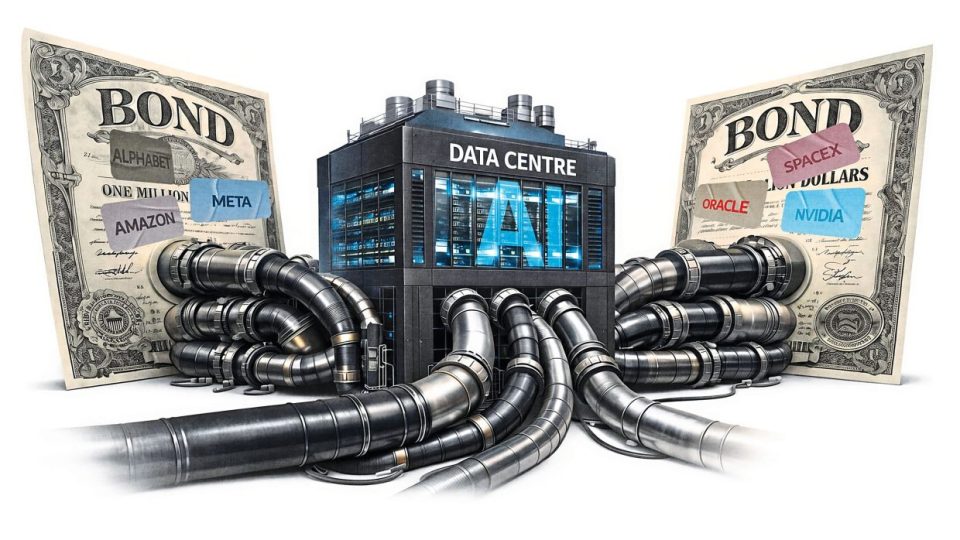
THE technology sector’s race to build artificial intelligence (AI) infrastructure is expected to keep fuelling record-sized bond sales, although investors are becoming increasingly selective as the wave of mega issuance stretches the limits of demand.
According to a Bloomberg report, what was once an extraordinary financing exercise reserved for blockbuster corporate takeovers has rapidly become standard practice for the world’s largest technology companies.
The newswire reported that bond offerings of at least US$25bil are now emerging as the preferred funding tool for hyperscalers seeking to finance AI-related investments, including data centres, chips and cloud infrastructure.
The trend gathered further momentum after Amazon.com Inc completed its latest US$25bil bond sale earlier this month, marking the seventh time in 2026 that a technology company had raised at least US$25bil in a single debt offering. Bloomberg noted that this already exceeds the total number of such jumbo transactions completed over the previous six years combined.
While the market has so far absorbed the unprecedented borrowing, signs are emerging that investors are becoming more cautious as repeated trips to the debt market increase exposure to the same issuers.
According to Bloomberg, Amazon’s latest sale attracted orders worth only about 1.6 times the amount offered, a noticeable decline from the demand generated by its previous issuance earlier this year and below the average order levels seen across comparable deals in 2026.
The softer reception highlights growing pressure in the investment-grade credit market, where institutional investors are balancing the appeal of high-quality technology issuers against concentration risks as AI spending accelerates.
“People are anticipating so much supply, and they don’t want to get too full on a name already, because they know companies are going to have to come back to market again only a few months later,” Bloomberg quoted Wellington Management portfolio manager Brij Khurana as saying.
Compelling advantages
Investor appetite also appeared less robust during SpaceX’s jumbo bond sale last month.
Bloomberg reported that the aerospace and satellite company secured final orders of around US$73bil for its US$25bil offering, while the bonds later weakened relative to US Treasuries in secondary trading, suggesting some investors quickly sold their holdings rather than retaining them.
Despite the cooling demand, large bond offerings continue to offer compelling advantages for both issuers and investors.
For technology companies, raising tens of billions of US dollars in one transaction reduces execution risk and allows them to secure funding in fewer visits to the debt market.
It can also lower overall financing costs while ensuring sufficient capital is available for long-term AI investments.
Bloomberg reported that Amazon, Alphabet Inc, Nvidia Corp, Meta Platforms Inc, Oracle Corp and SpaceX have collectively raised about US$182bil through US dollar-denominated investment-grade bond sales so far this year, compared with less than US$13bil during the same period last year.
The six companies now account for almost 15% of total US investment-grade bond issuance in 2026 and more than half of the increase in overall market supply, underscoring the growing influence of AI-related financing on global credit markets.
“The market has proven that it has the ability to absorb large deals, and from an issuer perspective, there’s the added advantage of reducing execution risk by reducing the number of trips to the new issue market,” Bloomberg quoted Bank of America head of investment-grade syndicate Dan Mead as saying.
Caution warranted
The appeal extends to investors as well. Large bond issues tend to be more liquid in secondary markets because they are widely held by institutional investors, making them easier to trade than smaller offerings.
Bloomberg also reported that these jumbo transactions generally come with a yield premium over existing debt issued by the same companies.
Amazon’s latest bonds, for example, were priced between 12 and 22 basis points above its outstanding securities, significantly higher than the average new issue concession across the broader investment-grade market this year.
The concentration of highly rated technology issuers is also lifting the overall quality of the investment-grade universe, an outcome that some large asset managers see as beneficial over the longer term.
Bloomberg cited Amundi chief investment officer for global fixed income Gregoire Pesques as saying the increase in both the size and frequency of mega bond sales would ultimately deepen market liquidity and create more opportunities for relative-value investing.
Historically, debt offerings of this scale were largely associated with transformational mergers and acquisitions.
Bloomberg pointed to Verizon Communications’ US$49bil bond sale in 2013, which helped finance the purchase of Vodafone Group’s stake in Verizon Wireless, and Anheuser-Busch InBev’s US$46bil issuance in 2016 to fund its acquisition of SABMiller.
Today’s borrowing boom, however, is being driven by AI rather than acquisitions.
The enormous capital required to build AI infrastructure is reshaping financing norms across global credit markets.
Bloomberg notes that JPMorgan Chase & Co strategists estimate AI infrastructure spending could reach US$5.5 trillion by 2030.
This includes around US$2.1 trillion of data-centre financing expected to be raised through investment-grade bonds over the next five years.
Such issuance is becoming large enough to influence the performance of the broader US investment-grade bond market.
Because benchmark indices increasingly include these sizeable transactions, fund managers who avoid participating risk underperforming their peers if the bonds perform well.
“You could just be neutral on a name, but neutral means you should buy,” Bloomberg quoted GW&K Investment Management portfolio manager Brett Kozlowski as saying.
Even so, some investors believe the rapid pace of borrowing warrants greater caution as AI investments mature.
Bloomberg reported that Loop Capital Asset Management chief investment officer for fixed income Scott Kimball expects the market will eventually reassess AI-related debt valuations as investors begin scrutinising whether massive infrastructure spending translates into sustainable earnings growth.
“This debt is all fresh, it’s new on the market,” Kimball says.
But as “this cycle continues to mature, and the economic outlook becomes a little shakier, I think in that instance you have more of a window for this debt to reprice.”