
U.S.-Iranian ex-diagnosis ⑤ U.S. debt dilemma
![Protesters hold signs targeting U.S. President Donald Trump in Mashhad, Iran, on June 9, when Iran's Supreme Leader Ali Khamenei's funeral was held. On the previous day, President Trump declared that the ceasefire with Iran was over. [Reuters Yonhap News]](https://wimg.mk.co.kr/news/cms/202607/12/news-p.v1.20260709.62be633e37674b44af35265146ac3583_P1.png)
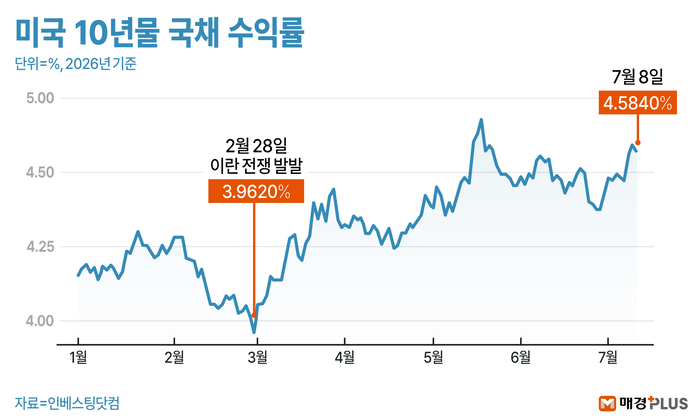
U.S. President Donald Trump declared that the ceasefire with Iran is over ahead of the NATO summit on July 8. The previous day, the U.S. military struck Iran again. The bond market and the raw material market moved together immediately after the remarks. The U.S. 10-year Treasury yield rose to 4.58%, up 0.1 percentage point this week alone. Brent crude rose 9% this week to $78.85, approaching $80 for the first time since June 22. Even Japan’s 10-year Treasury yield, which is not directly related to Iran, jumped to 2.9%, the highest since 1996. The war is more often reported on how far bonds and oil prices have moved than on where the missiles landed.
There is a reason why the market has become this sensitive. This is because the war itself lasted for more than four months, and the agreement that had been sealed has been broken again this time. The war in Iran began on February 28 with U.S.-Israeli airstrikes. On June 17, the U.S. and Iran signed an MOU. The plan was to end the war on all fronts, reopen the Strait of Hormuz, and dilute Iran’s highly enriched uranium to low concentrations under the supervision of the International Atomic Energy Agency (IAEA).
The MOU did not last more than three weeks. “The outage is a sign that the power outage is not as robust as the market assumed,” Raphidan Energy Group CEO Bob McNally told Reuters in an interview. The U.S. Treasury Department has approved Iran’s crude oil sales until August 21, but withdrew it after the recent airstrike, pushing the deadline to July 17.
The reason why the MOU was so easily shaken can be guessed by the situation in which the United States is in. If Iran is left as it is, nuclear and proxy forces continue to shake the US order in the Middle East. If you hit Iran directly, the cost comes back to oil prices and interest rates. The MOU, which was shaken in three weeks, shows that neither of them is fully covered by the U.S. The starting point of this dilemma is the Strait of Hormuz.
Interest Rate Spiral Created by the Strait of Hormuz
Gulf oil producers such as Saudi Arabia, the United Arab Emirates (UAE), Kuwait, Qatar and Iran carry crude oil through the strait. There is virtually no other channel. The U.S. Energy Information Administration (EIA) reported that oil passing through the strait in 2024 averaged 20 million barrels per day and 20% of global consumption.
Since the war began, this volume has decreased. Passage in the first quarter of 2026 was down nearly 30% from 20.4 million barrels a year ago to 14.6 million barrels. Saudi Arabia and the UAE have bypass pipelines, but the combined bypass capacity of the two countries is only 2.6 million barrels. It is less than half of the reduced volume.
This narrow passage did not just push up the price of crude oil. If ships delay or detour the passage of the Channel, the transportation period will be prolonged, and war risk insurance premiums and tanker fares will also rise. As oil prices, freight rates, and insurance premiums rose at the same time, energy costs spread more widely to consumer prices and corporate costs. The first place where the aftermath reached was the U.S. government bond market.

If it is a normal pattern, in the event of a war, money should flock to government bonds, which are safe assets, and interest rates should fall. However, on March 3, the fourth day of the war, the U.S. 10-year Treasury bond rate rose to 4.12%. The calculation that if Hormuz is blocked, oil prices will rise, and if oil prices rise, prices will move more than those who want to buy government bonds.
The full text of the article is available on Maeil Business Newspaper’s premium financial content platform Maekyung Plus. Search ‘Maekyung Plus’ on Naver or take a picture of the QR code below with a smartphone to connect.
