
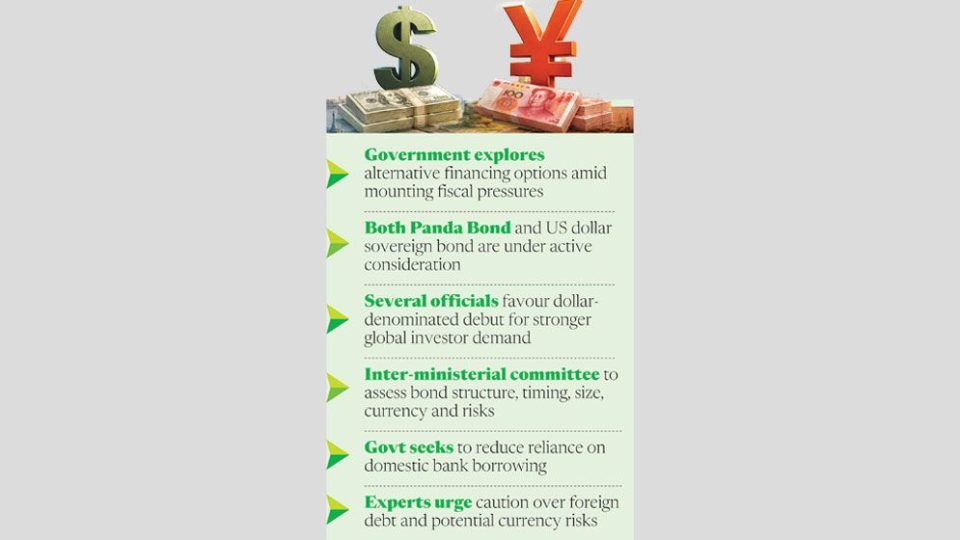
Facing mounting fiscal pressures and a tightening credit environment, the government has launched a high-level feasibility study into its maiden sovereign bond issuance.
As policymakers weigh the merits of entering the international capital markets, a pivotal debate has emerged within the corridors of power: whether to debut with a US dollar-denominated Eurobond or a Chinese yuan-denominated “Panda Bond.”
The discussions, held recently at the Prime Minister’s Office, with Finance Minister Amir Khosru Mahmud Chowdhury in the chair, underscore an urgent shift in strategy.
With the government eager to reduce its reliance on domestic bank borrowing – which has increasingly threatened to crowd out private-sector credit – sovereign bonds are being repositioned as a critical alternative financing vehicle.
The currency conundrum
The proposal has split opinion among senior policymakers.
Bangladesh Bank Governor Mostaqur Rahman has advocated for the Panda Bond, suggesting a modest initial issuance of approximately $50 million.
This, he argues, would allow the state to gauge investor appetite while containing financial exposure.
Conversely, Tanvir Ghani, special assistant to the prime minister, has championed the dollar-denominated route, citing the vastly broader pool of global investors. “Now is an appropriate time for Bangladesh to establish its presence in the international bond market,” Tanvir noted, asserting that the country’s current risk profile does not warrant a prohibitive “spread,” or risk premium, to attract capital.
The Economic Relations Division (ERD) has confirmed that Beijing is prepared to support a Panda Bond issuance.
However, officials remain cautious; ERD Secretary Shahriar Kader Siddiky warned that such a move could prompt scrutiny from the International Monetary Fund (IMF), potentially complicating the country’s eligibility for future concessional financing.
A measured approach
The push for international borrowing arrives at a delicate time.
Despite the government’s implementation of stringent austerity measures – ranging from the suspension of block allocations to strict controls on foreign travel and luxury expenditure – the nation’s debt risk profile is under closer watch.
Fitch Ratings recently adjusted Bangladesh’s foreign currency outlook to ‘Negative,’ maintaining a ‘B+’ rating, while the IMF has elevated its debt risk assessment from ‘low’ to ‘moderate.’
Finance Secretary Md Khairuzzaman Mozumder acknowledged these sensitivities, noting that the government had historically avoided sovereign bonds due to the attendant volatility.
“Given the current financing environment, the issue deserves fresh consideration,” he said, emphasising that any entry into global markets must be preceded by rigorous efforts to improve the nation’s sovereign credit rating.
To this end, the government is set to form an inter-ministerial committee to evaluate the structure, timing, and risk-adjusted pricing of the debut issuance.
Expert skepticism
While the move seeks to diversify funding, economic analysts have urged a cautious approach.
Dr Mustafa K Mujeri, former lead economist at Bangladesh Bank, warned that dollar-denominated debt introduces significant currency and servicing risks.
“The success of an international bond would largely depend on its structure and target investors,” he told the Daily Sun, suggesting instead that the government consider a bond tailored for expatriate Bangladeshis to help bolster foreign exchange reserves without increasing external currency exposure.
Echoing these concerns, Professor Mustafizur Rahman, distinguished fellow at the Centre for Policy Dialogue (CPD), pointed to the cautionary tale of Sri Lanka.
He insisted that the government must undertake a forensic analysis of its debt-repayment capacity before proceeding.
“Excessive foreign borrowing can create serious macroeconomic vulnerabilities,” he cautioned.
Strategic context
The government’s pivot towards international markets follows a year of intense domestic borrowing, with the state having tapped the banking sector for Tk1.31 trillion in the outgoing fiscal year – substantially exceeding initial targets.
While the original timeline for sovereign bond exploration was pegged for 2029, the combination of delayed multilateral loan disbursements and acute financing constraints has accelerated the agenda.
Minister Amir Khosru remains optimistic, viewing the bond initiative as a cornerstone of a wider strategy that includes the establishment of a Bangladesh Investment Fund in Hong Kong.
As the inter-ministerial committee prepares its recommendations, the government’s priority is clear: securing stable, long-term financing while navigating a global financial landscape that is increasingly wary of emerging market debt.