

TradingKey – On July 7, Eastern Time, geopolitical conflicts escalated once again, with two consecutive military clashes driving a rebound in oil prices. Following Iran’s launch of at least two missiles at several commercial vessels in the Strait of Hormuz, Ukraine used drones to attack Russia’s largest oil refinery. These successive military conflicts have shattered the recently eased geopolitical environment.
Impacted by the two conflicts, both major crude oil futures rose. As of press time, WTI crude oil futures rose 2.74% to $70.43, while Brent crude oil futures rose 2.7% to $74.
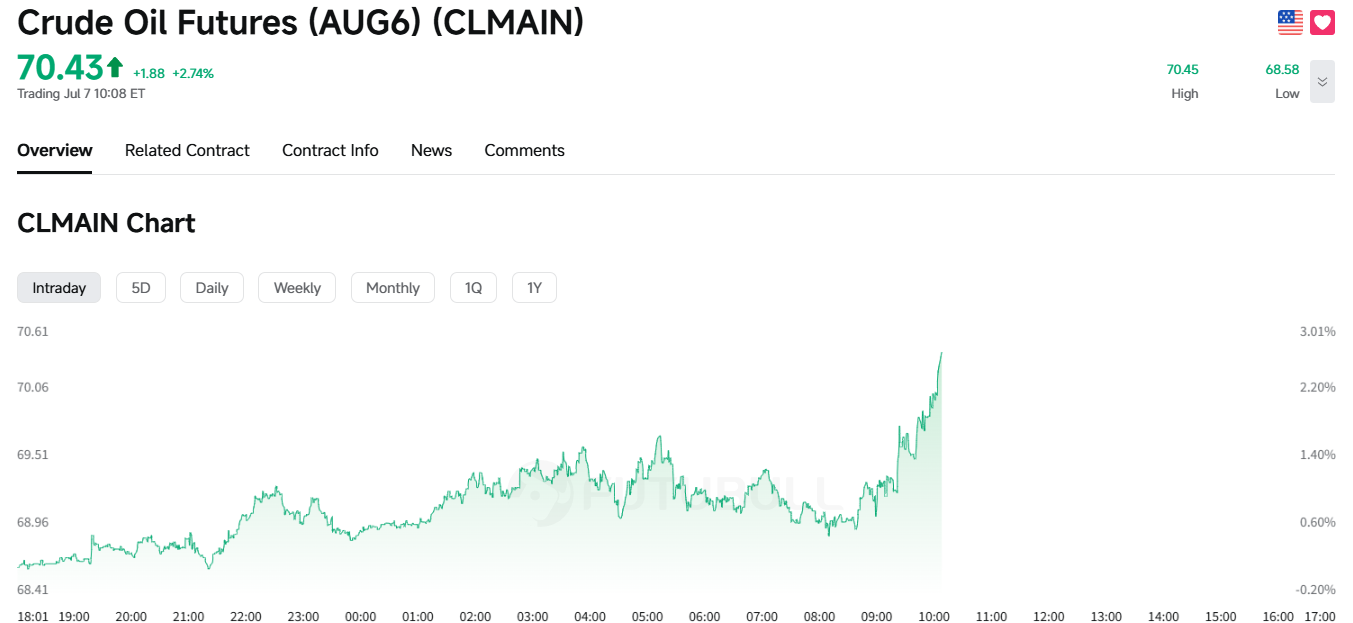
[Source: FutuBull]
Regarding the U.S.-Iran conflict, just three weeks ago, both sides officially signed a 14-point memorandum of understanding (MoU) in Switzerland. Following the signing of the agreement, two Iranian supertankers successfully navigated through the blockade zone and departed from the Gulf of Oman, and both parties agreed to restore maritime traffic to full capacity within 30 days. This series of developments was once seen as a clear signal of the end of the U.S.-Iran conflict.
However, today’s missile attacks directly violated the core commitment in the agreement regarding keeping the strait open, putting this fragile MoU at risk of complete collapse.
It is reported that the Strait of Hormuz carries a massive portion of global crude oil shipments, and whether the shipping lanes can flow smoothly profoundly impacts international oil price trends. Previously, when the U.S. and Iran reached the truce MoU and the maritime blockade was lifted, the geopolitical oil price premium quickly faded, and international crude prices fell significantly as the market stopped excessively worrying about crude supply disruptions.
But now that conflict and attacks have resumed, investors will re-evaluate the shipping safety hazards in the Strait of Hormuz. If missile attacks block shipping in the strait over the long term, or if the conflict spreads further and triggers a larger-scale war, the global crude oil supply chain will face a genuine risk of disruption.
On the other hand, Ukraine used its self-developed drones to travel nearly 2,500 kilometers to strike the Omsk Refinery in the heart of Western Siberia, setting a new record for deep strikes into Russian territory since the outbreak of the full-scale war, directly impacting Russia’s core oil processing system.
It is reported that as one of Russia’s largest gasoline production bases, the Omsk Refinery has an annual processing capacity of over 21 million tons and serves as a core hub for Russia’s petroleum economy and fuel supply.