
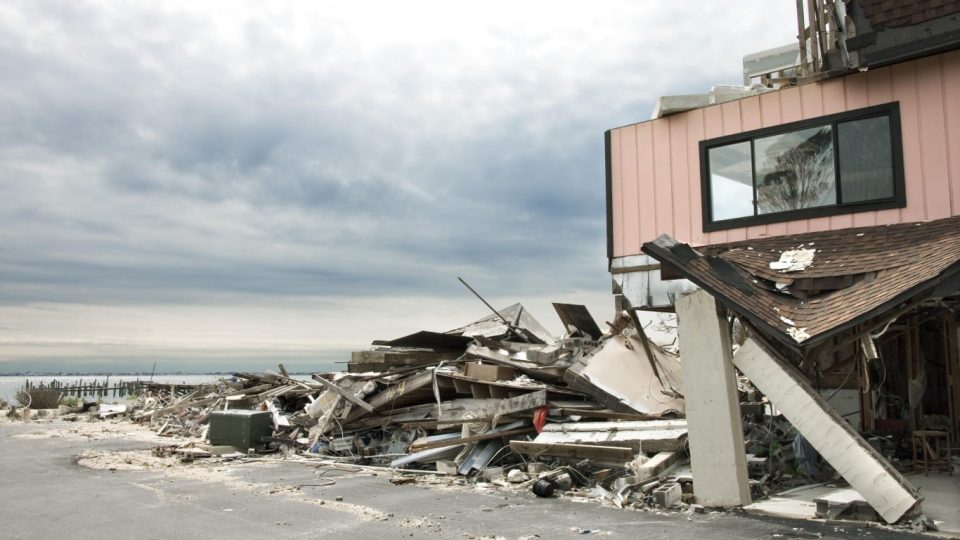
The cost of insuring against natural disasters has climbed sharply over the past decade. More people are living in coastal regions, wildfire-prone communities, and other high-risk areas, so when disasters strike, there is simply more property to repair or replace. At the same time, many scientists and insurers attribute a growing share of insured losses to climate change, which is increasing the frequency or severity of certain weather-related events.
The result has been steadily rising insurance claims and, in some cases, insurers pulling out of entire markets because the risks have become too expensive to underwrite. Now, insurance companies don’t shoulder all of that risk themselves. Instead, they often purchase protection from reinsurers, specialized insurance companies whose business is insuring other insurers. They basically pay a premium to transfer part of that risk to a larger institution with greater underwriting capacity.
The chain doesn’t stop there though. Reinsurers can transfer some of that exposure directly to capital markets through catastrophe bonds. These are specialized bonds where investors receive attractive interest payments in exchange for accepting the risk that some or all of their principal could be used to cover insured losses if a predefined catastrophic event occurs.
Until recently, catastrophe bonds were largely the domain of institutional investors. The ETF structure has changed that. Investors can now gain diversified exposure through products such as the Brookmont Catastrophic Bond ETF (ILS), which currently offers a 12-month trailing yield of approximately 8.1% as of July 2, 2026. That’s firmly in the territory of high-yield, or “junk,” bonds.
The difference is that ILS isn’t taking on lower corporate credit quality. Instead, investors are being compensated for assuming a very specific type of catastrophe risk that historically has exhibited relatively low correlation with traditional stocks and bonds. It’s one of the most unusual fixed-income ETFs on the market. If you understand what you’re actually being paid to insure, I think it can also be one of the most interesting sources of portfolio diversification.
What Does ILS Hold?
ILS invests in a diversified portfolio of roughly 100 catastrophe bonds. These bonds cover a variety of disaster types, including hurricanes, earthquakes, and wildfires, and are diversified across different geographic regions and issuers to reduce dependence on any single event.
One of the biggest attractions of catastrophe bonds is that their returns are generally uncorrelated with traditional financial markets. The factors that cause conventional bonds to sell off, such as rising interest rates or inflation surprises usually have little to do with hurricanes or earthquakes. Likewise, a major natural disaster doesn’t necessarily coincide with a stock market crash.
That’s why catastrophe bonds generally held up well during episodes like the 2008 financial crisis and the March 2020 COVID market selloff. That doesn’t mean they are risk-free. They can absolutely suffer losses, but those losses typically stem from insured catastrophe events rather than the macroeconomic forces driving traditional asset classes.
Another attractive feature is that many catastrophe bonds are floating-rate securities. Rather than paying a fixed coupon, they typically pay the Secured Overnight Financing Rate (SOFR) plus a spread. That means their coupons generally adjust upward when short-term interest rates rise, making them considerably less sensitive to interest-rate risk than traditional fixed-rate bonds.
As of July 2nd, ILS offers a 12-month trailing yield of approximately 8.14%, which is in line with high-yield bonds typically around the B and BB rated segment. One small difference from many bond ETFs is that ILS distributes income quarterly rather than monthly.
The Drawbacks of ILS
I’m not going to dwell on the catastrophe risk itself because that’s exactly what investors are being paid to assume. If you’re uncomfortable with the possibility that a major hurricane, earthquake, or wildfire could reduce the value of your investment, this simply isn’t the ETF for you.
My larger concern is liquidity. First, ILS exhibits a wider 30-day median bid-ask spread of approximately 0.1017% as of July 1, noticeably wider than what investors typically encounter in mainstream Treasury or investment-grade corporate bond ETFs.
Second, the ETF’s market price return has diverged from its net asset value (NAV) return quite a bit historically. Remember, investors buy and sell ETF shares at the market price, while the underlying portfolio is valued using NAV.
Normally, ETF arbitrage keeps those two figures closely aligned through the in-kind creation and redemption mechanism. That process works best when the underlying securities themselves are highly liquid. Catastrophe bonds simply aren’t. They trade in a much smaller institutional market than Treasury or corporate bonds, making perfect arbitrage more difficult.
One advantage, however, is that ILS is physically backed. The ETF owns catastrophe bonds directly rather than obtaining exposure through swaps or other derivatives, eliminating most counterparty risk. The trade-off is somewhat weaker liquidity compared with more conventional fixed-income ETFs.
My biggest criticism, though, is the expense ratio. At 1.58% annually, ILS is expensive by ETF standards. Those fees come directly out of investor returns and reduce the benefit of the fund’s attractive headline yield. If Brookmont were eventually able to lower the expense ratio below 1%, I think the ETF could appeal to a much broader audience.
Contact [email protected] for any questions or corrections.