
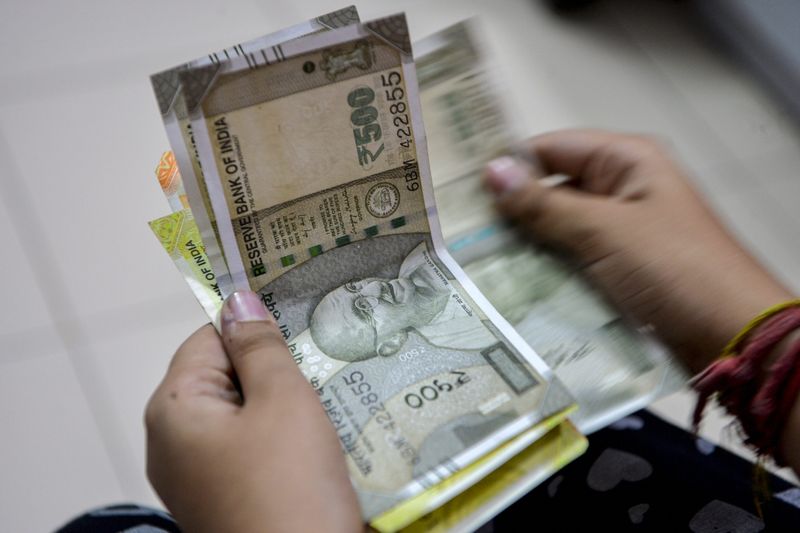
Despite the RBI’s efforts, the rupee remains 5.4% down against dollar for the year as foreign investors have pulled $31 billion out of Indian equities this year.
New Delhi: Rupee is likely to stay under pressure against the US dollar over the next few months, even though the Reserve Bank of India (RBI)’s latest steps to pull in foreign money are expected to help, according to a Reuters poll of currency analysts.
According to the poll of 44 strategists conducted between June 26 and July 1, the rupee is expected to hover near current levels, around 94.5 per dollar in three months, weakening slightly to 95 by the end of December 2026, and further to 95.9 in 12-months. That outlook hasn’t really changed from earlier polls, though analysts are somewhat less pessimistic than before, Reuters reported.
A steep fall in global oil prices, back to levels seen before the US-Israel war on Iran broke out on February 28, has helped the rupee regain some strength. The RBI’s fresh measures to draw in dollars have also lifted market sentiment a bit.
Despite these efforts, the rupee remains 5.4% down against dollar for the year as foreign investors have pulled $31 billion out of Indian equities this year.
Sakshi Gupta, principal economist at HDFC Bank told Reuters that sentiment has improved now that oil prices have eased, adding that “the capital account pressure will also ease with dollar flows coming in” from the RBI’s new measures. Still, she doesn’t expect the rupee to recover all its losses since March by the end of the year.
On June 8, the RBI said authorised dealer banks can tap into its swap facility for Foreign Currency Non-Resident (Bank) [FCNR(B)] deposits with maturities of three to five years till September 30. Through this facility, banks can swap their US dollar deposits with the central bank, helping them hedge against currency risk.
Besides that, on June 8 the government also rolled out a set of reforms aimed at drawing more Foreign Portfolio Investors (FPIs) into the government securities (G-Secs) market. The changes included tax exemption on interest income as well as long-term capital gains (LTCG) and short-term capital gains (STCG), a wider list of securities available under the Fully Accessible Route (FAR), and simpler rules for investment.
Notably, foreign investors have been buying up more Indian government bonds since the government did away with taxes on overseas bond investments, pushing June inflows to a record high, as per the Reuters report.
However, not everyone expects this to translate into a stronger rupee. Twelve of the 21 economists whose views were weighed in said the inflows would only soften the currency’s decline, not reverse it. The rest expect a modest rise.
One reason is that a part of the incoming dollars, especially through foreign currency non-resident deposits, will likely be swapped directly with the RBI and will not be sold in the open market. This limits how much the rupee actually gains, the report mentioned.
“However, the euphoria around short-term inflows won’t fix the core weakness in India’s external accounts. An economy that topped all forecasts and grew 7.8% in the March quarter — when the Iran war had already begun — shouldn’t be struggling with just $3 billion in net annual foreign direct investment. Nor ought it to be fighting so hard to bring back financial investors who have taken out $35 billion from the stock market over the past 12 months. Telling them that any individual can park money with an Indian portfolio manager isn’t of much use when they can as easily enter via a foreign fund. The problem is, they don’t want to. Not right now,” Andy Mukherjee wrote in a piece on Business Standard on June 9, after the latest measures were announced.
Foreign investors’s stake in Indian stocks hits 20-year low
A new RBI Financial Stability Report shows that FPIs now hold their smallest share of Indian equities in two decades. This is largely due to the relative underperformance of Indian stocks and sustained capital outflows over an extended period, The Hindu Businessline reported.
As of March-end, FPI ownership of Indian equities stood at 16%, compared to 20% for Domestic Institutional Investors (DIIs), as per the RBI report.
This year, FPIs have pulled $31 billion out of Indian stocks, topping the previous record outflow of $19 billion in 2025 and marking the worst stretch in two and a half decades.
The total value of FPI holdings dropped from around Rs 74 lakh crore in December to about Rs 68 lakh crore in May, a fall of roughly Rs 7 lakh crore, most of it (around Rs 5 lakh crore) due to falling stock prices rather than investors actually selling, though outflows accounted for about Rs 2 lakh crore of the drop, the report mentioned. India’s weight within emerging-market investment funds has also been shrinking, it added.
This article went live on July second, two thousand twenty six, at forty-two minutes past one in the afternoon.
The Wire is now on WhatsApp. Follow our channel for sharp analysis and opinions on the latest developments.